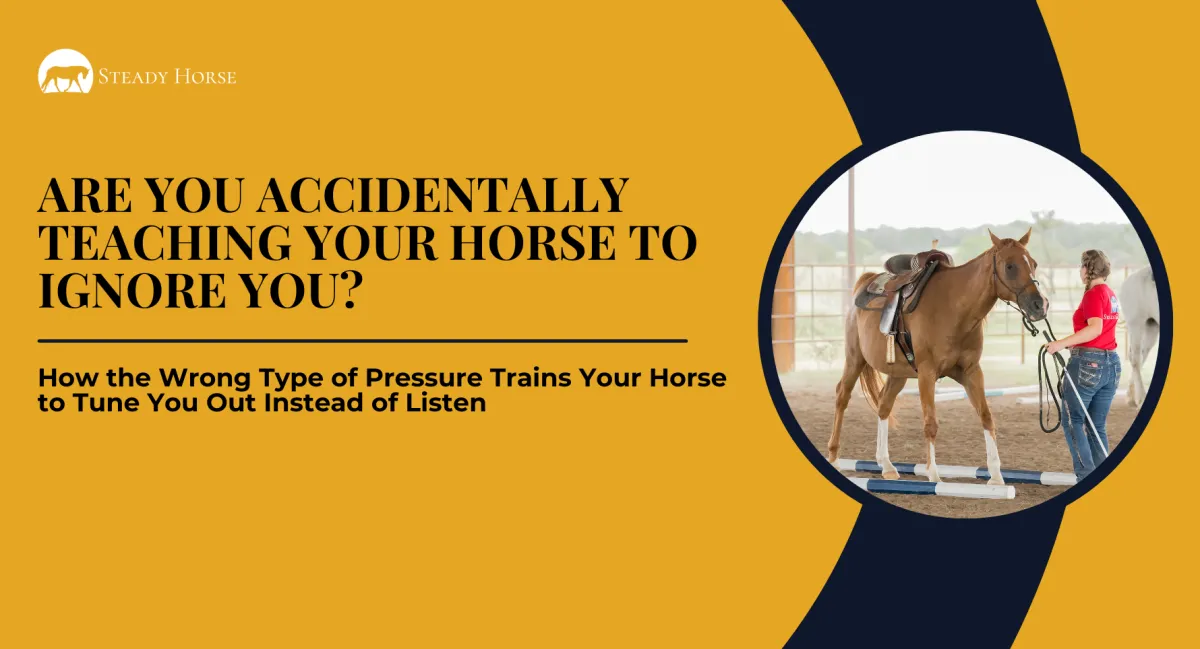
Are You Accidentally Teaching Your Horse to Ignore You?
You're standing in front of your horse, lead rope in hand, asking for the backup. You wiggle the rope gently. Nothing. You wiggle a little more. Still nothing. You increase the pressure slightly. Your horse blinks at you. You wiggle harder. They shift their weight but don't move. You escalate again. And again. And again.
By the time your horse finally takes a step backwards, you've climbed through every level of pressure you have. You're exhausted. Your horse looks at you like you've been making a lot of noise about nothing. And the worst part? Tomorrow, you're going to have to do the whole thing over again. Maybe even louder.
Here's the part that stings: you didn't just fail to get a good backup. You actually taught your horse something. You taught them that all of that pressure doesn't really mean anything. That they can stand there through levels one, two, three, four, five, and nothing bad happens. That your escalation is just background noise they can comfortably ignore.
You didn't mean to. You were doing what you've always been told to do. Start soft. Build slowly. Use the least amount of pressure possible. And for some horses, that advice is exactly right. But for others, it's the very thing that's making them duller, less responsive, and harder to reach with every session.
If your horse seems to care less and less about your cues over time, it might not be a training problem. It might be a pressure problem. And understanding the difference could change everything about how your horse responds to you.
The Gradual Pressure Trap
Let's start with what most of us were taught, because it's not wrong. It's just incomplete.
The concept of gradual pressure is simple and it makes intuitive sense. You start with the lightest possible cue and only increase if your horse doesn't respond. The idea is that you're giving your horse the chance to respond to softness before you ever have to get big. It's respectful. It's thoughtful. And for a sensitive, reactive horse, it's exactly the right approach.
But here's where it falls apart. Not every horse is sensitive and reactive. Some horses are dull. Some are lazy. Some are what we affectionately call "sleepy." And for those horses, gradual pressure doesn't teach responsiveness. It teaches tolerance.
Think about what actually happens when you use gradual pressure on a dull horse. You start at a one on a scale of one to ten. Nothing. You go to a two. Nothing. A three. Maybe a flick of an ear. A four. They shift their weight. A five. Still standing there. Six, seven, eight, nine, ten. Finally, at ten, they take one unenthusiastic step backwards and you release.
What did your horse just learn? They learned that levels one through nine don't matter. They learned that all of that buildup is just noise. They learned that they can comfortably stand there through the entire escalation and eventually, you'll either give up or they'll offer the bare minimum and the pressure goes away.
You just desensitized your horse to your own cues.
And here's where the math gets really uncomfortable. Say you repeat that cycle five times in a session, building from one to ten each time. That's a cumulative pressure of fifty on your horse. Fifty units of pressure across the session, and what did you get? A handful of reluctant steps and a horse that's even more convinced that your pressure doesn't mean much.
Compare that to starting at a six the first time and getting a response immediately. Six units of pressure. One clear message. One clear answer. One clear release. Your horse learned in a fraction of the time with a fraction of the total pressure, and the message was crystal clear.
Less total pressure. More clarity. Better response. That's the irony of adequate pressure. It feels like more in the moment, but it's actually far less pressure overall than the slow, grinding escalation that never quite gets the job done.
What Adequate Pressure Actually Looks Like
Adequate pressure is the amount of energy it takes to send a clear message to your horse right from the start. It means making an educated assessment of what your horse needs and beginning there instead of tiptoeing up from the bottom of the scale.
For the dull, lazy horse, that might mean starting at a six instead of a one. It means getting big right away. Not voice loud. Energy loud. Your body language is clear. Your lead rope is moving with purpose. Your intention is unmistakable. There is zero ambiguity in what you're asking.
And the moment your horse responds, the very instant they give you that step backwards, you release everything. All of it. Immediately. You breathe. You let them stand. You let them process what just happened.
That release is what teaches your horse. Not the pressure. The release. The pressure gets their attention. The release gives them the answer. And when the release comes quickly and clearly after the correct response, your horse learns fast.
Here's the key that makes adequate pressure work: you're not punishing your horse. You're not being harsh or unfair. You're being clear. There's a world of difference between a handler who escalates out of frustration and a handler who starts at the right level of energy because they know their horse and they know what it takes to communicate effectively.
Think about it from your horse's perspective. Which is more confusing: ten levels of escalating, unclear pressure that build over thirty seconds while your horse stands there wondering what you want? Or one clear, immediate ask at the right energy level that makes perfect sense and gets rewarded with an instant release the moment they respond?
The second one. Every time. Clarity is kindness. And adequate pressure, applied correctly, is one of the clearest forms of communication you can offer your horse.
Know Your Horse: Gradual vs. Adequate
This is not about choosing one type of pressure and using it on every horse. This is about knowing your horse and matching your approach to what they actually need.
If you have a sensitive, reactive horse, gradual pressure is your starting point. These are horses that respond to the lightest cue. You barely pick up your hand and they're already backing up. For this horse, starting at a six would be like shouting at someone who's standing right next to you. They'd shoot backwards, wide-eyed, wondering what they did wrong. That's not fair and it's not productive.
For the sensitive horse, you start soft. You use the least amount of energy necessary. You let their responsiveness guide how little pressure you actually need. These horses don't need to be woken up. They need to be reassured that your cues are going to be soft and consistent.
But if you have a dull, lazy horse, the one who stands there through your entire escalation and looks at you like you're putting on a show, gradual pressure is not serving them. It's confusing them. It's teaching them that pressure builds slowly, never really means much, and eventually goes away whether they respond or not.
For this horse, adequate pressure is the answer. Get clear. Get big. Get their attention from the first ask. And reward the response the instant it happens.
And if you're not sure which type of horse you have? Start with adequate pressure. Here's why: it's always easier to dial down from too much than to dig yourself out of too little. If you start at a six and your horse rockets backwards, you know immediately that they're more sensitive than you thought, and you can bring it down to a three or a four next time. You've learned something useful and your horse hasn't been harmed.
But if you start too soft on a dull horse and spend the entire session escalating with no clear response, you've just reinforced every pattern you're trying to break. You've burned through your credibility. And tomorrow, you'll need even more pressure to get the same non-result.
Start with enough. Dial down from there. That's the smarter path.
The Dialing Down Process
Once you've established that your horse responds well to adequate pressure, the goal isn't to stay at that level forever. The goal is to systematically bring it down.
Here's how that works. Say you've been starting at a six and getting consistent, willing responses from your horse. Good. Solid. Repeatable. That's your baseline.
Next session, try starting at a five. If you get the same quality of response at five, beautiful. That's your new starting point. Next time, try a four. Then a three. You're gradually lowering the amount of energy you need to use because your horse has already learned what the ask means. They don't need the big energy anymore because the communication is clear.
This is the opposite of what happens with gradual pressure on a dull horse. Instead of building up from nothing and teaching your horse to ignore the lower levels, you're starting where the message is clear and building down as your horse becomes more responsive. You're creating a horse that responds to less and less over time because they already understand what you're asking.
The end goal is the same either way: a horse that responds to the lightest possible cue. The difference is the path you take to get there. And for a dull horse, the path that works is adequate pressure first, then dial down. Not gradual pressure that never quite lands.
Position and Direction Matter Just as Much
Pressure is only one piece of the puzzle. If your horse is struggling with the backup, or any exercise for that matter, there are two other things to check before you adjust your energy.
The first is your position. Where you're standing in relation to your horse matters enormously. For the backup, you need to be clearly in front of your horse with real distance between you. Not right up on their nose. Four to six feet away, with plenty of slack in the lead rope so the belly of it nearly touches the ground.
Why does distance matter? Because your horse needs to be able to see you. They need to see your body language, your cues, your energy. If you're standing two feet from their face, waving a rope, they can't process what you're asking because you're too close for them to read you clearly. Get out there. Give them room. Let them see the full picture of what you're communicating.
The second is your direction. Your energy needs to move in the direction you want your horse to go. For the backup, that means your pressure is moving forward toward your horse, directing them backwards. Your lead rope is waving side to side, pushing energy toward them, asking them to move away from you.
Here's the mistake that catches a lot of people: their feet move backwards while they're asking the horse to back up. If you're stepping backwards, your body language is saying "come forward." But your rope is saying "go backwards." That's two conflicting messages at the same time, and your horse has no idea which one to follow.
Watch your feet. If they're moving backwards, you're drawing your horse in. If they're planted or moving forward, you're directing your horse back. Your feet tell the truth about your intention even when your hands are saying something different.
Position, direction, and energy. Check all three before you assume your horse is being stubborn. More often than not, the confusion is coming from our end, not theirs.
The Backup Is More Than an Exercise
It's easy to think of the backup as just one more thing on the training checklist. Something to practice, something to get solid, something to move past on the way to the "real" work.
But the backup is so much more than that. It's the foundation of your entire partnership.
When you teach your horse to back up willingly and softly, you're not just teaching them to move their feet in a particular direction. You're teaching them to stay with you. You're saying, "Don't flee. Don't give in to your instincts. Stay right here with me." And when your horse chooses to do that, when they choose to yield that space and stay connected to you instead of taking off, something powerful happens.
They're choosing you. Not because they're tied to you. Not because they're forced. Because you've earned it. Because you've given them clarity. Because you've communicated in a way that makes sense to them. Because you've been fair with your pressure and immediate with your release. Because you've shown them that being with you is the safest, most comfortable place to be.
That choice is what the backup is really about. It's the first exercise in the five ways to building a bond with your horse for a reason. It's where the relationship starts. It's where trust begins. And it's the tool you'll reach for first every single time things start to go sideways, whether you're on the ground or in the saddle.
Every time your horse backs up for you softly and willingly, they're telling you something. They're saying, "I hear you. I'm with you. I'm not going anywhere." And every time you release that pressure clearly and immediately, you're telling them something back. "I see you. I appreciate you. You made the right choice."
That conversation, repeated over and over with clarity and consistency, is what builds an unbreakable bond. Not fancy exercises. Not complicated training programs. Simple, clear communication where your horse knows exactly what you're asking and knows that choosing correctly is always worth it.
You Never Move Further Than You're Connected
There's a phrase we use at Steady Horse that applies to every single thing you do with your horse: you never move any further along than you and your horse are connected.
That means if the backup isn't solid, you don't move on. If the connection isn't there, you don't push forward. If your horse isn't with you mentally and emotionally, adding more exercises or more complexity isn't going to help. It's going to make things worse.
Every rider who has ever had an accident with their horse knows this feeling. That moment of honest reflection where you say, "I knew we weren't ready. I knew the connection wasn't there. I moved forward anyway."
The backup is your checkpoint. It's the exercise that tells you whether your horse is with you or not, right now, in this moment. And if they're not, that's not a failure. That's information. That's your cue to stay right here, keep working on the connection, and wait until your horse shows you they're ready.
That patience, that willingness to stay where you are until the connection is solid, is what separates riders who build confidence from riders who build anxiety. It's the difference between a horse that trusts you and a horse that tolerates you.
Take the time. Get the backup solid. Earn the connection. Everything else will follow.
Ready to Build That Foundation?
If you're ready to start building the kind of clear communication and deep connection with your horse that makes everything else possible, there's a free training available right now that shows you exactly where to begin. It's focused on safety, confidence, and the partnership your horse is waiting for you to build. It won't be available forever, so don't wait.
