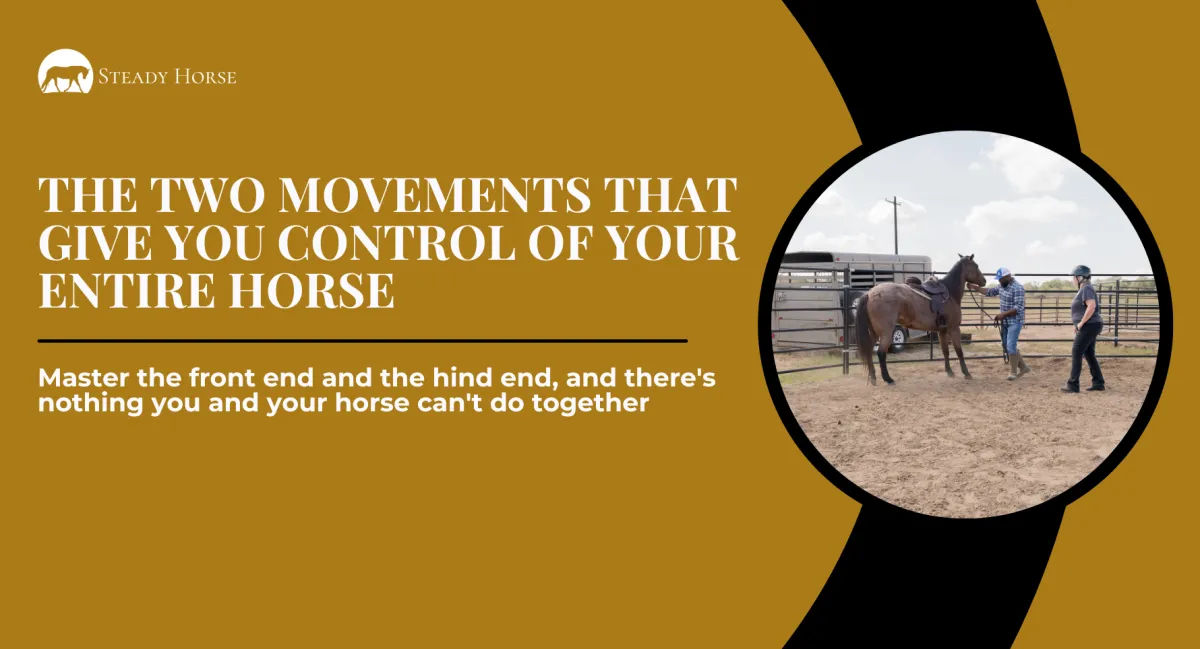
The Two Movements That Give You Control of Your Entire Horse
If I told you that the key to a softer, safer, more connected horse comes down to just two movements, you'd probably think I was oversimplifying.
But I'm not.
Everything you want from your horse, whether it's a smooth stop, a balanced turn, a willing departure, a quiet trail ride, or just the peace of mind that comes from knowing they're truly with you, it all comes back to two things: can you move their front end, and can you move their hind end?
That's it. Two movements. Front end. Hind end. If you can control both of those independently, with intention, with softness, and with your horse's full understanding, you can influence every part of their body. You can direct them anywhere. You can correct almost any problem that shows up, on the ground or in the saddle.
And if you can't? That's where the holes live. That's where the resistance creeps in. That's where a horse who seems "trained" suddenly falls apart when things get real.
So let's talk about what these two movements actually are, why they matter so much, and how to build them the right way.
Why Direction Is One of the Five Ways We Bond
Before we get into the mechanics, I want to put this in context. Teaching your horse to take your direction is one of the five ways we intentionally build a bond with our horses. It sits right after teaching them to stay with us, which is the backing up and leading work we've talked about before.
And here's why the order matters.
If your horse can't stay with you, if they can't back up with attention and follow your lead without resistance, then asking them to take direction is going to be a battle. You need that foundation of connection, attentiveness, responsiveness, and restraint before you start asking them to move specific parts of their body on command.
But once that foundation is in place, teaching direction is where things start to get really exciting. Because now you're not just asking your horse to be with you. You're asking them to go where you point them. Willingly. Softly. Without a fight.
When you think about what most of us actually want from our horses, it's pretty simple. Stop when I say whoa. Go when I say go. Turn left and right when I ask. That's it. We don't need anything fancy. We just need a horse who takes our direction clearly and calmly.
The problem is most people aren't intentional or methodical about how they develop that. And so you end up with horses, even highly trained ones, who can perform maneuvers but can't take a simple leading rein without fussing or bracing. There are holes in the training. Steps that got skipped. And those holes always show up eventually, usually at the worst possible time.
The Front End: Your Rudder
Let's start with the front end, because this is where direction lives.
Think of your horse's front end as the rudder of a ship. It doesn't generate the power. It doesn't push the boat forward. But it determines where everything goes. Wherever the front end points, the rest of the body follows.
If you can pick up that front end and place it where you want it, you can influence your horse's entire trajectory. You can redirect them when they're drifting. You can straighten them when they're falling in. You can set them up for any maneuver, any transition, any change of direction.
And here's something I want to be honest with you about. Moving the front end is one of the most difficult exercises to teach a horse. In my opinion, it might be the most difficult. So if you're struggling with it, if your horse keeps walking out of it, if your timing feels off, if the whole thing looks a little sloppy, don't beat yourself up. This is hard.
But here's the flip side. If you can teach your horse to move the front end well, and I mean really well, with softness and intention and understanding, there is nothing you cannot teach that horse to do. Nothing. That's how foundational this one exercise is.
Let me walk you through how to build it.
The Four Levels of Moving the Front End
Just like with backing up and leading, moving the front end has levels. And just like before, the riders who rush through the levels are the ones who end up circling back to patch holes later. Take your time. Build it right.
Level One: Your Horse Moves Away From Pressure
This is the starting point. You apply pressure toward your horse's face and shoulder area with your rope hand, and they move. That's it. They step that front end away from you.
Now, some horses will do this naturally. You march into their space with some energy, push toward their face, and they're like, "Whoa, okay, I'm moving." They get out of your way. Great.
But other horses? You push toward them and they lean on you like a thousand-pound doorstop. They're not being defiant. They just don't understand what you're asking.
Here's the rule: give them one to two seconds to respond to your initial pressure. If they don't move in that window, don't get into a pushing match. Reach up underneath the clip of the halter and physically move that front end over. The moment they shift, release the pressure completely.
It's going to look a little messy. It's going to feel a little clunky. That's perfectly fine. Every horse learns this way. You're not looking for clean and polished at level one. You're looking for understanding. Does my horse know that when pressure comes toward their face, the answer is to move away from it?
Get this ten out of ten times. You'll know it's solid when you go to reach for that clip and your horse moves before you even grab it. They're anticipating. They've figured out the game. That's when you're ready for level two.
Level Two: Creating Distance
Now we're asking for more space. Instead of being right up on your horse and pushing them over with your hand on the clip, you want to be able to apply pressure with your rope hand from a bit further away and have your horse move two, three, four steps away from you while you hold your feet still.
This is where you'll run into what I call the yo-yo effect. You push the front end away and your horse immediately bounces right back into you. Push them away, they swing back in. Over and over.
Nine times out of ten, when your horse is yo-yoing back into you, it's because you're accidentally pulling them back in. There are two ways this happens, and both are easy to miss.
The first is tension on the rope. If you're holding that line tight after you push them away, they feel the pull and they come right back. Give them plenty of slack. Let that rope have a belly in it so there's nothing drawing them toward you.
The second is stepping backwards. Even one step back creates a vacuum. Your horse feels you retreating and their natural curiosity draws them right into that space. You have to hold your feet. Stay planted. Let them figure out that staying away from you is where they find their release.
Every time they yo-yo back in, push them right back out. Don't get frustrated. Don't take it personally. They're literally doing what they think you're asking them to do. Your job is to make the expectation clear through repetition.
Level Three: Cleaning Up the Footwork
Once your horse is moving away from you and staying away with some consistency, now we start paying attention to how they're moving.
At level three, we want that inside leg, the one closest to you, crossing over the outside leg during the movement. This gives you a deeper, more balanced step. Your horse isn't just shuffling sideways. They're reaching and stepping with intention.
This is where you raise the bar. Your horse might move that front end over ten times without crossing in front. But on the eleventh try, they give you that deep crossover step. That's when you release. That's when you breathe. That's when they learn that you have a specific expectation for how they move, not just that they move.
Keep asking until you get it. Don't settle for less than the cross. And make sure through all of this that those hind feet are staying planted. We don't want the horse walking forward through the maneuver. We want the front end rotating around the hind end, like a gate swinging on a hinge.
Level Four: Sending Distance With Self-Carriage
This is mastery. This is what it looks like when your horse truly understands.
At level four, your horse is backed up to the circle you're about to send them on. Their hind end is on that circle. And from a distance, without you having to march into them, you can pick up your rope hand and move that front end out to the circle. They swing around, face the direction of travel, and hold their position.
No yo-yoing back in. No collapsing their shoulder toward you. No needing to be pushed or shoved. They just move with you like a dance partner who knows the choreography.
This is what directly translates to the saddle. You know that frustrating thing where your horse keeps dropping their shoulder and diving to the inside while you're riding? That's a front-end problem. And the fix isn't more rein pressure or kicking harder. The fix is going back to the ground and building self-carriage through these four levels so your horse develops the habit of staying balanced instead of falling in.
The Hind End: Your Motor
Now let's talk about the other half of the equation.
If the front end is the rudder, the hind end is the motor. It's the most powerful part of your horse's body. It's the largest muscle mass. And it's where all forward movement originates.
A lot of people think movement starts at the front because the front end is, well, in the front. But that's not how it works. The hind end pushes forward and moves the front end along. The front end can influence direction, but it doesn't have the strength to drag the hind end anywhere.
This is why backing up is so foundational. When you back your horse up, you're putting them on their hind end. You're loading that motor. You're teaching them to carry themselves from behind, which sets them up for everything that comes next.
And here's some good news. Most horses already know how to move their hind end. Think about it. Every time you lead your horse and make a sharp turn, what happens? That hind end swings out. They do it naturally. We're just going to make it intentional.
The Four Levels of Moving the Hind End
Level One: Getting the Movement From a Distance
Unlike the front end where we start up close and personal, with the hind end we actually want to start from a distance and work our way in. This feels more natural for both you and your horse.
Start on a longer line. As you're leading, make deliberate sharp turns and reach out to put some pressure behind the hip to encourage that hind end to swing. You're not asking for anything fancy. You're just unlocking the movement. Getting them used to the idea that when pressure comes toward their hip, that hip drives away.
Get this consistent before you move on. Your horse should start to understand that pressure on the hip means move the hip. Simple. Clear. Repeatable.
Level Two: Separating Front From Hind
Now we're teaching your horse to move the hind end while the front end stays relatively still. This is a big deal. You're asking for independence between two parts of the body that your horse is used to moving as one unit.
If you put pressure on the hip and the front end starts plowing forward, grab that lead rope and bump them to say, "Don't go forward. Try something else." The moment they move the hip without dragging the front end along, release.
You're teaching your horse that the hind end and the front end are two separate things that can operate independently. This is the foundation for every lateral movement, every collected transition, and every balanced stop your horse will ever give you.
Level Three: Close Proximity With a Deep Cross
Now we're getting closer to our horse. Holding about twelve to eighteen inches from the clip, asking to move the hip away from us. And we're being specific. We want that inside hind leg crossing over the outside leg. A deep, deliberate step, not just a shuffle.
This is where some riders get stuck. Their horse moves the hip, but they're not crossing over. They're just stepping sideways. The temptation is to add more pressure, but that's not always the answer.
If your horse is trying, if they're giving you effort, keep asking. Don't add more pressure. Just don't release until they give you the cross. They might take ten steps with a shallow movement, but on the eleventh, they reach deep and cross over. That's when you stop. That's when you breathe. That's when they learn exactly what you're looking for.
Now, if your horse isn't trying at all, if they've just locked up and quit giving you effort, then yes, add more pressure. But there's a difference between a horse who's trying and not quite getting it and a horse who's checked out. Your response should match what's happening.
Level Four: Flex, Move, Hold, Release
This is where groundwork starts to feel like riding. And for good reason. This level directly mimics what you'll do in the saddle.
Here's the sequence. First, flex your horse's nose around toward you. Get them soft. Count to three. Then, while keeping them flexed, put pressure where your heel would be if you were riding. Use your thumb on their barrel. The moment they move the hip and cross over, release the pressure from your thumb, but keep them flexed. Hold that softness for three seconds. Then release everything.
Flex. Breathe. Move the hip. Release the hip. Keep the flex. Breathe. Release.
It's methodical. It's quiet. It's patient. And it develops a horse who is waiting for each step instead of rushing through the whole thing to get it over with.
Get this solid under halter first. Then put the bridle on and do it again. Because the feel is different for your horse, and you want them confident and soft in both.
The Connection Versus the Compliance Trap
I want to talk about something important because it's a trap I see riders fall into constantly.
You can make a horse move their front end. You can make a horse move their hind end. With enough pressure, enough spurring, enough flagging, you can make almost any horse do almost anything in the moment. Horses are agreeable animals. They give to pressure. They go with the flow.
But compliance is not connection.
I've seen horses at the highest levels of training who can half-pass, shoulder-in, do flying lead changes, side-pass over a log, and work a rope gate, but they're doing it on autopilot. There's no connection. No understanding. Just a set of reflexes drilled in through repetition and pressure. And when something unexpected happens, when the real test comes, that horse is gone. Because they were never truly with their rider. They were just doing what they'd been made to do.
That's a false sense of security. And it's one of the most dangerous things that can happen with a horse.
The difference between what we're building here and what the old way produces comes down to one word: understanding. When your horse moves their front end because they genuinely understand what you're asking, when they feel your intention and move willingly instead of reactively, that's a horse you can trust. That's a horse who's with you.
Building that understanding takes longer. It requires more patience. More repetition. More willingness to stay at level one until it's truly solid. But the horse you end up with is worth every minute.
Keep Building. Don't Get Stuck.
One more thing before I let you go, because I know some of you are going to hear "ten out of ten" and freeze up.
Don't feel like you have to perfect one level before you touch anything else. You can keep moving forward in your training while you continue to refine the levels behind you. If you can get your horse to move the front end a step or two away from you, that's enough to start working on your sending. You don't need level four perfection to begin.
Keep building. Keep layering. Keep adding new exercises while you go back and sharpen the old ones. The levels are there to give you a roadmap, not a prison. They tell you where your horse is and where you're headed. But you don't have to sit in one spot until everything is flawless.
Progress isn't a straight line. It's a spiral. You'll come back to these fundamentals over and over, and every time you do, they'll be a little better, a little softer, a little more automatic. That's how real horsemanship works. Not in giant leaps, but in steady, patient, intentional repetition that compounds over time.
If you're ready to start building this kind of direction and connection with your horse, I've put together a free training that walks you through exactly where to begin. It's available for a limited time and it's designed for riders at every level who want a safer, softer, more willing partner.
