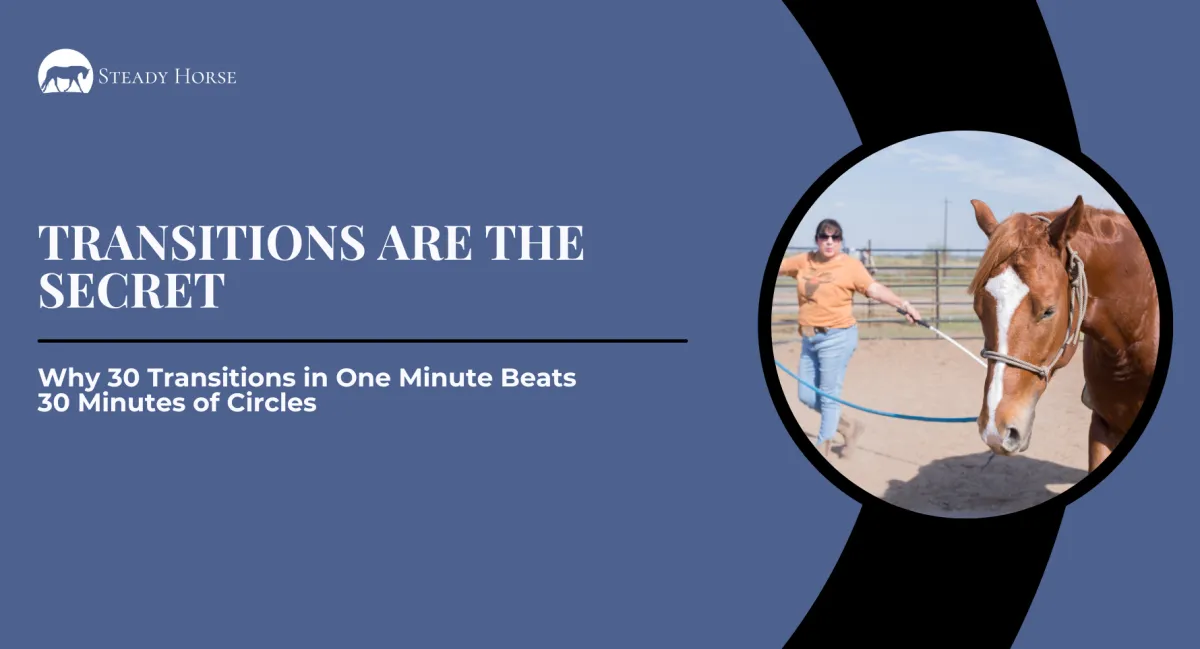
Transitions Are the Secret
Here's a scene that plays out at barns everywhere, every single day.
A rider walks their horse into the round pen, unclips the lead, and sends them off. The horse trots along the rail. Around and around. Five minutes. Ten minutes. Twenty minutes. The rider stands in the middle, maybe scrolling their phone, maybe watching but not really engaging. The horse checks out. Eyes glazed over. Just going through the motions.
Thirty minutes later, the horse is tired. The rider clips the lead back on and thinks, "Good. Got the energy out. Now we can ride."
But here's the truth nobody wants to hear: that horse didn't learn a single thing in those thirty minutes. Not one. They went in circles. They burned calories. And they are no softer, no more connected, and no more responsive than they were before you started.
Now compare that to one minute of purposeful sending filled with transitions. Walk to trot. Trot to canter. Canter to trot. Trot to walk. Walk to stop. Back up. Send again. In sixty seconds, your horse has listened to you, responded to you, adjusted their body, engaged their mind, and made a dozen decisions based on your leadership.
That one minute accomplished more than thirty minutes of circles ever could.
This is why transitions within sending are one of the most powerful tools in your groundwork training. And once you understand why, you'll never look at a round pen session the same way again.
The Problem With Mindless Circles
Let's be clear about something: sending your horse out on a circle is not the same thing as lunging.
Lunging, the way most people practice it, is passive. You send the horse out and let them go. Maybe you crack a whip to keep them moving. Maybe you change directions once or twice. But the horse is essentially on autopilot, running laps with no real engagement between the two of you.
That's not training. That's exercise. And while there's nothing wrong with exercise, it doesn't build what you actually need before you get in the saddle — connection, softness, responsiveness, and trust.
When a horse is running mindless circles, their brain checks out. They stop paying attention to you. They might be looking at the other horses, watching the barn, thinking about dinner. Their feet are moving, but their mind is somewhere else entirely. And a horse whose mind isn't with you on the ground is not going to suddenly be with you under saddle.
The whole point of groundwork is to prepare both you and your horse for a successful ride. You're reading each other. You're communicating. You're building a foundation that carries over into everything else you do together. None of that happens when the horse is just running laps.
Why Transitions Change Everything
So what makes transitions within sending so different?
Transitions demand attention. Every single time you ask your horse to shift from one gait to another, they have to listen to you. They have to process what you're asking. They have to adjust their body, engage their hindquarters, and respond. There is no checking out during a transition. The horse has to be present.
And that's exactly what we want.
When you ask for an upward transition — say, walk to trot — your horse has to lift into that movement. They engage their hind end, push off, and pick up the pace. When you ask for a downward transition — trot to walk — they have to collect themselves, shift their weight, and slow down. Every single transition requires your horse to think, adjust, and respond to you.
Now multiply that across a session. If you're asking for transitions every few strides, your horse doesn't have time to zone out. They're constantly tuned in to you, waiting for the next ask, ready to respond. Their ear is on you. Their attention is on you. They're engaged in a conversation with you rather than just running a track.
This is where softness is built. Not in the running. In the transitions between gaits.
Think about what happens physically when your horse moves through transitions. On the upward side, they're engaging the hind end and lifting into the movement. On the downward side, they're collecting, coming underneath themselves, and slowing with balance. That constant shifting builds strength, coordination, and body awareness. It teaches your horse to carry themselves properly rather than just dumping on the forehand and plowing around in circles.
And here's the part that matters most for your riding: a horse that responds to your energy shifts on the ground is a horse that will respond to your seat and breathing in the saddle. You're building the same communication system you'll use when you ride. The groundwork isn't separate from the riding. It's the foundation of it.
It's Not About Speed — It's About Responsiveness
One of the biggest misconceptions about sending is that the goal is to get your horse moving fast. To wear them out. To drain the tank so they're easier to handle.
That approach misses the point entirely.
The goal of sending with transitions isn't speed. It's responsiveness. You want your horse to match your energy. When you increase your energy, they pick up the pace. When you breathe and lower your energy, they slow down. That conversation — that give and take — is what builds a partnership.
When you're sending your horse and asking for transitions, you're using your body to communicate. You increase your energy to ask for an upward transition. You take a deep breath and lower your energy to ask for a downward transition. Over time, your horse becomes incredibly tuned in to those subtle shifts. They start reading you the way you're reading them.
And when that happens, something beautiful starts to unfold. You breathe, and your horse breathes. You soften, and your horse softens. You slow your body, and your horse slows their feet. That is connection. That is what we're building. Not a tired horse. A responsive one.
Rebecca often emphasizes this point: it's better to do one minute of sending with thirty transitions than thirty minutes of sending with just one transition. The learning doesn't happen in the sustained movement. It happens in the changes. Every upward transition teaches your horse to respond to your energy. Every downward transition teaches them to respond to your breath. Every stop teaches them to check in with you.
The horse that has been through thirty transitions in a minute has listened to you thirty times. The horse that has trotted in circles for thirty minutes has listened to you once — when you told them to go.
Which horse do you think is more prepared for a ride?
The Three Steps Most Riders Rush Through
Now, there's a right way and a wrong way to send. And the difference often comes down to how you initiate it.
At Steady Horse, sending is broken down into three distinct steps. Each one matters. And the pause between each one matters even more.
Step one: back your horse up. You're putting them on their hind end, creating space between you and your horse. This isn't just about getting distance. It's about asking your horse to shift their weight back and wait.
Step two: ask your horse to move their front end over. You're asking them to move away from you, turning on the haunches. This sets up the direction of the circle and positions your horse to move forward correctly.
Step three: drive them forward from behind. You send them out from the haunches, directing them onto the circle.
Here's the critical piece that separates this from lunging: between each step, you breathe. You pause. You give your horse a few seconds to process what just happened before you ask for the next thing.
One, breathe. Two, breathe. Three, breathe.
That pause does something powerful. It creates a horse that waits for your cue instead of reacting and bolting forward. It builds a horse that is thoughtful and methodical rather than anxious and anticipatory. The rushing — skipping the pause, blending the steps together, firing off the send like a starting gun — that's what creates the frantic, checked-out horse you're trying to avoid.
Slow it down. Make each step clean. Give your horse time to digest each ask. The quality of the send determines the quality of everything that follows.
What to Watch For During Transitions
One of the most valuable things about sending with transitions is that it gives you a real-time read on your horse. You're not just training them. You're assessing them. Every session, every send, is giving you information.
Here's what to look for.
Their cadence and rhythm. Is your horse moving fluidly, or are they choppy and braced? A horse that's softening through transitions will start to move with a more even, rhythmic cadence. That's a sign they're relaxing into the work.
Their tail carriage. A wringing, swishing tail often signals tension or frustration. As your horse softens and connects, the tail carriage will start to quiet down. It's a small thing that tells you a lot.
Their willingness to slow down. Is your horse fighting the downward transitions, or are they starting to offer the slow-down on their own? A connected horse will begin looking for the opportunity to come down to a slower gait. They're reading your energy and anticipating (in a good way) that you're about to ask them to ease off.
Nose tipping in. When your horse tips their nose toward you during sending, that's connection. Their eye or ear turning in your direction is them saying, "I'm with you. What's next?" That's the moment you know the transitions are doing their job.
Their breathing. When you take a deep breath and your horse responds by taking one too, exhaling and lowering their head, you've hit the sweet spot. That mirrored breathing is one of the clearest signs of connection you can get from the ground.
These indicators tell you when to push forward and when to draw your horse in for rest. And reading them accurately is a skill that directly transfers to riding. The more you practice reading your horse on the ground, the better you'll read them in the saddle.
Common Mistakes That Kill the Conversation
Even with the best intentions, there are a few common mistakes that can turn purposeful sending into the very thing we're trying to avoid. Here are the ones to watch for.
Standing still and facing your horse. This is the old way. Instead of standing in the center facing your horse while they orbit you, walk with them. Move in a small circle — roughly three to four feet in diameter — walking in the same direction your horse is moving. They take the bigger circle around you. This keeps you engaged and keeps the energy flowing correctly.
Being too far in front of the drive line. Your position matters. The drive line is where your horse's front feet are, where the neck ties into the body. When sending, you want to stay behind the shoulder, tracking at your horse's tail and hind legs. If you drift too far forward, your horse will turn into you or stall out because you've moved into a blocking position instead of a driving position.
Walking backwards. When you're driving your horse forward, your feet should never go backwards. The moment you step back, you've changed the conversation from "go forward" to "come in." If your horse keeps turning into you, check your feet first.
Holding the rope too short. Your horse needs enough line to move out onto the circle comfortably. If they hit the end of a tight rope, they'll pull back in toward you every time. Give them room. Your sending line is also your rein. You want to be able to communicate down that line to your horse's face with softness, not restriction.
Inconsistent cues. Pick your cues and stick with them. Point with your rope hand in the direction you want your horse to go. One cluck or kiss to ask for forward. Raise your steady stick to add pressure if needed. It doesn't matter exactly what cues you use. What matters is that they're the same every single time. Consistency is what builds understanding. Inconsistency builds anxiety.
Using Sending to Prepare for Everything Else
Here's something that might shift how you think about your entire training program: sending with transitions isn't just a groundwork exercise. It's the diagnostic tool that tells you whether you and your horse are ready for whatever comes next.
Think about trailer loading. You walk up to the trailer and your horse is braced, tense, not wanting any part of it. Rather than forcing the issue, you step away from the trailer and send your horse. You do your transitions. Walk, trot, canter, trot, walk, stop. You look for those indicators of connection — the nose tipping in, the ear turning toward you, the softening in their body.
Once that connection is solid, then you direct your horse near the trailer. You magnetize the trailer by letting your horse rest near it. If they're not interested, you put them back to work. You're not forcing anything. You're letting the connection lead the process.
This approach works for obstacles, for riding preparation, for any situation where your horse needs to be mentally and physically with you. And it all starts with sending and transitions.
The connection you build through transitions on the ground is the same connection that carries you through every ride, every challenge, every new situation your horse encounters. Without it, you're just hoping things go well. With it, you've done the work to set both of you up for success.
Make Every Minute Count
You don't need an hour in the round pen to make progress with your horse. You don't need to run them into the ground. You don't need fancy equipment or a complicated training plan.
You need transitions.
You need purposeful, intentional, thoughtful sending where every stride has a reason and every shift in gait is a conversation between you and your horse. Where you're reading them and they're reading you. Where the work is about connection, not exhaustion.
One minute of sending with thirty transitions will teach your horse more than thirty minutes of circles ever will. That's not an exaggeration. That's what happens when you replace mindless movement with meaningful engagement.
So the next time you walk into the round pen or pick up that lead rope, forget about wearing your horse out. Focus on waking them up. Ask for the transitions. Read the responses. Breathe when they breathe. And build the kind of softness and responsiveness that makes everything else possible.
Your horse is waiting for that kind of leadership. Give it to them.
Ready to See What Real Connection Looks Like?
If you're ready to move past mindless circles and start building the kind of groundwork foundation that transforms your relationship with your horse, there's a free training available right now that shows you exactly how. It's focused on safety, confidence, and the connection that makes everything else fall into place. It won't be available forever, so don't wait.
