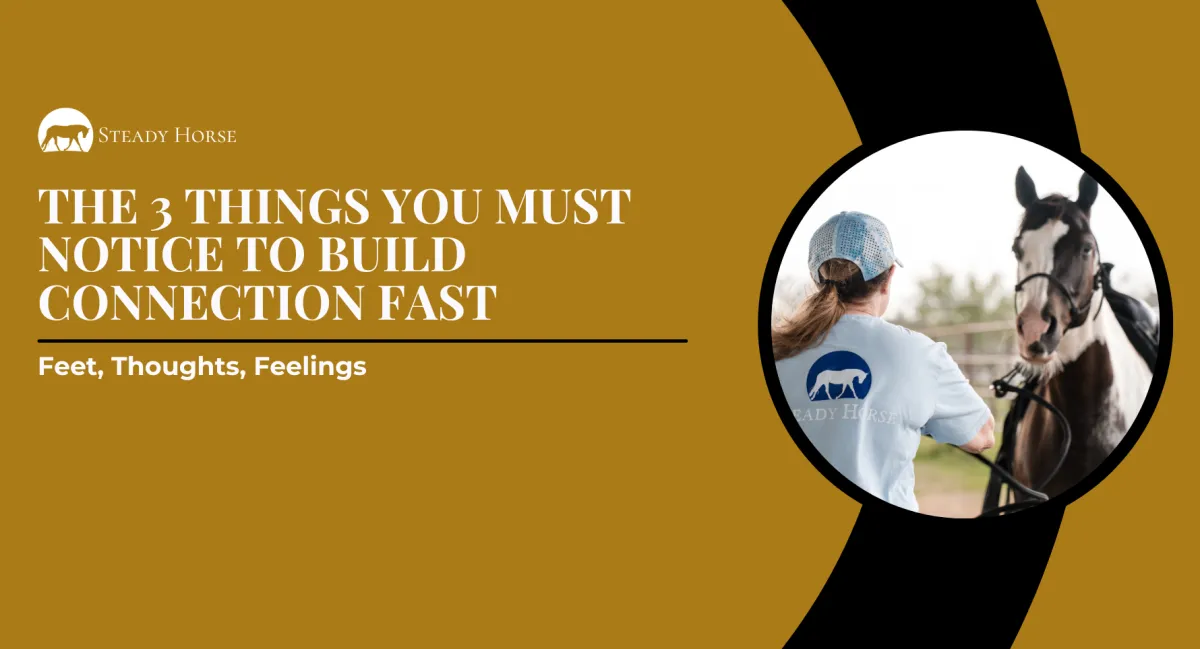
The 3 Things You Must Notice to Build Connection Fast
If your horse loves you but still won’t listen…
If they nicker when you show up but walk off at the mounting block…
If you feel like you’re constantly correcting, reminding, or “arguing” just to get basic cooperation…
You’re not dealing with a disrespect problem.
And you’re not dealing with a stubborn horse.
You’re dealing with a connection gap.
Connection is one of those words we use all the time in horse training — but most riders misunderstand what it actually means. We tend to think connection is about bonding, trust, or whether our horse “likes” us.
But connection isn’t a vibe.
It isn’t affection.
And it definitely isn’t just getting along.
True connection is attentiveness.
And it goes both ways.
In this article, I want to break down the three specific things you must learn to notice if you want to build connection fast — whether you’re working on the ground, in the saddle, or dealing with fear, distraction, or inconsistency.
Those three things are:
What your horse is doing
What your horse is thinking
How your horse is feeling
When you learn to notice these three things — and respond instead of react — connection stops being mysterious. It becomes something you can build deliberately, safely, and consistently.
Why “My Horse Likes Me” Isn’t the Same as Connection
Most horses are pretty easy to get along with.
Feed them.
Scratch them.
Spend time around them.
They’ll nicker when they see you. They’ll follow you in the pasture. They’ll stand quietly while you groom them.
That’s great — but it’s not the same thing as connection.
You can have a horse who absolutely loves you…
and still:
Walks off when you go to mount
Drags you toward the gate
Locks onto other horses instead of you
Spooks, rushes, or braces when things change
Why?
Because connection isn’t about affection.
Connection is about attention.
How attentive is your horse to you?
And just as important — how attentive are you to your horse?
When connection is missing, what we usually see is frustration:
“They’re not listening.”
“They’re being stubborn.”
“They know better.”
But most of the time, your horse is listening — just not to you.
They’re listening to their environment, their instincts, their habits, or their emotions.
That’s why real connection starts with noticing.
Notice #1: What Your Horse Is Doing (Feet Don’t Lie)
The most obvious — and most overlooked — piece of connection is what your horse is physically doing in the moment.
Not what you asked them to do.
Not what you wish they were doing.
What they’re actually doing.
Stop Focusing on What They’re Doing “Wrong”
Here’s where most riders get stuck:
They fixate on what their horse isn’t doing.
“I asked for the front end, and they walked forward.”
“I asked them to stand, and they won’t.”
“I asked for bend, and they braced.”
Instead of getting frustrated, ask a better question:
What are they doing right now?
That answer tells you exactly where the misunderstanding is.
Example: Front End Control
Let’s say you ask your horse to move the front end, and they:
Step sideways and walk forward
That tells you:
They partially understand
But your positioning, rope length, or clarity needs adjustment
So instead of correcting harder, you:
Change your position (more in front)
Shorten your lead rope
Prepare to block forward movement earlier
Your horse just gave you the information you needed — if you were paying attention.
Feet Reveal Focus
Where your horse’s feet go is where their attention is.
Walking off = thinking forward
Drifting toward the gate = thinking escape or comfort
Falling in on a circle = seeking connection without clarity
Feet are communication.
When you notice what your horse is doing without judgment, connection starts improving immediately.
Notice #2: What Your Horse Is Thinking (Read the Thought Before the Step)
Your horse always thinks before they move.
If you wait until the movement happens, you’re already late.
Connection deepens when you learn to read the thought behind the behavior.
Thoughts Show Up as Body Language
You can tell what your horse is thinking by noticing:
Weight shifts
Leaning
Head and neck position
Eye focus
Muscle tension
Some common examples:
Leaning forward = thinking forward
Weight rocked back = prepared to stop or wait
Shifting right = thinking about going right
Looking off = mentally leaving you
Even pawing gives you information.
Pawing is not always “bad behavior.”
Pawing is often a forward thought.
That’s why you’ll see it:
At the trailer
At obstacles
When tied
When anticipation builds
The mistake many riders make is punishing the symptom instead of guiding the thought.
Influence the Thought Before the Behavior
When you notice the thought early, you can step in calmly and say:
“Hey, stay here.”
“Rock back.”
“Wait.”
This is leadership — not correction.
You’re not scolding your horse for being wrong.
You’re helping them succeed before they fail.
That’s what builds trust.
Notice #3: How Your Horse Is Feeling (Emotion Is the Memory)
Horses remember how situations make them feel.
Not just once — but repeatedly.
This is where connection becomes emotional, not mechanical.
Pressure + Release Creates Emotion
Every interaction you have with your horse teaches them one of two things:
“This feels safe.”
“This feels stressful.”
When you apply pressure and release it at the right moment:
Your horse relaxes
Their nervous system settles
They associate you with peace
That’s why timing matters so much in horse behavior training and equestrian confidence building.
Magnet Training: Teaching Peace Through Direction
One of the most powerful ways to influence how your horse feels is magnet training.
The concept is simple:
Work where your horse wants to leave
Rest where you want them to be
Examples:
The gate
The mounting block
A spooky obstacle
Another horse
The trailer
You don’t trap them there.
You don’t force them.
You offer rest.
Over time, your horse learns:
“When I go where you send me, I feel better.”
That’s how you create an unbreakable bond with your horse — one built on choice, not force.
Pattern Interrupts: Competing for Attention Without Punishment
When your horse gets distracted, the goal is not to correct them.
The goal is to compete for their attention.
That’s where pattern interrupts come in.
Backing as a Reset Button
Backing up is one of the simplest and most effective pattern interrupts because:
It repositions your horse in front of you
It re-centers their focus
It requires thought and engagement
Here’s how it works:
Your horse gets distracted
You calmly back them up
The moment their attention returns, you release
You wait and observe
If they stay connected — leave them alone.
If they disconnect — back again.
Yes, it can take many repetitions.
Yes, it can feel tedious.
But consistency creates clarity.
Connection Creates Focus — Not the Other Way Around
Many riders chase focus.
They try to manage distraction, fear, spookiness, or inconsistency without addressing the foundation.
But focus doesn’t come first.
Connection does.
When your horse:
Feels seen
Feels supported
Feels understood
Feels relief when they choose you
Focus becomes natural.
That’s why connection is at the core of:
Safe horse handling practices
Horse training for fearful riders
Groundwork exercises for horses
Horse desensitization techniques
Building rider confidence
It’s not about being stricter.
It’s about being more attentive.
Practical Checklist: Build Connection Starting Today
Use this simple checklist the next time you work with your horse:
Ask Yourself:
What is my horse doing right now?
What does their body tell me they’re thinking?
How do they feel in this moment?
Then Respond By:
Adjusting your position before correcting
Influencing thoughts before behaviors
Releasing pressure the moment they try
Offering rest where you want them to be
Connection isn’t built in a single session — but it is built in moments.
Why This Matters for Safety and Confidence
Most fear in riding doesn’t come from big wrecks.
It comes from:
Inconsistency
Loss of control
Feeling disconnected
Not knowing how your horse will respond
When you learn to notice feet, thoughts, and feelings:
You get ahead of problems
Your horse feels guided instead of trapped
Confidence replaces tension — for both of you
This is the foundation of everything we teach inside our horse training courses and equestrian safety courses.
Ready to Build Real Connection?
You don’t have to live with fear, frustration, or uncertainty in the saddle.
There is a simple, proven process that helps riders:
Build trust
Improve connection
Stay safer with their horses
We walk you through it step by step in a free training, available for a limited time.
👉 Watch the Free Training
https://steadyhorse.com
