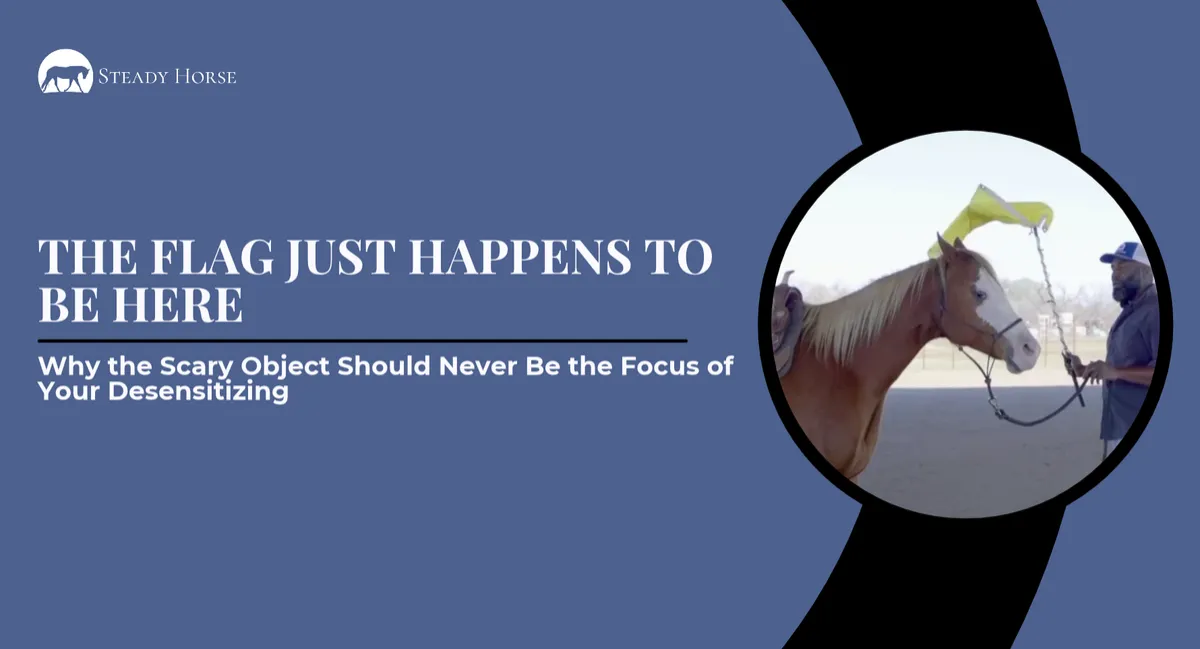
The Flag Just Happens to Be Here
f you’ve ever watched someone desensitize a horse, you’ve probably seen some version of the same thing. A person stands in the middle of a round pen waving a flag, a tarp, a plastic bag, or whatever the scary object of the day is, and the whole session revolves around getting that horse to stand still while the thing happens around them. The flag goes up, the horse moves. The flag goes up again, the horse moves again. Eventually the horse stops moving, the person says “good boy,” and everybody calls it progress.
On the surface, it looks like it worked. The horse stopped reacting. But if you look a little closer at that horse, you’ll notice something. That horse isn’t calm. That horse is enduring. And a horse who has learned to endure pressure is not the same thing as a horse who has learned to trust you through it.
Here’s what I’ve learned after thousands of hours of desensitizing work with all kinds of horses, from dead-broke trail horses to basket cases who came from uncertain pasts: the object is not the point. The flag, the tarp, the bag, the noise, whatever it is, that thing just happens to be there. The real session, the one that actually builds a braver, safer, more connected horse, is about something else entirely.
The Horse That Changed How I Think About Desensitizing
I was recently working with a horse named Rowan Oak during one of our Arena Access Live sessions. Rowan Oak came from a private rescue. He was an intact stallion when his owner got him, undernourished, hard to catch, had a big rat’s nest in his tail, and was the kind of horse who seemed afraid of his own skin. Someone would sneeze and he’d jump five feet in the air. He wouldn’t stand tied, danced around constantly, and had that wide-eyed, high-headed look of a horse who was always scanning for the nearest exit.
People looked at him and said the kinds of things people always say about horses like that: “That horse will never be quiet.” “He’s just skittish.” “That’s not going to be a safe horse for anyone.”
I’ve heard all of it before, and I know it’s not true. When you connect with a horse in a way that’s meaningful for them, you can begin to develop a braver horse. Period. Regardless of where they came from or what they’ve been through.
But the way you get there matters. And it’s not by making the flag the center of the conversation.
Before the Flag Ever Comes Out
Here’s something most people skip entirely. Before I ever start desensitizing a horse with a flag, a tarp, or anything else that might add pressure, I need to know that I have specific tools in place. These aren’t optional. These are the foundation that makes everything else work.
I need my horse to back up reliably. Not just once in a while when they feel like it. I mean consistently, from the clip, from pressure on the bridge of their nose, from a tap on the chest, from a tap on the forearm. If you’ve ever been with a horse who gets worried about something behind them, you know what happens: they bunch up, they crowd you, they come right over the top of you. I need the ability to move that horse off of me the moment I need to.
I need to be able to move the front end. When I ask my horse to step that shoulder over, they should be able to do it without plowing forward, without spinning away, without guessing at what I’m asking. This is one of the most underrated tools in all of horsemanship, and it becomes critical when you’re adding pressure.
I need a solid send. My horse should be able to move out on a circle at the walk, trot, and canter when I point them out, and they should be able to come back to me when I draw them in. This is the tool that lets me give my horse somewhere productive to go with their energy instead of just bottling it up.
I need my horse to lower their head. From underneath the clip and from over the poll. This is a big one because a horse whose head is up high is a horse on high alert. They’re scanning the environment, looking for escape routes, getting ready to flee. A horse who has learned to lower their head is telling you, “I feel safe here. I don’t have to worry. I know everything is fine as long as I’m with you.”
If any of those tools aren’t solid, I’m not moving to the flag yet. I don’t care how eager I am to get to the “exciting” part of the session. If my horse can’t back up 10 out of 10 times and stand there calmly waiting for the next ask, we’re staying right there until they can. Don’t skip steps to get to the desensitizing faster. The desensitizing is only as effective as the tools you bring into it.
The Flag Is Not What You Think It Is
Here’s where everything changes. Once I have those tools in place, I pick up the flag. And the first thing I want you to understand is that the flag is not the subject of the conversation. It’s background noise.
When I’m working Rowan Oak with the flag, I’m not thinking, “Can you stand still while I wave this?” I’m thinking, “Can you connect with me while this flag happens to be here?” Those are two completely different questions, and they produce two completely different outcomes.
I’ll tip his nose toward me. I’ll ask him to lower his head. I’ll move him through the same exercises we were just doing without the flag: back up, move the front end, send out, draw in. The flag just happens to be present while all of that is going on.
And here’s what’s fascinating. When I was doing those exercises without the flag, Rowan Oak was 10 out of 10. Perfect backup. Perfect front end. Calm, relaxed, licking and chewing between each ask. But the moment that flag enters the picture, you can see the holes. His head comes up. He gets a little bracy. His timing shifts. He’s not as responsive because part of his brain is paying attention to the flag instead of paying attention to me.
That’s the information I need. The flag didn’t create a problem. It revealed one. It showed me exactly how connected my horse is to me when there are pressures and distractions in the environment. And now I know exactly what to work on.
Connection Is the Only Thing That Gets Them Out of It
When Rowan Oak’s head goes up because the flag is there, I don’t chase the flag issue. I don’t wave it more aggressively to prove he should be okay with it. I don’t pull it away to give him a break from it. I go straight to what I actually care about: can you connect with me right now?
If his head goes up, I’ll put gentle pressure under the clip or over the poll, and I’ll wait for him to lower. Not because I need him to put his head down, but because lowering his head is how he connects with me. It’s how he says, “Okay, I’m with you. I’m listening. I trust you.”
The flag doesn’t go away when he reacts. The pressure from the flag doesn’t change based on his behavior. The only thing that changes his situation is connecting with me. When he tips his nose in and softens and lowers that head, that’s when the pressure releases. Not because he stood still. Not because he stopped flinching. Because he chose connection over reaction.
And the more I ignore the flag and focus on what I’m asking, the more he begins to understand that connecting with me is what gets him through this. It’s not about tolerating the flag. It’s about trusting the person holding it.
Desensitizing in Motion
Here’s another piece that most people miss. Traditional desensitizing is almost always done at the standstill. You flag your horse while they stand there and you hope they don’t move. But think about real life for a second. When does your horse encounter scary things? Almost never while standing perfectly still. They encounter them while you’re leading, while you’re riding, while you’re moving through a gate, while a plastic bag blows across the trail.
So I desensitize in motion. I’ll send Rowan Oak out on a circle and drag the flag on the ground behind me. Then I’ll shake it at ground level. Then I’ll bring it up higher. And the whole time, my focus isn’t on the flag. My focus is on one thing: is he paying more attention to my hand and my body language than he is to the flag?
When I shake the flag and his walk speeds up, I take a deep breath and slow him back down. Not because the flag is a problem, but because I didn’t ask him to speed up. My deep breath means slow down. My hand up means trot. My hand down means come back to the walk. The flag doesn’t get to dictate the tempo. I do.
And what happens over a few repetitions is remarkable. He starts to realize that the flag moving around does not mean trot. It does not mean canter. It does not mean go faster. The only thing that means trot is when I pick my hand up and ask for it. So he stops reacting to the flag and starts listening to me, because I’ve been consistent about what each cue actually means regardless of what else is happening around us.
That’s how you build a horse who is thoughtful instead of reactive. You’re not training them to ignore the flag. You’re training them to pay attention to you in spite of it.
The Tired Horse Advantage
Here’s a strategy I use that a lot of people haven’t considered. After I’ve done my basic desensitizing and my desensitizing in motion, I’ll put my horse to work. I’ll send them around, push them through walk, trot, canter transitions, get them huffy and puffy. I want their heart rate up and their respiration going.
Then, when they’re physically tired and catching their breath, that’s when I bring in the heavy pressure.
Why? Because a horse who is tired has more incentive to stand still. Standing still and resting is more meaningful to them in that moment than it was at the beginning of the session when they had all the energy in the world. So when I come in with bigger flag work, more noise, more motion, more intensity, they’re looking for a reason to just plant their feet and breathe. And they start associating the desensitizing with the rest period.
There’s an old saying: a tired horse is a good horse. And there’s real truth to it. A tired horse is more focused on catching their breath than on being worried about distractions. So they can handle a level of pressure that would have sent them sideways at the beginning of the session.
This is not about exhausting your horse into submission. This is about timing your session so that the most intense desensitizing work happens when your horse is in the best mental state to process it.
Don’t Recoil
I need to say this clearly because it’s one of the most common mistakes I see, and I used to make it myself.
When your horse overreacts to something, whether it’s the flag, your hand, a noise, anything, do not pull away. Do not recoil. Do not drop the flag and say, “Oh, I’m sorry, that was too much.”
When you recoil, you teach your horse that overreacting makes the pressure go away. That’s the exact opposite of what you want. You want them to learn that softening into you is what makes the pressure go away. Not spooking, not darting sideways, not throwing their head up. Connecting.
So if I put my hand up near Rowan Oak’s face and he throws his head up, my hand stays right where it is. I don’t chase him, but I don’t retreat either. I wait. And the moment he starts to lower back toward my hand, the moment he begins to soften, that’s when the pressure releases.
Over time, something incredible happens. Instead of seeing my hand come up and bracing against it, he starts to fall into it. Because every single time my hand has been there, the release came from softening. Not from reacting. Not from resisting. From trusting.
That same principle applies to everything. The flag, the tarp, the saddle, the bridle, the trailer. Whatever the stimulus is, your horse’s path out of the pressure is always the same: connect with you. And the only way they learn that is if you stay consistent. Every time.
Find the Holes on Purpose
Here’s where I’ll push you a little bit, because I think a lot of people sell themselves short.
It’s tempting to desensitize your horse just enough that they look okay and then stop. You wave the flag lightly, they stand still, you rub them and say “good boy” and call it a day. And yes, that horse looked fine. But you didn’t teach them anything new.
The goal of desensitizing is not to make your horse look good. It’s to find out where the holes are. Where are they still uncomfortable? What level of pressure causes them to lose their connection with you? What area of their body do they not want you near? What direction of movement makes them bracy?
When I’m working Rowan Oak, I don’t just rub him with the flag and call it done. I whip it overhead. I shake it behind his hip where he can’t see it. I tap him with it. I bring it in fast and unexpected. Not to terrorize him, but to find out exactly where his threshold is so I can work him through it.
Because here’s the reality: if you only desensitize at a comfortable level, you’re going to find out where the real holes are at the worst possible time. On the trail when a branch smacks your horse in the hindquarters. In the arena when a gust of wind catches the banner. At the trailer when someone drops a bucket. You’d rather find those holes in a controlled environment where you can work through them than discover them while you’re in the saddle.
What a Real Session Looks Like
If I were mapping out a full desensitizing session with a spooky horse, here’s the progression:
Start with your tools. Confirm the backup, the front end, the send, and the head lowering are all solid. If any of them aren’t where they need to be, stay there.
Start with light desensitizing. Something you know your horse will be relatively comfortable with. Just rubbing the flag over their body, moving it across their back, switching sides while keeping their nose tipped toward you. Start writing those connection files.
Move to desensitizing in motion. Send your horse out with the flag present. Drag it, shake it, bring it up. Keep your focus on the cues and communication, not the flag. The flag just happens to be there.
Do your groundwork. Transitions, circles, direction changes. Get your horse moving and working physically. Build up that heart rate.
Finish with heavy pressure desensitizing. While your horse is catching their breath, bring the intensity up. Bigger flag work, more motion, unexpected angles. Find the holes. Work through them. Let your horse discover that connecting with you is the answer no matter how big the pressure gets.
This progression isn’t random. Each phase sets up the next one. You start by confirming your tools, then you use those tools while adding light pressure, then you add motion, then you add physical effort, then you bring the real pressure when your horse is in the best state to handle it.
You Can’t Desensitize to Everything (But You Don’t Have to)
I’ll be honest with you. You cannot desensitize your horse to every single thing in the world. There are too many sounds, too many objects, too many situations, too many variables. Something is always going to surprise your horse at some point.
But that’s not the goal. The goal is to teach your horse that regardless of what’s happening around them, connecting with you is what makes everything okay. When you’ve put in thorough, intentional, methodical desensitizing work where the scary object was always incidental and the connection was always the point, your horse’s first instinct in a moment of fear won’t be to spin, bolt, buck, or rear. Their first instinct will be to find you.
That’s what makes a horse safe. Not the absence of fear. The presence of trust.
The vast majority of horse-related accidents come from spooking. The horse spooks and bucks, spooks and bolts, spooks and rears, spooks and spins. The common thread is always the spook. And if more people were thorough, methodical, and intentional about how they approach desensitizing, that alone would probably eliminate the majority of those incidents.
So the next time you pick up a flag or a tarp or anything else that might worry your horse, remember: the object is not the point. It never was. The object just happens to be there. The real session, the one that actually changes your horse, is the conversation happening between you and your horse about trust, connection, and leadership.
Make that the focus, and the flag takes care of itself.
If you’re ready to start building real trust and confidence with your horse through connected, methodical work, I’ve put together a free training that walks you through exactly how to get started. It’s available for a limited time and focuses on the safety and connection that come from doing this work the right way.
