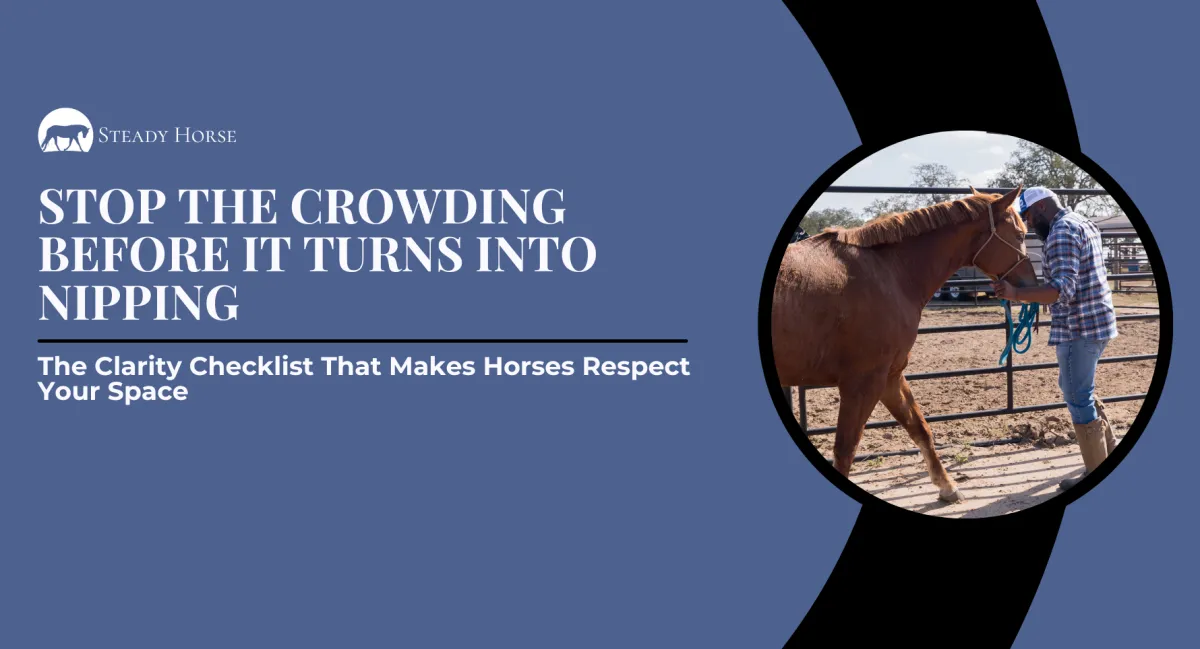
Stop the Crowding Before It Turns Into Nipping
If you’ve got a horse that’s always in your pocket… always reaching for your hand… always trying to chew the lead rope… and every now and then they get brave enough to nip…
I want you to hear me clearly:
That’s not a “personality problem.”
That’s a communication problem.
And the reason this matters is because a pushy, mouthy horse doesn’t just feel annoying… it turns into a safety issue fast. One day it’s “he’s just being silly,” and the next day you’re flinching every time you go to halter, tie, flex, or walk past the spooky end of the arena.
So today, I want to give you a simple framework that changes everything:
First: we fix the space problem (the crowding) before it becomes a biting problem.
Then: we use a clarity checklist — Position, Direction, and Energy — so your horse understands you the first time.
This is the kind of horse behavior training that sticks, because it’s not about overpowering them. It’s about building the kind of equine partnership development where your horse knows the rules, trusts your leadership, and can relax.
Let’s get into it.
Why mouthy, nippy horses are almost always a communication issue
A lot of riders get stuck here:
“My horse won’t quit nipping. How do I correct the nip?”
But nipping is usually not the first problem.
It’s the last step in a chain.
Most nippy horses start with something like this:
Crowding your space
Walking into you on the lead rope
Constantly sniffing your pocket
“Nuzzling” that turns into mouthiness
Chewing the lead rope, reins, or your sleeve
Getting extra pushy in trigger zones (spooky corners, gates, barn doors, trailer area)
And here’s what’s really happening:
Your horse is saying, “I don’t clearly understand where I’m supposed to be.”
That’s a communication problem.
So instead of waiting for the teeth… we correct the moment your horse comes inside the boundary.
That’s how you stay safe and teach your horse in a way they can actually understand.
The Bubble Rule: fix crowding before you fix biting
I call this the “bubble.”
For most horses, your bubble should be about an arm’s length.
Why?
Because if your horse is at an arm’s length…
They can’t nip you.
They can’t mug you for treats.
They can’t bump into you when they get worried.
And you can still communicate clearly without wrestling.
So here’s the rule:
Your horse does not enter your bubble unless you invite them.
Not “because they’re sweet.”
Not “because they want love.”
Not “because they’re just curious.”
If they come in without permission, we correct that.
And the correction is not a fight.
It’s simply: back up.
The fastest boundary reset in the world: backing up with a “cost”
I’m going to give you a simple concept that changes how your horse thinks.
Most people back their horse up like this:
Horse steps forward → rider backs up 1 step → horse steps forward again
That does nothing.
The horse learns:
“I can walk into you and it doesn’t really matter.”
So here’s what we do instead:
If your horse moves forward without permission, it costs them energy.
Meaning:
Horse steps into your bubble → back up 4–5 steps
Horse steps into your bubble again → back up 4–5 steps
Horse thinks about stepping into your bubble (weight shift forward) → back up 4–5 steps
That last one is important.
We don’t just correct what they did.
We correct what they’re thinking about doing.
Because horses think fast — they think and then they do.
So if you get ahead of the thought, you stay ahead of the feet.
This is the kind of safe horse handling practice that builds respect without drama.
The Clarity Checklist: Position, Direction, Energy
Now let’s talk about why this works… and why sometimes people do “backing up” and still feel like nothing changes.
Most of the time, it comes back to clarity.
When I’m helping someone troubleshoot, I run through three things every time:
Position
Direction
Energy
You can apply this to trailer loading, sending, side passing, mounting, tying… all of it.
But today we’re going to apply it to the bubble and mouthiness — because that’s where people get hurt.
1) Position: your body is either inviting them in… or pushing them out
This is the sneaky one.
Because you can say “back up”…
…but your body can still be saying “come here.”
Here’s what I see all the time:
A horse crowds and gets mouthy, and the rider does this:
Leans away from the horse
Steps back
Turns their shoulders away
Gets “small” to avoid getting nipped
From the horse’s perspective, that looks like an invitation.
It’s like you’re creating space and saying, “Fill it.”
So if you want your horse out of your bubble, your body has to say:
shoulders forward
posture up
feet planted or stepping into the space you want them to leave
Not aggressive. Not angry.
Just clear.
Action step
When your horse crowds you, don’t retreat.
Step into the space you want them to leave.
That one change fixes a lot of “he’s good one day and terrible the next” horses, because it removes mixed signals.
2) Direction: pressure has to point where you want the feet to go
Direction is where people accidentally get confusing.
If you want your horse to back up, your pressure needs to say “back.”
That means:
your rope motion (or stick motion) is directed toward the horse in a way that creates backward motion
not waving out to the side
not pointing like you’re sending
A good example is when someone is trying to move the front end over.
They point outward like “go around,” and the horse just stands there confused.
Because the direction isn’t saying, “Move your shoulder.”
It’s saying, “I don’t know… something… out there.”
With the bubble
Direction means: we correct the bubble entry, not the bite.
So the moment your horse’s nose comes in and their feet step forward…
Your direction is backward.
Back up.
Back up straight.
Then release.
That’s communication.
3) Energy: gradual for sensitive horses… adequate for dull horses
Energy is relative.
Some horses are like Chili (super sensitive). You breathe and they back away.
Other horses are like Prospector (dull and lazy). You might need a 20 out of 10 to get one step.
And here’s where people get stuck:
They feel guilty using enough energy to be heard.
So they stay at a 2…
and the horse never changes.
Let me reframe this:
Adequate pressure isn’t punishment. It’s volume.
If you’re quiet and your horse can’t “hear” you, they don’t learn.
And the dull horses actually appreciate it when you communicate clearly enough that they can understand.
So your job is not “never use energy.”
Your job is:
Start low for sensitive horses
Build gradually if needed
For dull horses, make an educated guess and start at a level that actually gets a response
That’s how you build real responsiveness in your horse training courses work, your groundwork exercises for horses, and your under-saddle riding too.
“Don’t reward by inviting them back into your space”
This is huge.
Let’s say you backed your horse up, and they finally stay out of your bubble.
A lot of riders immediately do this:
Walk into the horse
Rub their face
Love on them
That can send a mixed message:
“Stay out… but also come in.”
So for now, I want you to reward the bubble with distance.
Here are two clean rewards:
Release (drop pressure and let them stand)
Scratch with the stick (reach out and rub them at arm’s length)
That teaches:
“Peace happens out here.”
And that’s how you build a safer horse and a calmer mind.
Troubleshooting common mouthy/nippy moments
Let’s hit the big ones that came up in this session.
1) “He’s fine one day, and the next day he acts clueless”
That’s usually one of two things:
Your clarity changed (position, direction, energy got soft or inconsistent)
His environment changed (trigger zone, spooky corner, more tension)
Solution: don’t get emotional about it. Get methodical.
Back him up before he crowds.
Back him up even on good days to set the tone.
Consistency builds confidence.
2) “He gets mouthy during flexion/bending”
This is common.
If you bring his head around and he nips, don’t release during the nip.
Instead:
bump the line (or rein) until the teeth go away
then release when he softens politely
He learns:
nipping = no release
softness = release
That’s clean communication.
3) “He rears when I correct him”
First: safety is priority. Stay off to the shoulder so you don’t get struck.
Second: rearing on the ground often means you touched a real thread.
You don’t quit because he reared.
You simply:
soften pressure slightly during the rear so you don’t flip him
maintain enough presence that the pressure still “exists”
the moment his feet hit the ground, you go right back to the ask
What he learns:
“Blowing up doesn’t remove pressure. Peace comes from responding.”
That’s how you create a horse that’s less reactive under saddle too — because you did the hard conversation on the ground first.
4) “He chews the lead rope but isn’t nipping me”
Same concept.
That’s an attention problem and an oral fixation.
Pattern interrupt:
back him up
ask him to connect with you
release when he’s quiet and present
Your job is to be the loudest, clearest voice.
A simple 7-day boundary reset you can start today
If you want a plan you can actually follow, do this for a week.
Day 1–2: Set the bubble
Halter on → immediately back up 4–5 steps
Walk forward → if he crowds, back up 4–5 steps
Stand still → if he leans in, back up 4–5 steps
Reward only with release or stick scratches at distance
Day 3–4: Add distance backing
Practice backing from farther away (more slack in the rope)
Correct weight shifts before the step forward happens
If he snakes his hind end to evade, tap the hind back under and continue backing
Day 5–6: Add trigger zones
Work near the spooky end, gate, or barn entrance
If he crowds, you don’t argue — you back up
Keep sessions short, clear, and consistent
Day 7: Test real-life moments
Flexion
standing tied (if appropriate)
walking past distractions
mounting block work
trailer area (without trying to load)
You’ll be shocked how quickly your horse starts to relax when the rules are simple.
That’s how you build building trust with horses and real equestrian confidence building for you.
The real win: a horse that can relax because they understand you
At the end of the day, this isn’t about being “strict.”
It’s about giving your horse clarity.
When your horse understands:
where to stand
how to find peace
how to respond to pressure
and what doesn’t work anymore
They stop searching for answers like:
crowding
nipping
pawing
rearing
spinning
leaving
And they start choosing the answer you want:
softness
patience
forward when asked
back when asked
calm in your space
That’s the start of an unbreakable bond with horse — the kind that keeps you safer in the saddle and calmer on the ground.
You don’t have to keep riding (or handling your horse) with that low-level tension in your chest — waiting for the next nip, the next crowd, the next blow-up.
There’s a simple process for building confidence and staying safe with your horse, and we’re giving it away in a free training for a limited time.
🎥 Watch the free training here: https://steadyhorse.com
