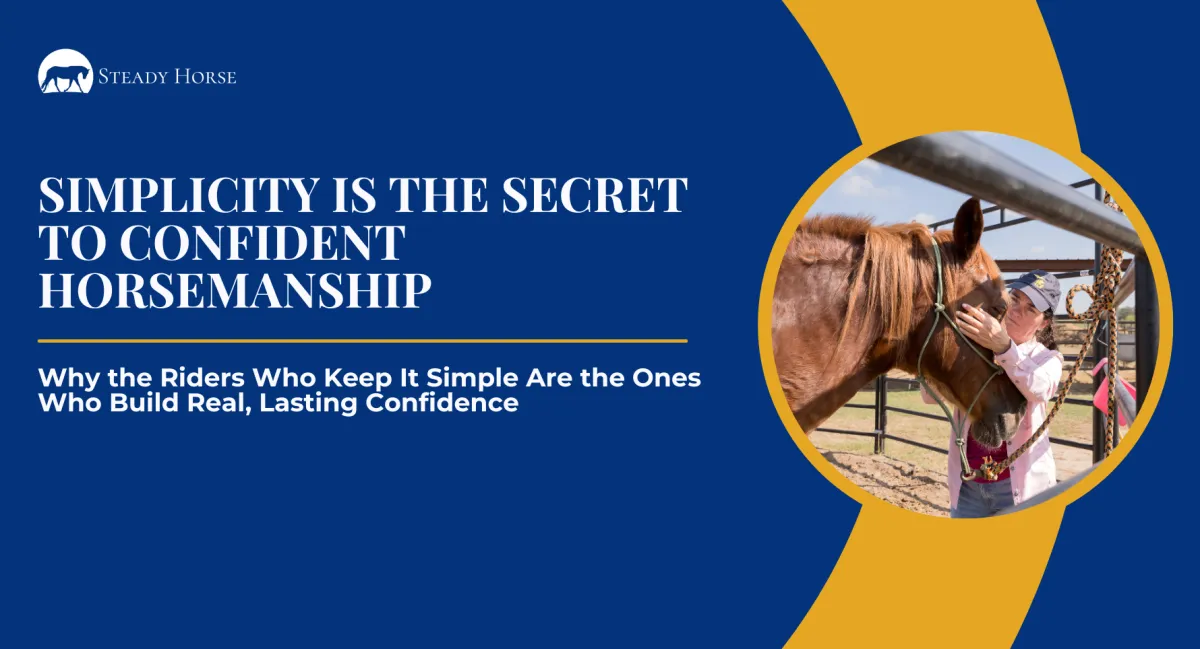
Simplicity is Key
There's a pattern that shows up all the time in the horse world, and it sounds like this.
"We've been working on so many things, but nothing feels solid."
"I know what I'm supposed to do, but when I get out there, it all falls apart."
"Some days we're great and some days it feels like we're starting from scratch."
If any of that hits home, you're not alone. And here's something that might surprise you: the issue probably isn't that you're not working hard enough. It's that you're working on too much.
The riders who build real, lasting confidence with their horses aren't the ones doing the most. They're the ones keeping it simple. They're breaking things down. They're repeating what matters. They're measuring what's actually happening instead of chasing what they wish was happening.
Simplicity isn't a shortcut. It's the strategy. And once you understand how to apply it, everything about your training starts to shift.
The Temptation to Overcomplicate
It's easy to fall into the trap of thinking that more is better. More exercises. More variety. More challenges. More ground to cover in every session.
We see something cool in a video and want to try it. We read about an exercise and add it to the list. We have a good moment with one thing and immediately want to move on to the next. Before we know it, we're trying to cover ten different things in a single session, and none of them are getting the time and attention they actually need.
Here's the problem with that approach. Our horses need to know their ABCs before they can spell out words or put together full sentences. And when we pile exercise on top of exercise without making sure each one is truly solid, we're essentially asking our horse to write an essay when they're still learning the alphabet.
That's not a recipe for confidence. That's a recipe for confusion. For both of you.
Confusion in a horse shows up as resistance, anxiety, dullness, and frustration. And confusion in a rider shows up as self-doubt, inconsistency, and that nagging feeling that you're not making progress no matter how hard you try.
The fix isn't adding more to your training. It's stripping things back and doing less, better.
Pillar One: Break It Down
The first principle of keeping it simple is breaking every exercise down into smaller steps. And I mean every exercise.
Whatever you're asking your horse to do, you can break it into a minimum of three to five distinct steps. Even things that seem simple on the surface have layers underneath them that your horse needs to understand individually before they can put the whole picture together.
Take the backup, for example. It's one of the most fundamental exercises in your toolbox. It seems straightforward enough. Ask your horse to move backwards. But watch what actually happens when you start breaking it down.
Your first step might just be getting a response. For a lazy or dull horse, that alone is a win. Your second step might be getting your horse to rock back onto their haunches, shifting their weight to the hind end. Your third step might be seeing them begin to lift that front hoof and break over at the knee, showing you they're thinking backwards. And your fourth step might be that full, clean step backwards where the foot lifts and moves with softness and intention.
Four distinct steps inside one exercise that most people treat as a single ask.
Now think about something bigger, like trailer loading. Before your horse ever sets foot on that ramp, they need to know how to send. And sending itself breaks down into three steps: backup, move the front end over, drive forward from behind. They also need to know how to tie. That's another skill set entirely. And they need to have done enough obstacle work to be comfortable walking onto things, stepping down off things, and moving over unfamiliar surfaces.
Each of those skills is its own set of small steps. And each of those small steps needs to be understood and solid before the next one gets layered on top.
This is what clarity looks like. It's not about dumbing things down. It's about giving your horse the chance to truly understand what you're asking, one piece at a time, so that when you do put the pieces together, they have a foundation that holds.
The riders who break things down are the riders whose horses are soft, willing, and confident. Because those horses were never asked to guess. They were shown, step by step, exactly what was expected. And they were given the time to get each step right before the next one was introduced.
Pillar Two: Repeat It
The second principle is repetition. And this is where a lot of riders struggle, not because they don't know repetition matters, but because they get bored with it.
You have a good session with an exercise. Your horse responds well. Things feel solid. And immediately, your brain says, "Great. What's next?"
That impulse to move on is one of the biggest obstacles to building real confidence. Because "good" is not the same as "solid." And "solid" is not the same as "10 out of 10."
When your horse does an exercise well once, that's encouraging. When they do it well three times in a row, that's promising. When they do it well ten times in a row, across multiple sessions, in different environments, with different distractions present, that's solid. That's the kind of understanding you can trust. That's the kind of response you can count on when things get challenging.
Repetition isn't about drilling your horse into submission. It's about building certainty. You're giving your horse the opportunity to practice their response until it becomes second nature. Until they don't have to think about it. Until their body just knows what to do when you make a particular ask.
Think about how you learned to drive a car. The first time you checked your mirrors, signaled, and merged onto a highway, it took every ounce of your concentration. Now you do it without thinking. That's what repetition built. And that's what repetition builds in your horse.
The riders who resist the urge to move on too quickly are the riders whose horses are the most confident. Because those horses have done the work enough times to own it. It's not something they're still figuring out. It's something they know.
Pillar Three: Measure It
The third principle is measurement. And this is the one that takes simplicity from a philosophy to a practice.
Because here's the reality: if you're not measuring your progress, you're guessing. And guessing is where frustration lives. It's where you convince yourself nothing is working. It's where you lose sight of how far you've actually come because you're too focused on how far you still have to go.
Measurement gives you something concrete to look at. It takes the emotion out of your evaluation and replaces it with facts. And facts are a lot more useful than feelings when it comes to knowing whether your training is working.
So how do you measure progress with your horse? There are several ways, and none of them require fancy equipment or complicated systems.
Count the steps. If you're working on the backup, how many steps does your horse take backwards today? One? Two? Four? If it was one step last week and two steps this week, that's measurable progress.
Measure the distance. When you ask for the backup, how far does your horse move away from you? Two feet? Three feet? Track it over time and you'll see the improvement even when it doesn't feel dramatic.
Time the response. How long does it take your horse to respond when you ask? Twenty seconds? Ten? Five? If that gap is shrinking, your horse is understanding your ask more quickly. That's progress.
Use the 10 out of 10 standard. This is the most important measurement of all. When you ask your horse to do something, how confident are you that they'll give you a soft, willing, correct response? Not seven out of ten. Not eight. Ten out of ten. That's your benchmark for knowing an exercise is truly solid and you're ready to move on.
Here's what makes measurement so powerful: it keeps you honest. It prevents you from moving forward before you're ready. And it shows you, in clear and undeniable terms, that you are making progress even on the days when it doesn't feel like it.
Because progress with horses is almost never linear. Some days your horse will be amazing. Some days it will feel like you're back to square one. That's normal. That's the nature of working with a living, feeling animal who has good days and hard days just like you do.
But when you have measurements to look back on, you can see the bigger picture. You can see that even with the setbacks, the overall trend is moving forward. And that perspective is what keeps you in the game when the hard days make you want to quit.
Why Simplicity Builds Confidence
So how does all of this connect to confidence? Let's bring it back to the Fearless Rider formula.
The four C's are change, connection, communication, and confidence. Simplicity lives inside the third C, communication. It's the part of communication that ensures your horse actually understands what you're telling them. And when communication is clear, everything else falls into place.
When you break things down, your horse gets clarity. When you repeat, your horse gets certainty. When you measure, you get confidence.
Not the kind of confidence that comes from telling yourself everything will be fine. The kind that comes from evidence. From seeing, session after session, that your horse understands your ask and responds with softness and willingness. The kind that comes from knowing you have a 10 out of 10 response on the ground before you ever think about getting in the saddle.
That confidence doesn't just help you ride better. It changes how you show up for your horse entirely. You're calmer. You're more patient. You're more attentive. And your horse feels all of that.
Horses are incredibly perceptive. They read your energy, your body language, your breathing. When you walk out to the barn carrying the weight of frustration and self-doubt, your horse knows it before you ever touch the lead rope. But when you walk out knowing you've been doing the work, knowing you've been measuring the progress, knowing your horse has shown you time and again that they understand, you carry a completely different energy. And your horse responds to that energy by being softer, more willing, and more connected.
Confidence feeds connection. Connection feeds communication. Communication feeds confidence. It's a cycle. And simplicity is what keeps that cycle spinning.
The Attentiveness Connection
There's one more piece to this that deserves attention, and it's about your attentiveness to your horse.
Rebecca often makes this point: our timing comes from our attentiveness. If you're worried about your timing, don't focus on timing. Focus on paying attention to your horse.
When you're truly attentive to your horse — reading their body language, noticing what they're thinking, watching for the subtle shifts that tell you what they're about to do — your timing naturally improves. You start rewarding sooner because you see the try sooner. You start being preemptive because you read the warning signs before the behavior escalates.
A horse that is parked out forward with their weight on the front end is thinking about leaving. A horse that is rocked back on their haunches is thinking about staying with you. If you're attentive enough to see the difference in real time, you can respond before the moment passes.
This is where simplicity and attentiveness work together. When you're only focused on one or two things in a session instead of ten, you have the mental bandwidth to actually pay attention to your horse. You're not running through a mental checklist of exercises. You're present. You're watching. You're listening.
And your horse feels that. They feel when you're giving them that level of attention. It means something to them. It makes them a more willing partner. It makes them learn faster. And it makes them more likely to give you their attention in return, because you've shown them that you're worth being attentive to.
Meet Your Horse Where They Are
One last thing. And this might be the most important part of keeping it simple.
Not every day is going to be a good day. Some days your horse will be right there with you, soft and willing and connected from the first ask. Other days, it's going to feel like you've never trained a day in your life.
That's normal. That's horses.
The key is to meet your horse where they are on that particular day. Don't walk out to the barn with a rigid agenda and get frustrated when your horse doesn't match it. Walk out with your tools, your attentiveness, and your willingness to adjust.
If today is a day where your horse needs twenty minutes just to stand at the mounting block, then that's what today is about. If today is a day where the backup is sticky and resistant, then that's where the work lives today. If today is a day where everything clicks and your horse is a dream, then enjoy it, reinforce it, and call it a win.
Progress isn't linear. It never has been. But every day that you show up, break things down, repeat what matters, and measure what's happening, you're moving forward. Even when it doesn't feel like it.
Keep it simple. Trust the process. And give your horse the clarity they deserve.
Ready to Start Building That Foundation?
If you're looking for a clear, simple path to building safety and confidence with your horse, there's a free training available right now that shows you exactly where to start. No overwhelm. No overcomplication. Just the foundational exercises that set you and your horse up for real, lasting success. It's available for a limited time, so don't let it pass you by.
