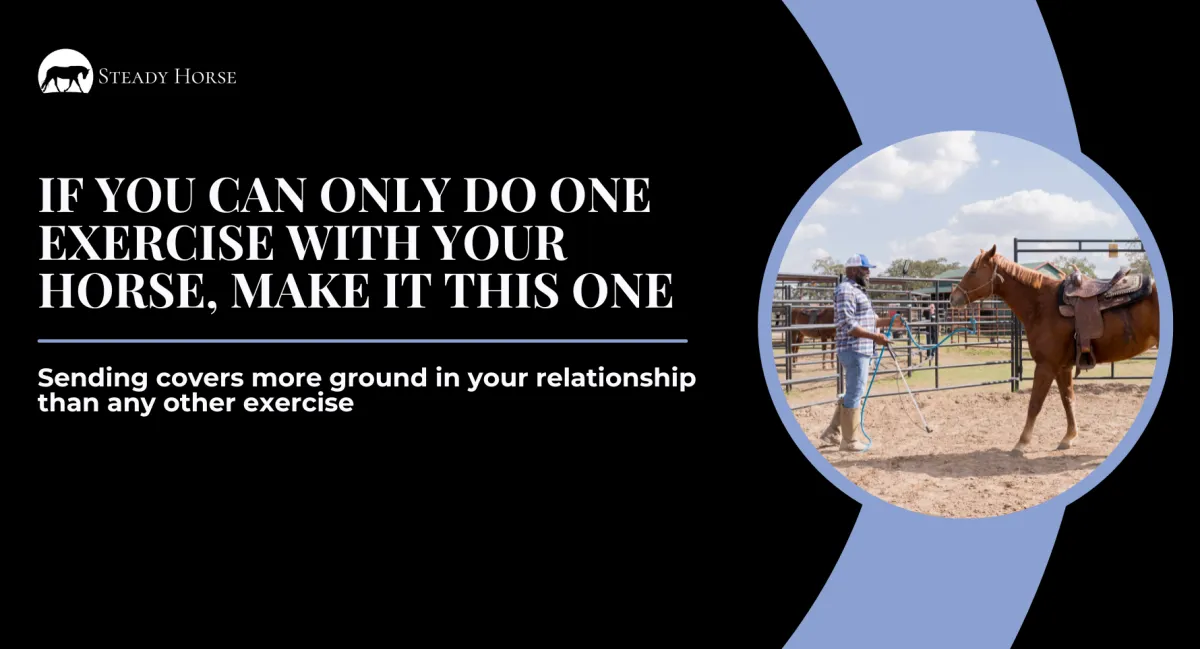
The Single Best Movement
If someone asked me to pick one exercise, just one, that I'd want every horse owner to do with their horse before they ever ride, it wouldn't even be close.
It's sending.
Not because it looks impressive. Not because it's complicated. But because sending covers more ground in your relationship with your horse than anything else you can do from the ground. It builds on your backing up. It tests your ability to move the front end. It develops transitions. It reveals whether your horse is truly connected to you or just going through the motions. And it gives you a tool you can use in almost any situation to help your horse slow down, think, and find their way back to you.
There is no single exercise that does more for your horse's confidence, your safety, and the bond between you. And yet most people either skip it, rush through it, or treat it like lunging with extra steps.
It's not lunging. It's not even close. And by the time you finish reading this, you'll understand why.
Why Sending Matters More Than You Think
Let me break down what's actually happening when you send your horse, because I think a lot of riders underestimate it.
When you send your horse, you are asking them to back up away from you. You are asking them to move their front end in a specific direction. You are asking them to move forward from behind. You are working on upward transitions and downward transitions. You are asking them to accept changes of direction. You are asking them to regulate their speed. You are testing their attention, their patience, and their willingness to stay connected to you while they're moving away from you.
All of that, in one exercise.
And here's the part that makes sending truly powerful. It's also one of the most effective tools for desensitizing your horse. When you send your horse in a new environment, past something they're worried about, through an obstacle they've never seen, you're teaching them to slow down and think instead of react. You're teaching them that change doesn't have to be dangerous.
Because here's the thing about horses. They hate change. Fundamentally, instinctively, down to their bones, they do not like when things are different. A new shadow on the ground. A flag that wasn't there yesterday. The sound of something unfamiliar coming from the barn. Any change at all can send a horse into that reactive, instinctive, self-preservation mode where they stop thinking and start surviving.
Sending is one of the five ways we teach our horses to be okay with change. When they're moving on that circle, they're seeing things from different angles. Their left eye catches something, then their right eye. Things are behind them, then in front of them. The world is constantly shifting around them, and they're learning to move through it calmly because you're right there guiding them.
That's not something you get from lunging a horse in circles until they're tired. That's intentional, methodical work that changes how your horse processes the world.
The Three Steps You Should Never Skip
Every time you send your horse, the process starts the same way. Three steps. Always three steps. No shortcuts. No exceptions.
Step One: Back Your Horse Up
You back your horse up so their hind legs are on the circle you're about to send them on. But this isn't just about positioning. Backing up establishes attention. It puts your horse on their haunches. And it gives you immediate information about where their mind is.
The further away your horse is from you, the easier it is for them to be distracted. When they're standing right in front of you, you're all they can see. But as you back them up and create distance, now they can look past you. They can glance at another horse. They can check out the gate or the barn. And that tells you everything you need to know about whether they're mentally with you before you ask for anything else.
Most horses are going to yo-yo here. You back them up, they creep forward. You back them up again, they lean in. That's normal. That's their brain predicting that forward is where safety lives. Be ready for it. Catch it before the foot moves if you can. And don't move on until they're committed to staying back on their haunches and keeping their attention on you.
Step Two: Move the Front End
Now you're directing your horse into the path they're about to travel. If you're sending to the left, you sweep that front end around to the left. If you're sending to the right, you move it to the right.
This is where a lot of horses want to anticipate. They feel you start to move their front end and they think, "I know what's coming. Let me just launch forward." When that happens, you shut it down. Bump them back. Ask them to wait. Move the front end over again. You might have to do this a dozen times before they stand there quietly and let you place them without rushing.
Be careful here that you're not accidentally yo-yoing your horse back into you. If you're holding the rope too short, they'll hit the end and bounce right back. If you're already shifting your body to get into position to drive from behind, you might be pulling on their face without realizing it. Give them plenty of slack. Let that rope have a belly in it. And hold your feet so you're not creating a vacuum that draws them in.
Step Three: Drive From Behind
Now, and only now, you drive your horse forward from behind. You want to get them moving on that circle. It might not be pretty. It might only be one or two steps. That's okay. As long as it's forward, definitively forward, that's what earns the release.
Your cues here should follow a consistent escalation. Maybe you start by raising your rope hand and opening your body to show them the direction. If they don't move, you cluck or kiss. If they still don't move, you pick up your stick. For a really lazy horse, you might need to give a tap on the hind end to say, "Hey, I mean it. Let's go."
The key is consistency. Whatever your sequence of cues is, use the same sequence every time. Horses thrive on clarity. They fall apart with inconsistency. If you're wishy-washy, hot one day and cold the next, your horse can't learn the language you're trying to teach them.
And the moment they move forward, everything comes down. Your hand lowers. Your stick comes down. Your energy softens. You reward that effort immediately.
The Pause That Changes Everything
Between each of those three steps, I want you to do something that feels almost too simple to matter.
Take a deep breath. Count to three.
That's it. Back up. Breathe. One, two, three. Move the front end. Breathe. One, two, three. Drive forward.
I had a mentor, Barbara White, an incredible horsewoman. And when I was younger, I did everything fast. I was rushing, flying through steps, moving my horse's body like I was in a race. And she'd stop me every single time. "Slow down. Break things into steps."
Barb taught me that anything, no matter how big the problem appeared to be, could be broken down into simple steps. And when you break things into simple steps, you can do big things. You can conquer some big hills.
That pause between each step does more than you realize. It gives your horse time to process. It prevents anticipation. It builds patience. And it gives you a window to see what your horse is thinking before you ask for the next thing.
Are they leaning forward? Are they looking away? Are they soft and waiting? That three-second window tells you whether to proceed or reset. And horses who learn to wait through those pauses become horses who don't spin, don't rush, don't anticipate their way into dangerous habits.
I see it all the time with people who skip the pause. They're doing these rapid-fire direction changes, sending left, sending right, spinning their horse back and forth. And they think they're building responsiveness. But what they're actually building is a horse who has learned to react without thinking. A horse who cycles through movements like a robot because they've been trained through speed and pressure instead of understanding.
That's not a connected horse. That's a patterned horse. And there's a dangerous difference between the two.
Connected vs. Patterned: The Difference That Keeps You Safe
This is something I want to camp on because it matters more than most people realize.
A patterned horse is one who performs movements without thinking. They've been drilled through repetition and pressure until the response is automatic. They lope around in circles looking dead inside because they're terrified of what happens if they don't. They can change directions on a dime, not because they understand what you're asking, but because they've learned that if they don't react fast enough, something unpleasant is coming.
A patterned horse can look incredibly well trained. From the outside, you'd think they were the safest horse in the barn. But here's what happens with a patterned horse. You take them out of the pattern. You ride them in a new environment. Something comes from left field that they didn't expect. And that horse comes unglued. Because they were never truly with their rider. They were just running a program.
A connected horse is different. A connected horse is reading you. They're paying attention to your breathing, your energy, your body position. They're making decisions based on your leadership, not based on fear. And when something unexpected happens, they look to you instead of looking for an exit.
That's what sending builds when you do it right. Not a pattern. A conversation.
When you pause between steps, when you reward effort, when you wait for signs of relaxation before asking for more, you're teaching your horse that this isn't a drill. This is a dialogue. You're saying something, they're responding, and you're listening to their response before you say the next thing.
That's the horse you can trust on the trail. That's the horse who won't leave you when the world gets unpredictable. Because even though everything around them might be changing, you never change. You're consistent. You're clear. And your horse knows that wherever you point them is a good place to go.
Upward Transitions: Getting the Departure Right
Let's talk specifics now, because the quality of your transitions within sending is where the real refinement happens.
When you're asking your horse to speed up, whether that's from a walk to a trot or a trot to a canter, you're only looking for the departure at first. Not five strides. Not a full lap around the circle. Just the initial effort. Just the "yes."
Think about it the way I described it with the three steps. You're not asking for everything at once. You're asking for one thing, and when your horse gives it to you, you reward it.
So if you ask for the canter and your horse gives you one stride before dropping back to the trot, that's fine. Lower your hand. Lower your stick. Let them know they made a good decision. Yes, they slowed back down. That's okay. They're going to yo-yo. Almost every horse does. They go up, they come back down.
Anticipate the come-down. And as soon as you see them thinking about breaking gait, push them back up. Ask again. Not with frustration. Not with more pressure than last time. Just clearly. "Hey, let's go again."
Get that departure clean and crisp ten out of ten times before you even think about asking for sustained strides. Because once you have a reliable departure, sustaining the gait becomes a natural extension. Your horse figures out pretty quickly that it's more work to keep stopping and starting than it is to just stay in the gait you asked for.
One more thing about upward transitions. Pay attention to where on the circle your horse naturally has more energy. Most horses are more forward in certain spots and lazier in others. They almost always slow down near the gate. Set your horse up for success by asking for that first departure in the spot where they're most likely to say yes. Get a few consistent wins there, then gradually start asking in the harder spots.
Downward Transitions: Where the Real Connection Lives
If upward transitions are about getting your horse to say "yes" to more energy, downward transitions are about something much deeper.
Downward transitions are where you find out if your horse is truly connected to you.
The goal is to get to a place where you can take a deep breath, soften the energy in your body, slow your feet down, and your horse mirrors you. They feel your exhale and they match it. Their cadence slows. Their head lowers. Their body softens. Not because you pulled on them or stepped in front of them, but because they're so tuned in to your breathing and your energy that they naturally come down with you.
That doesn't happen on day one. For a lot of horses, it takes significant time and patience to get there. Especially with the hotter, more sensitive horses who have so much go in them that slowing down feels like a foreign language.
For those horses, I wait. I don't try to force the downward transition. I let them move. I let them burn that energy. And I watch for indicators that they're ready to connect. Maybe they slow down on their own. Maybe their head drops a little. Maybe they take a deep breath. Maybe their tail softens. Maybe they start looking toward me instead of past me.
I like to see three to five of those indicators before I offer the opportunity to slow down. And I use the word "offer" intentionally. Because the downward transition should feel like a gift to your horse. "Oh, you've been working hard. You're showing me you're ready. Okay, let's slow down. Let's breathe together."
And when they do slow down, let them enjoy it. Don't immediately push them back up. Give them a few strides to settle in. Let them lick and chew. Let them stretch their neck. Let them feel how good it is to be in that slow, connected, quiet place with you. Because the more rewarding that slow-down feels, the more your horse is going to hunt for it next time.
That's how you create a horse whose default speed is slow. Whose instinct, when things get uncertain, is to come back to you instead of running from whatever scared them.
The Four Levels of Sending
Just like with every exercise we teach, sending has levels. And just like always, the riders who skip levels are the ones who end up going back to fix what they missed.
Level One: Introductory. Can your horse perform the basic three-step sequence? Back up, move the front end, drive forward. Ten out of ten times. That's it. You're not looking at the quality of the departures or whether their nose is tipped in or whether the transitions are smooth. You're just looking for understanding of the sequence.
Level Two: Basic Understanding. Now things start to flow. It's not choppy and stop-start anymore. There's some rhythm. Some fluidity. Your horse is starting to move with you instead of being directed step by separate step. You're having a conversation, even if it's still a little clunky.
Level Three: Precision. Your horse backs up immediately when you ask. The front end moves and they wait for your next cue. Departures happen with less pressure. Downward transitions are responsive. You're starting to prepare for what you're going to ask, and your horse is reading your intention before you even finish the cue. You're reading your horse and your horse is reading you.
Level Four: Attunement. This is where it becomes art. Your horse is so in tune with you that communication feels effortless. The lead rope and halter are almost a formality. Transitions are smooth. There's no pulling, no yanking, no resistance. The nose is tipped in. The energy flows between you like you're thinking together.
Here's what's critical to understand about these levels. Your horse might be at level four in your round pen and level two in the pasture. They might be at level three on a calm day and level one on a windy day when the barn door keeps slamming. That's normal. That's how horses work. They don't generalize the way we wish they would.
When the environment changes, meet your horse where they are. Go back to the level they need. Get ten out of ten at that level in that environment, and then build back up. That's not regression. That's horsemanship. That's you being the kind of leader your horse needs.
Why This Exercise Prepares You for the Real World
Here's what I want you to walk away with.
Trail horses have to put up with more unpredictability than almost any horse in any discipline. Every ride is different. Every day is different. The wind shifts. A deer jumps out. Another horse appears around the bend. A tarp flaps on someone's property line. A dog comes running. A branch falls.
An arena horse working patterns in a controlled environment never has to deal with any of that. And if that's all they've been trained for, you better be holding on tight when real life shows up.
Sending prepares your horse for real life because it teaches them the one skill that matters more than any maneuver, any pattern, any test score: the ability to stay connected to you when everything around them is changing.
When you've done this work, when you've built those levels, when your horse knows that your breathing means slow down and your energy means go, when they trust that wherever you point them is a safe place, you have something that no amount of arena training can replicate.
You have a horse who chooses you even when their instincts are screaming at them to do something else. And that's the horse who keeps you safe. That's the horse who takes you on the adventures you've been dreaming about. That's the horse who becomes your partner in every sense of the word.
It all starts with three steps. Back up. Move the front end. Drive forward. Take your time. Build it level by level. And never, ever skip the pause.
If you're ready to start building this kind of connection with your horse, I've put together a free training that walks you through exactly where to begin. It's available for a limited time and it's designed for riders at every level who want to feel safer, more confident, and more connected every time they're with their horse.
