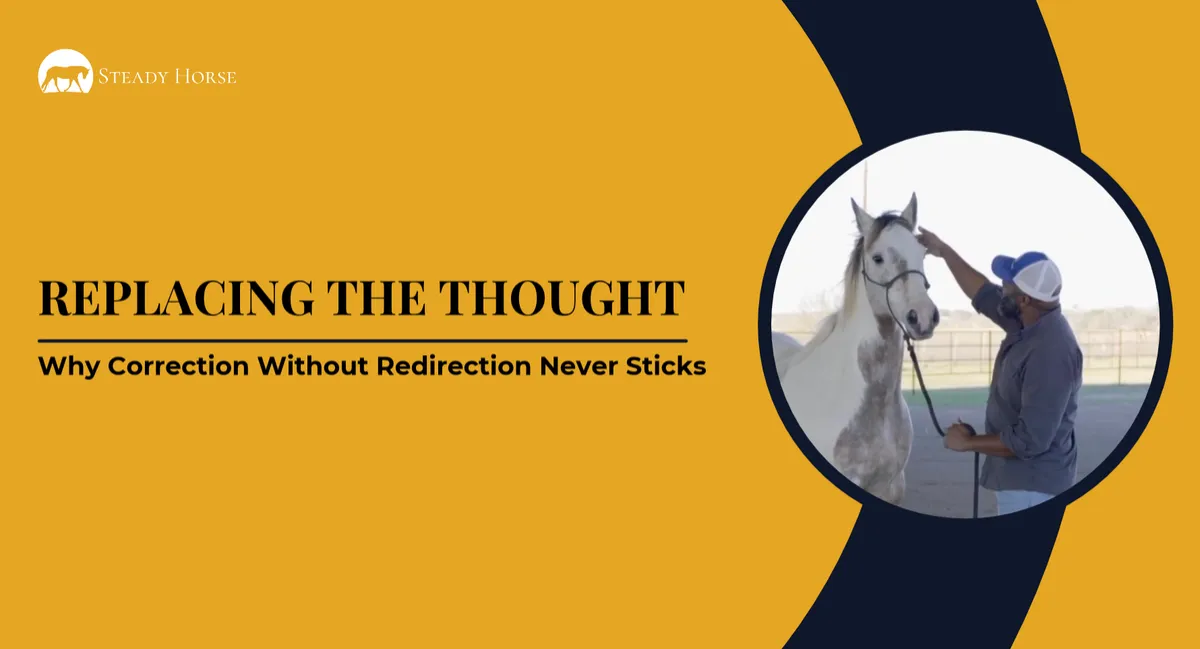
Replacing the Thought
If all you do is say “no,” your horse has nowhere to go but back to the same mistake.
Every horse person has been there. Your horse does something you don’t want. Maybe they crowd your space. Maybe they reach over and nip at your arm. Maybe they swing their head into you while you’re trying to saddle up. And your response? “No. Stop. Quit.”
You push them off. You swat at them. You raise your voice. And for a second, it works. They stop. They pause. They look at you like they understood.
Then thirty seconds later, they do the exact same thing.
And you correct them again. And again. And again. Until eventually you’re exhausted, your horse is confused, and neither one of you feels any better about the situation than when you started.
Here’s the problem. You told your horse what not to do. But you never told them what to do instead.
That’s the gap most people never close. And it’s the reason correction alone never sticks.
The “No” Problem
Let’s think about this from your horse’s perspective for a second.
Your horse is standing tied to the hitching post. They’re a little anxious. Maybe they’re bored. Maybe they’re not sure what’s coming next. So they do what comes naturally. They start messing with the lead rope. Chewing on the snap. Lipping at the buckle. Maybe they turn their head and start nibbling on your jacket.
You say, “No,” and push their face away.
Now what? From your horse’s point of view, they were doing something that made them feel better. Chewing and mouthing is how a lot of horses self-soothe. It’s their version of biting your nails or tapping your foot. It’s not aggression (at least not yet). It’s a nervous habit that helps them regulate.
You just took that away. But you didn’t give them anything to replace it with.
So their brain does the only thing it knows how to do. It goes right back to the behavior that was working before you interrupted it. Because at least that behavior served a purpose. Standing still and doing nothing? That doesn’t serve any purpose their brain can identify.
This is why correction without redirection is like pulling weeds without planting anything in their place. The soil is still there. The conditions are still right. Something is going to grow. The only question is whether you’re going to choose what grows or let the weeds come back on their own.
What Redirection Actually Looks Like
Redirection means giving your horse a job to do in the exact moment you’re taking away the behavior you don’t want. Not after. Not later. Right then.
I was working with a pony recently who was about as mouthy as they come. This little guy could not keep his mouth off of anything. The lead rope, the stick, the flag, the buckle on his halter. If it was within reach, he was chewing on it. And it wasn’t because he was mean or aggressive. He was a sweet pony. Loved people. Loved attention. But he’d been allowed to mouth on things his entire life, and now it was a deeply ingrained habit that was one small step away from becoming a real biting problem.
Every time he went for something with his mouth, I didn’t just correct him. I replaced the thought.
He reaches for the lead rope? I back him up. Now his brain isn’t thinking about the rope anymore. It’s thinking about the pressure on his halter and where his feet need to go.
He leans forward to chew on the stick? I move his front end away from me. Now he’s thinking about repositioning his body, not about what’s in front of his face.
He yo-yos back into my space after I’ve backed him up? I back him up again and then ask him to come forward on my terms. Now he’s thinking about the draw, about connecting with me, about waiting for permission to move.
Every single correction became a conversation. Not just “no.” It was “no, and here’s what I want you to do instead.”
That’s the difference. And it changes everything about how fast your horse learns.
Why the Replacement Matters More Than the Correction
Here’s something I want you to sit with for a minute, because it’s one of the most misunderstood things in horsemanship.
The correction is not what teaches your horse. The replacement is.
When you back your horse up because they were being mouthy, backing up is where the learning happens. When you move their front end because they were crowding you, moving the front end is where the learning happens. The correction (the initial “no”) just opens the door. The redirection (the new task) is what walks through it.
Think about it this way. If you correct your horse and then just stand there, what have they learned? They learned that doing the thing gets a reaction from you. That’s it. Some horses will actually start doing the unwanted behavior more because the reaction itself becomes stimulating. It’s something happening. It’s engagement. Even negative engagement is still engagement to a bored or anxious horse.
But if you correct your horse and immediately channel that energy into a task, now they’ve learned something useful. They’ve learned that when they make a certain choice, the result is work. Not punishment. Work. Productive, directed, purposeful movement that gives their brain something to do besides loop back to the old habit.
Over time, something really interesting happens. Your horse starts skipping the unwanted behavior altogether. Not because they’re afraid of the correction, but because the replacement behavior has become their default. Backing up when they feel anxious starts to feel more natural than chewing on the rope. Looking to you for direction starts to feel more natural than leaning into your space.
You didn’t train the bad behavior out. You trained something better in.
The Self-Soothing Trap
This brings up something that I think a lot of people miss, and it’s worth spending some time on.
A lot of the behaviors we want to correct in our horses are self-soothing behaviors. Mouthiness. Pawing. Weaving. Head tossing. Fidgeting. These aren’t random acts of defiance. They’re coping mechanisms. Your horse developed them because at some point, those behaviors helped them manage stress or boredom or uncertainty.
When you take away a self-soothing behavior without replacing it with something else, you’re essentially telling your horse, “Stop managing your anxiety.” But you’re not giving them a new way to manage it.
That’s why some horses get worse after repeated corrections. You’ve taken away their coping mechanism but given them nothing in return. So the anxiety builds. The frustration builds. And eventually, it comes out in a bigger, more dramatic way. The horse that was just mouthy starts biting. The horse that was just fidgety starts rearing. The horse that was just leaning into your space starts running you over.
The correction didn’t cause the escalation, but the lack of redirection did.
When you replace a self-soothing behavior with a productive task, you’re giving your horse a new way to cope. You’re saying, “I see that you’re anxious. I’m not going to let you chew on the rope, but I am going to give you something to do with that energy. Back up. Move your feet. Think about this new task. Let me guide you through it.”
The task itself becomes the new self-soothing mechanism. And because it’s a task that involves connecting with you, following your direction, and finding release through effort, it’s a healthier, safer, more productive way for your horse to manage their emotional state.
How to Build This Into Your Daily Work
This isn’t a technique you pull out when your horse is being difficult. This is a philosophy that should run through everything you do with your horse, every single session.
Always have a “next ask” ready. Before you even start working with your horse, know what your redirection tools are. For most situations, backing up is your go-to. It’s simple, it’s clear, and it moves your horse’s feet and brain in a productive direction. But you should also be comfortable moving the front end, moving the hind end, and sending. These are your replacement behaviors. The more fluent you are with them, the faster you can redirect in the moment.
Correct and redirect in one motion. Don’t correct, pause, and then redirect. The pause is where your horse’s brain goes right back to the old behavior. Make the correction and the new task feel like one continuous thing. Your horse reaches for the rope, and before they even get their mouth on it, you’re already walking them backwards. It’s not two separate events. It’s one flowing response.
Match the energy of the redirection to the energy of the behavior. If your horse gently leans forward, a calm backup is appropriate. If your horse aggressively lunges at you with their mouth, a sharp, decisive backup with some real energy behind it is appropriate. You’re not punishing them. You’re matching their intensity so that the redirection is meaningful enough to actually interrupt the thought pattern.
Don’t skip the release. This is where a lot of people go wrong. They get so focused on correcting and redirecting that they forget the most important part: releasing when the horse gives them the right answer. If you back your horse up and they stand there on their haunches, breathing, waiting, that is the moment you take all the pressure away. That is the moment you let them know they found the right answer. Without the release, the redirection just becomes more pressure on top of pressure, and your horse learns nothing except that pressure never ends.
Be relentlessly consistent. The hardest part of this approach is that it requires you to be paying attention all the time. Every single time your horse defaults to the unwanted behavior, you redirect. Not most of the time. Every time. That can be exhausting, especially with a horse who has a deeply ingrained habit. But consistency is what rewires the pattern. Every time you catch it and replace it, you’re weakening the old habit and strengthening the new one. Skip it once, and you’ve just told your horse that sometimes the old behavior still works.
Train the Horse You Have
One more thing, and this is important.
The way you redirect has to match the horse standing in front of you. Not the horse in the YouTube video. Not the horse your trainer talked about. Your horse.
If you have a horse that’s reactive and scared, your corrections are going to be softer and your redirections are going to lean toward drawing them in, building connection, encouraging curiosity. You’re not going to aggressively back up a horse that’s already terrified. That would just add more fear to an already overwhelmed brain.
But if you have a horse that’s brave, pushy, and entitled (and a lot of mouthy horses fall into this category), your corrections can carry more weight because that horse isn’t operating out of fear. They’re operating out of habit and entitlement. They need clear, firm boundaries, and they need to be redirected into tasks that remind them you’re the one giving direction, not them.
The principle is the same either way: never correct without redirecting. But the application changes based on what your horse actually needs from you in that moment.
This is why horsemanship is an art, not a formula. You can learn the tools. You can memorize the steps. But knowing when to apply which tool, how much pressure to use, and when to release? That comes from paying attention. From being present. From knowing your horse well enough to read what they’re telling you and respond with something better than just “no.”
What You’re Really Building
When you commit to replacing the thought instead of just correcting the behavior, you’re doing something much bigger than fixing a bad habit.
You’re teaching your horse that you always have a plan. That when things go sideways, you don’t just react. You redirect. You guide. You give them somewhere to go and something to do that makes sense.
And that’s what builds trust. Not the absence of correction. Not the absence of boundaries. The presence of guidance. The consistency of always having an answer. The reliability of being the person who never just says “no” and walks away, but says “no, and here’s what we’re going to do instead.”
Your horse doesn’t need you to be perfect. They need you to be clear. They need you to be consistent. And they need you to always, always give them something better than the thing you just took away.
That’s how habits change. That’s how connection deepens. That’s how you build a horse who doesn’t just stop doing the wrong thing but starts choosing the right thing on their own.
If you’re ready to start building that kind of clarity and connection with your horse, I’ve put together a free training that shows you exactly where to begin. It’s available for a limited time and focuses on the safety and confidence that come from doing this work with intention.
