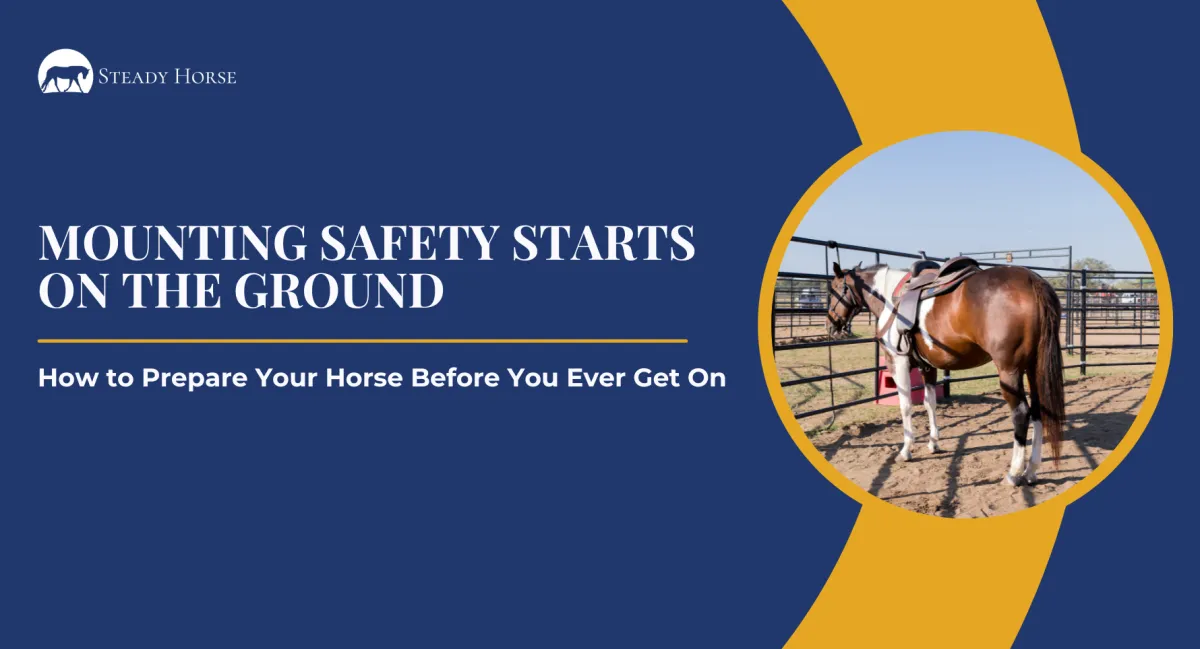
Mounting Safety Starts on the Ground
There is a statistic that surprises a lot of people. A large number of riding accidents do not happen on the trail. They do not happen in the arena. They do not happen at a lope or during a spook or on a steep hillside. They happen when people are simply getting on their horse. Just the act of mounting — something most riders do without a second thought — is one of the most common moments for things to go wrong.
And it makes sense when you think about it. You are asking your horse to stand perfectly still while you shift their balance, swing your body over top of them, and settle into the saddle. If your horse is not prepared for that, if they have not been trained to be comfortable with everything that mounting involves, that moment becomes unpredictable. And unpredictable is where people get hurt.
The good news is that mounting safety is not about luck or having the right horse. It is something you build. It is something you train. And it starts long before you ever put a foot in the stirrup. It starts on the ground.
Desensitize Them to What Mounting Actually Feels Like
Before your horse can be comfortable with you getting on, they need to be comfortable with everything that comes with you getting on. And there is more to it than most people realize.
Think about what mounting looks like from your horse's perspective. Someone is standing beside them, reaching up and over their body, swinging a leg across their back, shifting weight onto one side, and then settling down on top of them. There are bumps, there are noises, there is movement coming from above and from both sides. Stirrups clank. Boots occasionally make contact where they should not. Saddles shift. Balance gets disrupted.
If your horse has not been desensitized to all of that, you are asking them to hold it together through a situation that feels chaotic and unpredictable to them. And for a prey animal whose survival instincts are wired to react first and think later, that is a big ask.
This is why overhead desensitizing matters so much. Your horse needs to be comfortable with things moving above them, around their head, over their back, and along their sides. The flag is one of the best tools for this. You are moving it over their head, along their body, across their back — getting them used to that sensation of something coming from above and from all directions.
If you do not have a flag, you can make one easily. A training stick with a plastic bag tied to the end works just fine. The important thing is the process, not the equipment.
A few key principles to keep in mind with any desensitizing:
Always start gradual. Do not go from zero to full-blown flag waving in one session. Start with basic desensitizing with your steady stick first. Build up to the flag work over time.
Float with them if they move away. This is critical. If your horse tries to escape the pressure by moving away, do not stop. Stay with them. Keep the pressure consistent until you see them soften. If you stop when they move away, you are teaching them that moving away makes the pressure disappear, and that is the opposite of what you want.
Release at the right moment. The instant you see a sign of softening — a deep breath, a lowering of the head, a relaxation in the eye — that is when you release all pressure, lower the flag completely, and let them rest. Then go back to it.
Keep a hand up near their head. Some horses will swing their head toward you as a reaction. Having your hand positioned near their head gives you the ability to redirect them if they push into your space.
Beyond the flag, there are other creative ways to prepare your horse for the physical reality of mounting. You can use your steady stick to tap and poke on them gently, mimicking the accidental bumps that happen when you are getting on. Pool noodles work great for rubbing all over their body. Some people build a simple tool out of two short pieces of PVC pipe connected by a rope that you drape over the horse like a dummy leg, simulating the sensation of a leg swinging over their back. The beauty of that tool is you can remove it quickly if your horse overreacts.
The bottom line is this: you want to go above and beyond what you think your horse might need. You never can do too much desensitizing, no matter how old or how seasoned your horse is. It is not a one-and-done exercise. It is something you maintain throughout the life of your partnership.
Get Them Comfortable With the Mounting Block Itself
Here is something that gets overlooked more often than you would expect. Your horse needs to be desensitized to the mounting block itself, not just the act of mounting. The block is an object in their environment, and some horses are uneasy about standing next to it, especially if they associate it with the pressure and commotion of someone climbing on.
And here is the bigger picture. At some point in your riding life, you are going to need to mount from something other than your usual mounting block. Maybe you are out on a trail and you get off to check your horse's hoof or take a break. Now you need to get back on, and your mounting block is sitting back at the barn. You are looking around for a rock, a tree stump, a log — whatever you can find.
Your horse needs to be okay with that. They need to be comfortable with you mounting from different heights, different surfaces, and different positions. But that comfort starts with being solid at the mounting block first. Do not skip ahead to trail-side improvisation until your horse is calm, connected, and standing still at the block every single time.
The best tool for building that comfort is direction and magnet training. If you are not familiar with it, here is how it works applied to the mounting block:
If your horse is antsy, nervous, or will not stand still at the block, you do not fight them into position. Instead, you put them to work. Send them around the mounting block. Give them direction — move their feet, get their heart rate up, make them work. You are not being harsh. You are simply establishing a clear equation: if you will not stand still, your feet are going to move, and I am the one who decides how, when, and where they move.
As you are sending them around, watch for the subtle signs of softening. They might lower their head slightly. They might incline an ear toward the block. They might slow down as they pass near it. When you see those signs, stop. Lower your energy completely. Take a deep breath. See if you can guide them one step closer to the block.
If they take that step, let them rest. Even if it is just for a few seconds. Then put them back to work. Repeat the process. What you are building in your horse's mind is a clear understanding:
At the mounting block = rest. This is where I get to stand still, breathe, and relax.
Away from the mounting block = work. This is where my feet have to move and I have to put in effort.
Over time, the mounting block becomes a magnet. Your horse does not just tolerate standing there — they want to be there. They choose it because you have made it the most comfortable place to be. That is the power of magnet training, and it works for so much more than just the mounting block. Trailers, hitching posts, anywhere you need your horse to stand quietly — the same principle applies.
Flexing: Your Safety Net in the Saddle
Before you mount, your horse needs to flex well. And they need to be able to hold that flex. This is one of the most important safety tools you have, and it does not get the attention it deserves.
There are three levels of softening to understand:
The tip — Very subtle. Just barely tipping the nose when you apply pressure with the lead rope or rein. This is where every exercise begins.
The bend — A moderate turn, roughly a 45-degree angle of the head and neck.
The flex — A full turn where the horse brings their head all the way around toward their barrel and hip.
For mounting safety, the tip is your best friend. When you are getting ready to mount, you want that nose tipped slightly toward you. Here is why: if your horse moves while you are getting on, having their nose tipped in your direction means they are going to move toward you, not away from you. You know where they are going. You have predictability, and predictability is safety.
But your horse also needs to be able to flex in motion. This means holding a flex while their feet are moving. Why does this matter for mounting? Because sometimes things do not go perfectly. Maybe you bump them off balance as you are getting on. Maybe the ground is uneven and their weight shifts. Maybe they take a step. You need to know that you can hold that flex and maintain control even when their feet are not still.
And here is something a lot of riders do not think about. Once you are in the saddle, do not just walk off. Your horse should stand still until you specifically ask them to move forward. Use that time to do flexing exercises in the saddle. Check their softness. Check their connection with you. Some horsemen will flex their horse twenty times on each side before they ever ask for forward. You may not need to go that far, but the principle is sound — make sure your horse is soft and connected before you go anywhere.
The Hang-On Exercise
There is a simple exercise that bridges the gap between ground work and actually mounting, and it is called the hang-on exercise. It is one of the best tools for teaching your horse to relax with your weight on them before you ever fully mount.
Here is what it looks like. Start by tipping their nose in toward you. Then hug your knee against their side and lean your body over them. You are not mounting. You are not putting a foot in the stirrup. You are just draping your weight across their back and hanging there.
If your horse moves, that is okay. Just stay with them. Hang on until they stop. Most horses will stop moving fairly quickly. When they do, slide off. That slide is the release of pressure. You are teaching them that standing still with weight on their back leads to relief.
This exercise is safe because your foot is never in the stirrup. If things go sideways, you simply slide off. There is nothing to get caught on, nothing to get hung up in. You can do it from the ground or from the mounting block, and it gives your horse the chance to process the sensation of weight and movement on their back without the full commitment of a mounted rider.
Over time, your horse learns that this is not something to worry about. They relax into it. They stop seeing weight on their back as a threat and start seeing it as just another normal part of their relationship with you.
Forward Is Never an Option Unless You Say So
There is a hard rule in this kind of training, and it applies directly to mounting: your horse should never go forward unless you specifically ask them to. Never.
This is about more than just mounting safety. It is about the overall relationship and the expectation you establish with your horse. When your horse understands that forward is not their decision, you eliminate one of the most common and most dangerous scenarios in riding — a horse that walks off while you are getting on, while you are adjusting your tack, while you are settling into the saddle.
We have all seen it or lived it. You are halfway on, one foot in the stirrup, doing the saddle scramble, and your horse starts walking off. It is the kind of thing people used to laugh about, but there is nothing funny about it. It is dangerous. And it is completely preventable.
If your horse walks off during mounting, the answer is not to scramble faster. The answer is to go back to the ground work and establish that forward only happens when you ask for it. When they go forward without permission, you apply pressure and back them up. You are not punishing them. You are giving them clarity: that was not the right answer. The right answer is to stand still and wait.
Over time, your horse learns the expectation. Standing still becomes the default, not something you have to fight for every time you get on. And that changes everything about how mounting feels — for both of you.
It Is Okay to Ask for Help
Here is something that needs to be said, and it needs to be said clearly. If your horse is still moving and you do not feel safe getting on, it is okay to have someone hold your horse for you.
There is an old-school mentality that says you should be able to handle everything on your own, that needing help is a sign of weakness or incompetence. That mentality has gotten people hurt. There is no shame in having someone steady your horse while you mount. Safety always comes first. Always.
Having said that, the goal is still to train your horse to the point where they stand quietly and willingly on their own. Having someone hold your horse is a bridge, not a destination. You are still working toward that calm, connected, standing-still horse. But while you are getting there, do not risk your safety to prove a point.
Never Mount a Horse That Is Not Relaxed
If there is one rule that ties all of this together, it is this: never attempt to mount a horse that is not relaxed. Not antsy. Not distracted. Not anxious. Relaxed.
If your horse is not there yet, go back to the ground work. Do your desensitizing. Do your sending. Do your connection checks. Get them soft and connected with you first. If that means you do not ride that day, then you do not ride that day. And that is not a failure. That is good horsemanship.
It takes courage to make that call. It takes maturity to say, "We are not ready today, and that is okay." But your safety is worth more than any ride, and your horse's trust in you is worth more than checking a box on your training plan.
Mounting safety is not a single skill. It is the result of everything you have built with your horse on the ground — the desensitizing, the connection, the softness, the understanding that you are their leader and they can trust you through anything. When all of that is in place, getting on your horse stops being a moment of uncertainty and starts being a natural extension of the partnership you have already built.
And that is when riding really begins.
If you want to build this kind of safety and connection with your horse, there is a free training available right now that can help you get started. It walks you through the foundation of building trust, confidence, and real partnership with your horse — and it will not be available forever. Head over to https://steadyhorse.com and check it out while you can.
