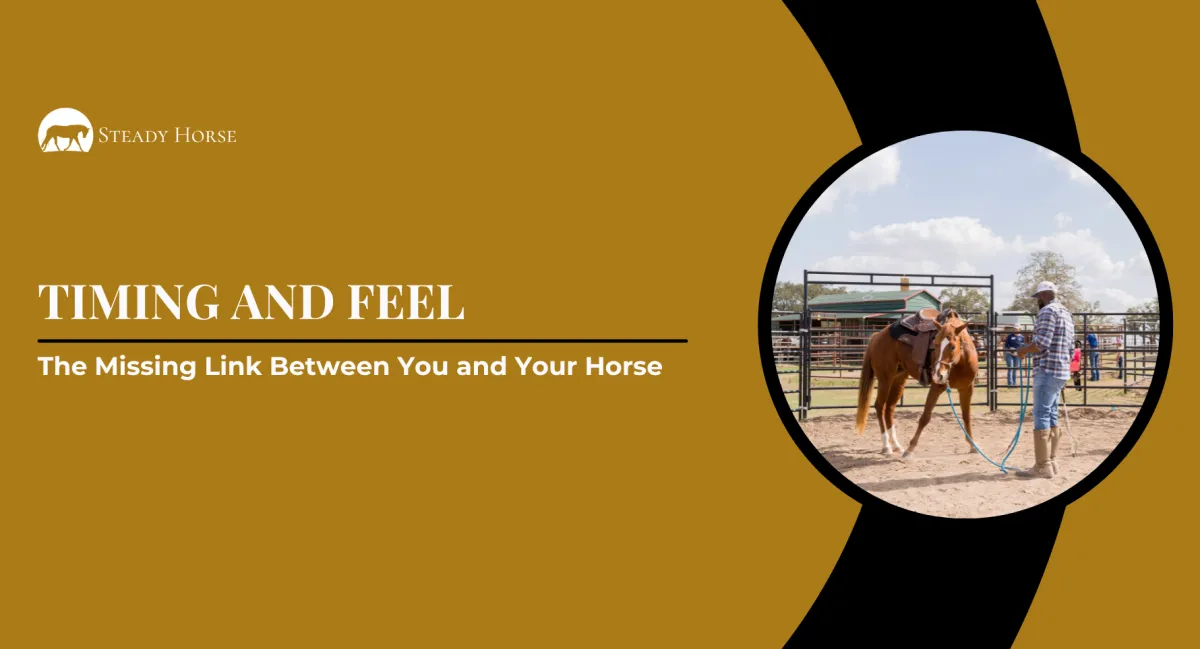
The Missing Link Between You and Your Horse
If you’ve been around horses for any amount of time, you’ve heard those two words thrown around like everybody automatically knows what they mean:
“You just need better timing.”
“You’ve got to develop feel.”
And listen—those aren’t wrong. But they’re also not that helpful unless we break them down into something you can actually do the next time you’re standing in the round pen, sitting in the saddle, or holding a lead rope wondering why your horse is either dull… or blowing up.
So today I want to put timing and feel into plain language.
Not the fancy kind. Not the vague kind.
The kind you can apply.
Because when you start to understand timing and feel, what happens is you stop feeling like you’re constantly “behind” your horse… and you start feeling like you’re actually with your horse.
And that’s where trust gets built. That’s where confidence shows up. That’s where safety lives.
The real goal
The goal isn’t to become some magical horse whisperer.
The goal is to become so attentive—so present—that you start responding to what your horse is thinking, not just what your horse is doing.
That’s the shift.
What Timing Actually Is
Let’s keep this simple.
Timing is when you release or add pressure. That’s it.
When you pick up a rein… that’s timing.
When you bump with your leg… that’s timing.
When you soften your hand… that’s timing.
When you stop wiggling the rope… that’s timing.
Timing is the act.
It’s the moment you say: “Yes.”
Or: “No, not that—try again.”
Timing is the “yes/no” language your horse understands.
What Feel Actually Is
Now here’s where people get tripped up.
Feel is knowing when to release or add pressure.
Feel is the decision before the act.
Timing is the “release.”
Feel is knowing the right moment to release.
And here’s the good news:
Feel isn’t something you’re born with. It’s something you develop.
Feel comes from one thing:
Feel comes from attentiveness.
Not talent.
Not luck.
Not your “natural horsey instincts.”
Attentiveness.
The more attentive you are, the more you can tell what your horse is thinking. The more you can tell what they’re thinking, the better your feel gets. And the better your feel gets, the better your timing gets.
So if you want better timing, don’t chase timing.
Chase attentiveness.
Why Horses Are Better at This Than We Are
Horses communicate with each other constantly—but most of it isn’t vocal.
It’s energy. Intention. Patterns. Movement. Awareness.
Sometimes they don’t even have to visibly see something to feel it.
And we can learn that too.
But most riders don’t get taught that.
Most riders get taught to correct what already happened:
Horse slows down → “Kick him!”
Horse walks off at the mounting block → “Pull his head!”
Horse spooks → “Whoa!”
Horse drifts to the gate → “Get over!”
That’s reactive.
And reactive training creates horses that feel like they’re constantly being micromanaged, constantly getting “in trouble,” constantly confused.
What horses really love is direction.
They love knowing you’ve got a plan.
Because a horse that believes you have a plan is:
more confident,
more relaxed,
and more trusting.
That’s equestrian confidence building at the deepest level.
The Three Things That Build Feel Fast
There are a hundred things you can pay attention to, but if you want a simple framework, here are the three things I want you watching:
1) Body language
Your horse’s body will tell you what their mind is about to do.
Examples:
Thinking forward? They’ll often shift weight forward before stepping.
Thinking about leaving? Their shoulder might start to “leak” away.
Thinking about bracing? Their neck and jaw get tight before the whole body does.
When you learn to read body language, you stop waiting for the problem to show up.
You see it coming.
That’s feel.
2) Patterns and habits
Horses are pattern machines.
If you’re doing a sending exercise and every time you approach the gate your horse slows down—guess what?
They’re not “randomly” slowing down. They’ve developed a pattern.
And patterns give you power, because you can prepare before it happens.
Patterns might look like:
slowing at the gate,
getting sticky near the barn,
anticipating the stop at a certain spot,
getting buddy sour around other horses,
leaning on one rein consistently.
This is a huge part of horse behavior training and equine behavior modification—because you’re not just reacting to behavior, you’re understanding what produces it.
3) Changes in energy and tempo
This one is massive, especially under saddle.
Your horse rarely just breaks gait out of nowhere.
If they’re cantering and about to drop to trot, you’ll often feel:
the energy decrease,
the rhythm change,
the effort fade.
That change happens before the gait break.
And that little moment is where feel lives.
That’s where you either:
add clarity and direction,
or release and reward.
The Biggest Timing Mistake Riders Make
Most riders time their release based on what their horse did.
But the best timing is paired with what your horse is thinking.
Let’s look at the difference:
Reactive timing
Horse finally backs up → you release.
Horse finally moves over → you release.
Horse finally stops → you release.
That’s not “bad,” but it’s usually late.
Proactive timing
Horse thinks about backing up → you soften.
Horse tries to move over → you release.
Horse shifts toward softness → you reward.
This is how you build a horse that feels understood.
And that’s how you build a horse that starts offering the right answer faster and faster—because your release is teaching them what the answer is.
This is the foundation of:
groundwork exercises for horses
safe horse handling practices
and truly building trust with horses
The Attentiveness Loop: How Trust Gets Built
Here’s what happens when you start pairing timing with your horse’s thoughts:
You notice what your horse is thinking (body language / patterns / energy).
You release or add pressure at the right moment.
Your horse feels understood and guided.
They relax.
They trust you more.
They look to you sooner the next time.
That’s the loop.
That’s equine partnership development.
And it’s what creates that “unbreakable bond with horse” that everybody wants—but few people know how to build on purpose.
“What If I Get It Wrong?”
Let me say this as plainly as I can:
If you get your timing and feel wrong, it’s not the end of the world.
Horses are unbelievably forgiving.
If you’re early, late, sloppy, unsure—don’t beat yourself up.
Just make a mental note:
“I should have released sooner.”
“I should have asked before we got to the gate.”
“I should have redirected when I felt the energy change.”
And then try again.
What you don’t want to do is quit.
The worst thing you can do is stop because you didn’t do it perfectly.
Timing and feel are built through repetition and intentionality.
So keep rolling.
Practical Ways to Train Feel (Without Overcomplicating It)
Let’s get real practical. If you want to develop feel, here are a few places to start that work immediately.
1) Practice “micro releases” on the ground
Next time you’re doing groundwork, look for tiny moments of try.
Examples:
Your horse shifts weight where you wanted → release.
Your horse softens their face → release.
Your horse even thinks about stepping over → release.
This is how you build a responsive horse without escalating pressure.
It’s also how you build confidence for riders who are working through overcoming fear of riding—because you’re learning to create control through softness, not force.
2) Use exercises that make timing obvious
Some exercises naturally sharpen timing and feel because they give you clear feedback.
A few of my favorites:
Moving the front end
Moving the hind end
Backing up with softness
Sending (because it shows patterns, energy changes, and attentiveness fast)
Ground driving (because it forces you to get real precise)
Ground driving especially will expose your timing.
You’ll learn quickly:
when to push,
when to soften,
when you’re too heavy,
when you’re late,
when your horse is getting “choked up.”
That’s why it’s such an underrated tool in horse training video courses and horse training courses—because it makes the invisible visible.
3) Stop rewarding the drama—reward the decision
A lot of horses learn that big reactions get big attention.
What we want is a horse that learns:
calm decisions get rewarded,
trying gets relief,
looking to you gets peace.
That’s what creates a safer ride.
That’s building rider confidence from the inside out.
Timing and Feel Under Saddle: Where Riders Get Scared
A lot of riders can grasp timing and feel on the ground… but under saddle it gets emotional.
Because now the stakes feel higher.
So here are a few simple principles to keep you steady:
Keep your horse directed
When horses get scared, their instinct is to handle it themselves.
That usually looks like:
bolting,
spinning,
rushing,
leaving,
bracing,
or shutting down.
Your job is to give them direction.
Not punishment. Not panic.
Direction.
When your horse feels you directing their feet, it gives them certainty.
And certainty is calming.
Reward softness, not just stopping
Stopping isn’t always relaxation.
A horse can be stopped and still mentally gone.
Look for softness:
lowering the head,
licking and chewing,
breathing,
releasing tension in the neck and jaw.
That’s what you want to reward.
Action Steps: Build Better Timing and Feel This Week
If you want a simple plan, here it is. Don’t overthink it.
Step 1: Pick one session to focus on attentiveness
Before you ask for anything big, spend 5 minutes watching:
body language,
patterns,
energy changes.
No judgment. Just noticing.
Step 2: Choose one exercise and focus on release timing
Pick something simple:
moving the hind end,
moving the front end,
backing,
flexing.
And focus on one thing: release faster when they try.
Step 3: Practice proactive timing once
If you know your horse slows near the gate…
Don’t wait until they slow.
Ask for energy and direction before you get there.
Then release when they stay with you.
That one change alone will make you feel like a different rider.
Step 4: End with a confidence builder
End the session with something your horse can win at.
That might be:
standing quietly,
flexing softly,
a calm send,
a simple obstacle.
Confidence is built through repeated wins.
The Payoff: Why Timing and Feel Make You Safer
If you’re a fearful rider—or even just a cautious rider—timing and feel matter because they reduce surprise.
Surprise is what creates fear in the saddle.
When you get better at reading your horse, you prevent a lot of the “out of nowhere” moments.
And when you’re not constantly getting caught off guard, your confidence grows.
That’s not hype.
That’s skill.
That’s why this stuff matters in horse training for fearful riders and every equestrian safety course worth its salt.
Because the safest rider isn’t the toughest rider.
It’s the most attentive rider.
Closing Thought: Your Horse Wants You to Lead
Your horse isn’t looking for perfection.
They’re looking for leadership.
They want to know:
you’re paying attention,
you have a plan,
and you’ll guide them through pressure instead of abandoning them to figure it out alone.
That’s what timing and feel really create.
Not “better riding.”
A better relationship.
A calmer horse.
A safer ride.
And a partnership that feels like you’re finally speaking the same language.
You don’t have to live with fear in the saddle.
Learn the simple, proven process to build confidence and stay safe with your horse—starting today.
👉 Watch the Free Training (https://steadyhorse.com)
