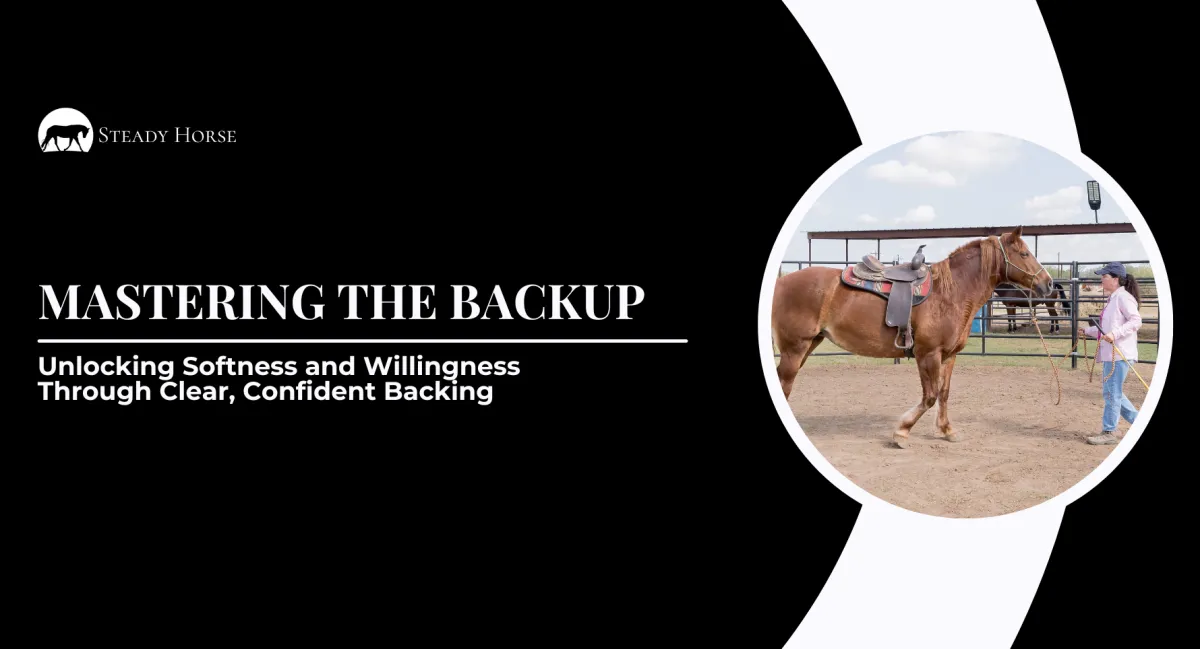
Mastering the Backup
If there’s one exercise most riders quietly skip, rush through, or underestimate, it’s the backup. Not because they don’t believe it matters, but because it doesn’t feel exciting. It’s not glamorous like riding down the trail, teaching a new maneuver, or working through obstacles. And honestly? Most horses don’t exactly love backing up either. It’s not natural for them, and it certainly doesn’t feel as instinctive as moving forward.
But here’s the truth I’ve seen again and again—
and I know some of you have heard me say it quite a bit:
The backup is the foundation for almost everything we want from our horse.
Softness.
Willingness.
Respect.
Connection.
Safety.
Leadership.
It all comes back to how well your horse can, and will, back up for you.
And if you’re struggling with a horse who:
pushes into your space
rushes forward
gets distracted
takes over mentally
feels braced
ignores your cues
gets dull over time
or anticipates before you even ask
…then this simple, often-overlooked exercise is likely the missing link.
Today, we’re going to slow down and unpack that together—with warmth, clarity, and lots of reassurance. Because teaching the backup the right way isn’t just about mechanics.
It’s about retraining your horse’s instincts, reshaping the conversation between you, and creating a partnership built on trust rather than tension.
Let’s dig in.
Why Riders Skip the Backup—And Why That Causes Problems Later
Most riders would never say this out loud, but I’ll just go ahead and name it:
The backup doesn’t feel fun.
It’s basic.
It’s repetitive.
And it forces us to pay attention to pressure, timing, energy, and clarity—which can feel like a lot.
That’s why so many people breeze past it on their way to “the good stuff.”
But here’s the challenge with that:
When the foundation is weak, everything else gets shaky.
If your horse:
moves forward when unsure
ignores pressure
doesn’t connect the release to the try
drifts into your bubble
gets anxious
or hesitates to respond
…it almost always goes back to the backup.
A horse that backs softly and willingly is a horse that:
respects the bubble
thinks before reacting
tunes in to your body language
waits for your leadership
stays mentally connected
And when needed, they will stop thinking forward and reconnect to you instead.
That’s why I often say:
Forward is never the answer—connection is.
And the backup is how we create that connection.
Forward Thinking Is Natural. Backing Up Is Not.
This part is so important to understand:
In nature, horses survive by moving forward.
If something scary jumps out behind them, they run.
If they’re unsure, they run.
If pressure shows up—physical, emotional, or mental—they run.
It’s God-given survival instinct.
So when we ask a horse to back up, we’re essentially saying:
“I know your instincts tell you forward is safer,
but I need you to trust me enough to move the opposite way.”
That’s big.
That’s vulnerable.
That’s leadership.
And when your horse chooses to back up for you, they’re choosing trust over instinct.
This is why we reward even the tiniest try.
This is why timing matters.
This is why clarity matters.
This is why softness in the backup leads to softness everywhere else.
The #1 Reason Horses Don’t Back Up Well: Not Enough Clarity
Let’s talk about something I see constantly:
Most riders use too little pressure.
Not because they’re lazy.
Not because they’re scared.
But because they don’t want to feel harsh.
And I get that.
Many of us were taught that “soft” equals “light” and “gentle.”
But light isn’t always clear.
Clarity is what the horse understands.
A dull or lazy horse doesn’t need a whisper—they need a leader who speaks loudly enough the first time.
Here’s what happens when you don’t:
You wiggle the rope lightly… nothing.
You wiggle more… still nothing.
You wiggle more… they step forward or get annoyed.
Next time? They ignore you sooner.
Over time? They get dull to all your cues.
I call it death by a thousand paper cuts.
A tiny bit of pressure… repeated endlessly… with no clear meaning.
It’s irritating.
It’s confusing.
And it breaks connection instead of building it.
Adequate Pressure vs. Gradual Pressure
Now let’s clear this up, because it is the heart of the backup:
Gradual Pressure
You start at “1” and slowly build up:
1 → 2 → 3 → 4 → 5…
This works beautifully for sensitive horses who respond early.
Adequate Pressure
You start with the number you believe will work for that horse.
No ramping up.
No tiptoeing.
No half-hearted tries.
For a dull horse, that might be a 5 or 6 on the pressure scale right away.
For a sensitive horse, that might be a light 2.
It’s not harsh.
It’s not dominance.
It’s clarity.
And clarity is kindness.
Because once your horse understands what you’re asking…
you can lower the pressure.
You can soften.
You can refine.
But without clarity first, softness has nothing to stand on.
The Instant the Horse Tries—You Must Release
Your timing matters far more than your pressure.
Even if your horse:
shifts their weight backward
rocks onto the haunches
leans away from the cue
takes even half a step
You release.
Why?
Because the horse learns from the release, not the pressure.
The release says:
“Good decision. Thank you for staying with me. Let’s do that again.”
And the more your horse learns that backing up leads to comfort, the more willingly they’ll offer it.
The Five Ways to Ask for a Backup
Here’s one thing I love about this exercise:
It’s the only maneuver with FIVE separate ways to ask.
That’s how important it is.
You want your horse to back up:
when they’re close to you
when they’re far from you
when they’re distracted
in tight spaces
under pressure
in emergencies
during trailer loading
during groundwork
and under saddle
The more ways they know how to back up, the more automatic it becomes.
Here are the five methods:
1. Lead Rope Energy (Shaking the Rope)
You stand in front, create energy through the rope, and ask them to retreat from that pressure.
2. Clip Pressure Under the Chin
Used during leading or changes of direction—driving backward from a direct, upward cue.
3. Pressure on the Bridge of the Nose
A steady, clear feel until the horse shifts back, then release immediately.
4. Direct Pressure on the Chest
Two fingers against the chest. Light for sensitive horses; firmer for dull types.
5. Tapping the Chest or Forearm With the Steady Stick
Not punishment—clarity.
A rhythmic tap that says: “Move your feet backward.”
When your horse knows all five, you have a reliable pattern interrupt no matter the situation.
Forward is no longer the default.
Thinking is.
Connection is.
Leadership is.
When Horses Anticipate and Back Up Before You Ask
This comes up a lot.
If your horse starts backing before your cue, here’s what that means:
They are paying attention.
They are trying.
But they are thinking ahead of you.
It’s not wrong—it’s just a moment to clarify.
Here’s what to do:
✔️ Let them back up a few steps
✔️ Release
✔️ Pause
✔️ Then ask again, intentionally
You’re telling your horse:
“I see your thought. Thank you. Now here’s what I actually want.”
This keeps them engaged without letting them take over the conversation.
Speed: How Fast Should They Back Up?
The answer is actually simple:
Your horse’s speed should match your energy.
If you want slow and soft?
Stay calm, steady, and relaxed.
If you need them to back up quickly someday?
Practice putting more energy into your body language and pressure.
You are responsible for setting the tempo.
Your horse is responsible for mirroring it.
Action Steps: How to Build a Soft, Willing Backup That Transforms Your Horse
Let’s make this practical.
Here’s how to start improving your horse’s backup right away.
✔️ Step 1: Decide Before You Ask
Are you using gradual pressure or adequate pressure today?
Sensitive horse: gradual pressure
Dull/Lazy horse: adequate pressure
Choose before you lift a finger.
✔️ Step 2: Get Big Enough to Be Clear
Your first ask should be the one that works.
If your horse has ignored soft cues in the past…
don’t start soft.
Start clear.
This is leadership, not harshness.
✔️ Step 3: Match the Energy to the Speed You Want
Low energy → slow backup
High energy → fast backup
Practice both so your horse can read your body language.
✔️ Step 4: Release at the First Try
Timing is everything.
The moment your horse:
leans back
shifts weight
rocks the haunches
or steps back
Release and relax.
✔️ Step 5: Reward Big for Tries From Sensitive Horses
A sensitive or anxious horse is fighting instinct when they back up.
Love on them.
Pet them.
Let them breathe.
Show them they made a beautiful choice.
This builds trust faster than any exercise you’ll ever teach.
Why the Backup Creates an Unbreakable Bond
Once your horse learns to:
pause
think
yield
listen
and stay connected
…you’re no longer fighting instincts.
You’re partnering with them.
The backup becomes the thread that ties everything together:
leading
stopping
standing still
trailer loading
saddling
mounting
trail riding
confidence under pressure
softness in the bridle
and emotional regulation
When your horse can back willingly for you, you have unlocked their mind.
You’ve shifted them from reactive to responsive.
You’ve taught them that the safest place to be is with you.
And that, friend, is how you build an unbreakable bond.
