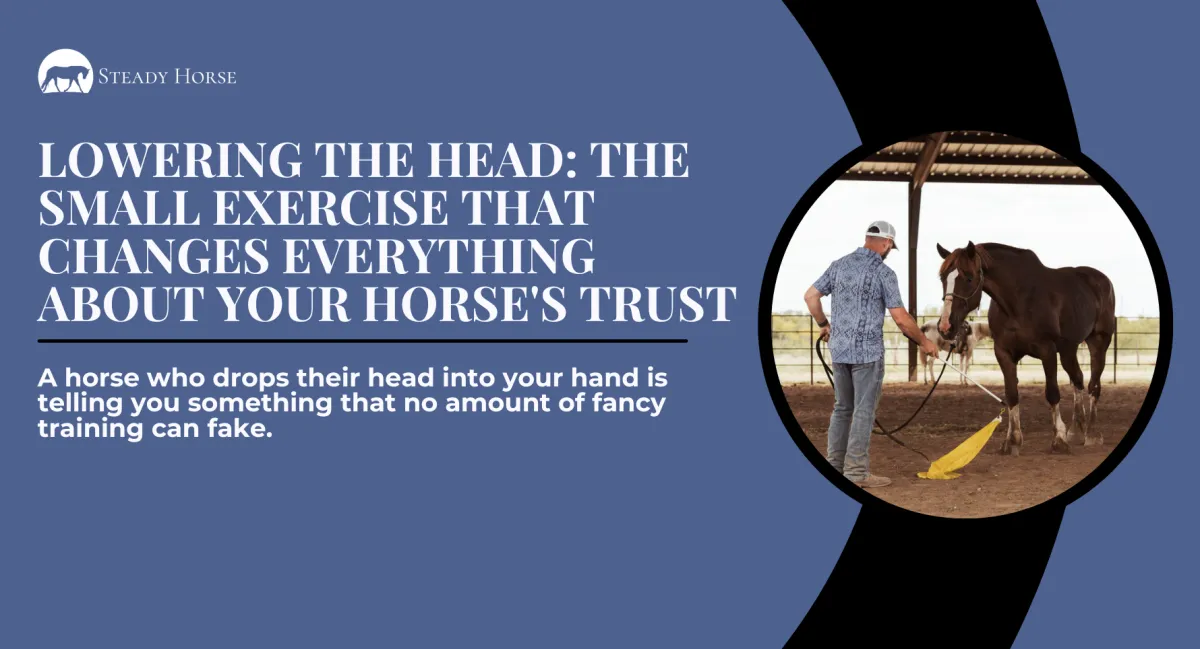
Lowering the Head: The Small Exercise That Changes Everything About Your Horse's Trust
If I had to pick one thing that tells me everything I need to know about where a horse is mentally, emotionally, and in their relationship with the person handling them, it wouldn't be a fancy maneuver. It wouldn't be a sliding stop or a perfect departure or a flawless side pass.
It would be whether that horse lowers their head when you ask.
That's it. One small, quiet, seemingly insignificant exercise. And yet it reveals more about your horse's trust, their confidence, and their connection with you than almost anything else you can do.
A horse who lowers their head into your hand is telling you they feel safe. A horse who braces against you, throws their head up, roots their nose away, or fights the pressure is telling you something very different. And until you address what that head position is really saying, everything else you build on top of it is sitting on a shaky foundation.
Why the Head Goes Up in the First Place
Before we talk about getting the head down, we need to understand why it goes up.
When a horse raises their head, they're in self-preservation mode. It's not stubbornness. It's not attitude. It's their nervous system doing exactly what it was designed to do.
A horse with their head up high can see more of their environment. They can scan for threats. They can identify escape routes. They can see the gate, the barn, the fence line, whatever they've mentally flagged as their exit strategy. The higher that head goes, the more of the world they're taking in, and the more prepared they are to flee.
Think about what that means from your horse's perspective. When you add pressure, whether it's a flag, a new environment, your hand reaching up toward their face, or even just the uncertainty of something unfamiliar, their head goes up because they feel threatened. They want to know what's coming. They want to have a plan. They want to be ready.
A high head is a horse on high alert. And a horse on high alert is not connected to you. They're connected to their surroundings. They're scanning, evaluating, preparing. Their brain is running survival calculations, not listening to what you're asking.
And here's the part most people miss. The higher the head goes, the more the rest of the body tenses up. The neck locks. The jaw braces. The back hollows. The hind end disengages. That horse is no longer in a position to respond softly to anything you ask. They're a coiled spring, and anything could set them off.
Lowering the head reverses all of that. It's not just a physical position. It's a neurological shift. When a horse drops their head, their parasympathetic nervous system starts to engage. Their breathing deepens. Their muscles release tension. Endorphins begin to flow. They literally start to feel better, calmer, more regulated.
That's why a low headset isn't something we manufacture or force. It's something we help our horse find. And when they find it, everything changes.
What a Lowered Head Really Tells You
A lot of people chase the low headset because it looks good. They want their horse's head down because they've seen well-trained horses carrying themselves that way and they want theirs to look the same.
But the headset isn't the goal. The headset is the indicator.
When your horse lowers their head voluntarily, without being cranked down, without being tied around, without being mechanically forced into position, they're telling you a handful of things that are all critically important.
"I feel safe." A horse who drops their head is a horse who feels secure enough to take their eyes off the horizon. They're no longer scanning for threats. They're no longer mapping escape routes. They trust that whatever's happening around them is manageable, and a big part of that trust comes from you.
"I understand what you're asking." Head-lowering is one of the last signs of true understanding to develop in any exercise. When you're teaching your horse to back up, for example, they might back up with a high, stiff head for weeks or even months before that head starts to come down. The lowering happens when the exercise becomes familiar, comfortable, and routine. It's a demonstration that your horse isn't just complying. They get it.
"I'm choosing to be with you." This is the big one. A horse who lowers their head into your hand is making a choice. They're saying, "I could brace against this pressure. I could throw my head up. I could fight. But I'm choosing to soften because I trust where this leads." That choice is the foundation of everything we're trying to build.
You cannot fake a voluntarily lowered head. You can force a horse's head down mechanically. You can exhaust them until they're too tired to hold it up. You can use draw reins or tie-downs or other equipment to hold it in place. But none of those things produce what a genuinely lowered head produces, which is a horse who is soft, connected, trusting, and regulated from the inside out.
How to Teach It (And Where Most People Go Wrong)
Teaching a horse to lower their head is one of the simplest exercises you'll ever do. It's also one of the most commonly botched.
Here's the basic concept. You apply light, steady, downward pressure, either from underneath the clip of the halter or over the poll, and you hold it until your horse gives. The moment they lower even slightly, you release the pressure completely. That's the conversation. Pressure says, "Lower your head." Release says, "That's exactly what I wanted."
Simple. But here's where people go wrong.
Mistake number one: recoiling when the head goes up. This is the big one. You reach up to apply pressure, your horse throws their head up, and your gut instinct is to pull your hand back. "Oh, I'm sorry. Too much pressure. I spooked you."
Don't do that. Ever.
When you recoil, you teach your horse that raising their head makes pressure go away. That's the opposite of what you want. If you reach up and your horse's head shoots up, your hand stays there. You hold. You wait. You're patient. And when that head comes down even an inch, you release.
Your hand going up should never be something your horse needs to escape from. Over time, your horse should learn that your hand reaching up is actually a good thing. It means rubs. It means scratches. It means softness and connection. But they can only learn that if you don't retreat every time they overreact.
Mistake number two: asking for too much too soon. If your horse's head is up at giraffe level, you don't need them to drop it to their knees on the first try. You need one inch. Maybe two. Wherever they are, if they give you even the slightest downward movement, that's your release point.
Think about levels, just like we do with every other exercise. Maybe today, you get your horse from "head in the clouds" to "head at normal standing height." Next session, maybe you get from normal standing height to slightly below that. You build incrementally. You reward progress, not perfection.
Mistake number three: not being specific about how they lower. This is something that gets overlooked a lot. Some horses will learn to lower their head, but they do it rudely. They root their nose down. They jerk against the pressure. They toss their head and then drop it to avoid you. They yank the lead rope out of your hand on the way down.
That's not softness. That's avoidance wearing a disguise. I want my horse to lower their head politely. Smoothly. Without attitude. If they're jerky or rude about it, I hold the pressure through the rudeness and only release when they give me something genuine. The lowering has to be a real offer, not a dodge.
Two Ways to Ask (And Why You Need Both)
There are two primary ways to ask your horse to lower their head from the ground, and your horse needs to understand both because they create different conversations.
From underneath the clip. This is where you take hold of the halter underneath the chin, apply gentle downward pressure, and wait for your horse to follow that pressure down. This teaches your horse to give to direct pressure on the halter, which translates directly to how they respond to rein contact when you're riding. A horse who softens downward from underneath the clip is a horse who's learning to fall into your hand instead of bracing against it.
From over the poll. This is where you reach up over the top of your horse's head, behind the ears, and apply downward pressure on the poll. This one tends to be harder for a lot of horses, especially those who have had rough handling around their head or who are naturally high-headed. The poll is a sensitive area, and pressure there can trigger a pretty strong bracing response at first.
But it's essential. Because when you're riding, the pressure from the bit or the bosal communicates through the poll. If your horse doesn't know how to soften to poll pressure on the ground, they're going to brace against your hands in the saddle. And that braciness shows up as a stiff neck, a locked jaw, resistance to turning, and an inability to collect.
Work both ways. Get your horse solid with lowering from underneath the clip first, since that tends to be easier and less threatening. Then introduce the poll work gradually. And with both, the same rules apply: don't recoil, be patient, release for any genuine effort, and only accept polite responses.
What This Has to Do With Desensitizing
Here's where the head-lowering exercise becomes something much bigger than it appears.
When you're desensitizing your horse, whether it's with a flag, a tarp, a plastic bag, or any other stimulus, one of the first things that happens is the head goes up. Every time. Flag comes out, head goes up. Tarp rattles, head goes up. Something moves in the peripheral vision, head goes up.
If you don't have the tools to help your horse bring that head back down, you're stuck. You're standing there with a high-headed, wide-eyed, tense horse, waving a flag, hoping they'll eventually relax on their own. Sometimes they do. But more often, you either flood them into shutting down or you give up and put the flag away, and neither of those outcomes builds real trust.
But if you've done the groundwork of teaching your horse to lower their head, you have a tool you can use in the middle of that desensitizing session. Flag comes out, head goes up, and you can calmly apply pressure under the clip or over the poll and ask them to bring it back down. Not by forcing. By reminding. "Hey, you know this one. Lower your head. There you go. See? You're okay."
The flag just happens to be there. Your focus isn't on making them accept the flag. Your focus is on connection. Can you still connect with me? Can you still lower your head for me? Can you still soften into my hand even though that flag is waving?
That's the real test. And a horse who can lower their head in the presence of something that scares them is a horse who is choosing you over their fear. That's not tolerance. That's not shutdown. That's trust, and it's the most powerful thing you can build with a horse.
The Quiet Moments Where Trust Gets Built
There's something else about the head-lowering exercise that I want you to understand because it's easy to miss.
The most important moments in your training aren't the big ones. They're not the perfect departure or the clean direction change or the first time your horse walks over the scary bridge. The most important moments are the quiet ones in between.
When you back your horse up and you release the pressure and you just stand there together for a few seconds, watching their head slowly start to lower, watching their jaw soften, watching them take a deep breath and shift their weight and maybe cock a hind foot. Those moments are where the real bonding happens.
That's your horse regulating. They're coming down from the alertness of being asked to do something. They're processing what just happened. They're deciding how they feel about it. And when they lower that head, when they lick and chew, when they exhale and settle in, they're filing that experience away as a good one.
If you rush past those moments, if you ask for the next thing before your horse has had time to process the last thing, you're robbing them of the opportunity to build confidence. You're stacking asks without stacking understanding.
Let the quiet happen. Let your horse's head come down on its own timeline. Breathe with them. Wait for those signs of relaxation. A cocked hind foot. A softening of the eye. A stretch through the neck. A deep exhale.
Those are the moments where your horse is deciding that being with you is a good place to be. Don't rush them. They're doing the most important work of the entire session.
What Becomes Possible When You Build This Right
I work with a horse named Rowan Oak. He came from a private rescue. Undernourished. Untouched. Wouldn't let you catch him. Afraid of his own shadow. The kind of horse people look at and say, "That one will never be quiet."
When I started working with him, his head lived in the clouds. Every new stimulus sent it straight up. You could see the whites of his eyes from across the arena. He was the definition of a horse on high alert, all the time, about everything.
We started with the head. Not with flags. Not with tarps. Not with anything dramatic. Just the simple, boring, repetitive exercise of asking him to lower his head and waiting for him to do it. Underneath the clip. Over the poll. With my hand near his face. With me standing on different sides of his body. Over and over and over.
And gradually, session by session, that head started coming down faster. The bracing got shorter. The softness came quicker. He started to associate my hand reaching up not with something to escape from but with something that led to rubs, scratches, relief, and rest.
From that foundation, everything else became possible. The flag work. The desensitizing in motion. The sending. The transitions. All built on top of a horse who had learned, through hundreds of quiet repetitions, that lowering his head into my hand was the safest place he could be.
He's still not finished. He still has moments where that head shoots up and the old uncertainty flashes across his face. But the difference now is how fast he comes back. How quickly he finds that softness again. How willingly he chooses to reconnect instead of disconnect.
That didn't come from flagging him into submission. It came from one small exercise, repeated with patience, that taught him trust was possible.
Start Here. Start Today.
If you're reading this and you're not sure where to begin with your horse, start with the head.
Teach them to lower it. From underneath the clip. From over the poll. In the barn aisle. In the arena. At the hitching post. While you're grooming. While you're just standing together doing nothing.
Make it the thing you work on when you don't know what else to work on. Make it the exercise you return to when everything else feels hard. Because every time your horse drops that head into your hand, they're building a habit that will carry over into everything else you do together.
A horse who softens into your hand on the ground will soften into your hand in the saddle. A horse who lowers their head during desensitizing is a horse who's choosing connection over fear. A horse who drops their head after you back them up is showing you that they understand, they're relaxed, and they trust you.
It's the smallest exercise. And it changes everything.
If you're ready to start building this kind of trust with your horse, I've put together a free training that walks you through exactly where to begin. It's available for a limited time and it's designed for riders at every level who want a safer, more connected partnership with their horse.
