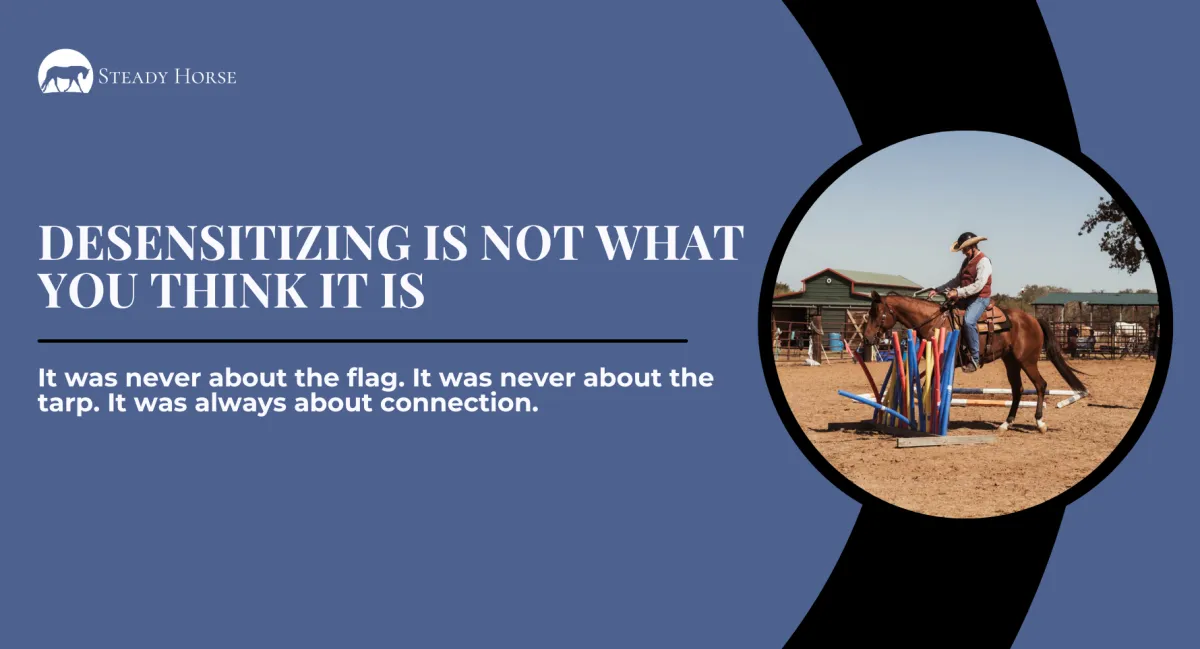
Desensitizing Is Not What You Think It Is
When most people hear the word desensitizing, they picture someone waving a flag at a horse until the horse stops flinching. They picture tarps being thrown over backs, plastic bags tied to sticks, pool noodles flailing around. They picture noise and chaos and a horse that eventually just gives up and stands there.
And if that is what desensitizing looks like to you, it makes sense that it might feel intimidating. It makes sense that you might wonder whether all that waving and flapping is actually doing anything meaningful for your horse or whether you are just wearing both of you out.
Here is the truth. Desensitizing is actually one of the easier things you can do with your horse. And the payoff for doing it well is tremendous. But the reason most people do not experience that payoff is because they are focused on the wrong thing. They are focused on the exercise. They are focused on the flag, the tarp, the noise. They are trying to get their horse used to a thing.
That is not what desensitizing is about. Not even close.
Desensitizing, when it is done right, is about connection. It is about building the kind of trust where your horse feels safe with you even when the world around them is scary. It is about proving to your horse, one moment at a time, that you are their safe place to land. The flag is just the tool. The connection is the point.
What the Old Way Gets Wrong
There is an old school approach to desensitizing that a lot of people still follow, and it looks something like this: you take a flag or a blanket or a saddle pad and you go after your horse with it. You wave it, you swing it, you toss it on and yank it off. You keep going no matter what your horse does. You do not stop until they stop. You push and push and push until your horse finally gives in and stands there.
And when the horse stands there, the person calls it a success. They think their horse has been desensitized. But what has actually happened?
That horse did not choose to stand there. That horse gave in. They were overloaded mentally and emotionally until they had no fight left. They are complying out of fear, not because they feel safe. Not because they trust their handler. Not because they made a decision to be okay with what was happening. They simply shut down.
That is not desensitizing. That is domination. And it teaches your horse absolutely nothing except that when the pressure gets bad enough, the only option is to stop fighting.
The new way is completely different. The new way is about recognizing when your horse is struggling and giving them assurance instead of more pressure. It is about being able to tell when you are using too much pressure. It is about only using enough to make them uncomfortable, not enough to make them panic, and then staying right there at that level until they process it and relax.
There is a world of difference between a horse that stands still because they have been mentally overloaded and a horse that stands still because they trust you. One of those horses is going to fall apart the next time real pressure shows up. The other is going to look to you and say, "I am scared, but I know I am safe with you." That is the horse you want. And that is the horse desensitizing is meant to build.
The Real Purpose Behind Every Exercise
Here is what is actually happening when you desensitize your horse the right way. You are not just getting them used to a flag or a tarp or a noise. You are building a file in their mind.
Horses file things away. They process experiences and store them, and they draw on those files when similar situations come up in the future. Every time you desensitize your horse and they make it through, every time you stay with them through the discomfort and then release the pressure when they relax, you are adding to that file. You are giving them evidence that says, "My person stayed with me. The scary thing did not hurt me. I was okay."
Over time, that file gets thick. And when something new and scary shows up out on the trail or in the arena or anywhere else, your horse does not have to start from scratch. They pull that file and think, "Every other time something scared me, my person was there. I made it through. I was safe." That is how trust compounds. That is how connection deepens. That is why every single desensitizing session matters, even the ones that feel small or repetitive.
Picture it from your horse's perspective. You are doing the desensitizing. They do not like it. They are trying to move away, trying to escape the pressure. But you stay with them. You float with them. You do not chase them, you do not escalate, you do not punish. You simply stay present and keep the pressure consistent. And then the moment they relax, the moment you see that deep breath or that softening in their eye, you release everything. You lower the flag. You take your own deep breath. You stand there quietly and let them process what just happened.
In that moment, your horse is learning something profound. They are learning that the pressure was not permanent. They are learning that their person was paying attention. They are learning that relaxation, not panic, is what makes the scary thing stop. And most importantly, they are learning that they are safe with you.
That is what desensitizing is. It is not an exercise. It is a conversation. And every time you have that conversation with your horse, you are deepening the bond between the two of you in ways that will show up everywhere else in your partnership.
The Details That Make the Difference
One of the things that separates effective desensitizing from ineffective desensitizing is attention to the small things. The subtle details that most people overlook are often the ones that matter most.
Your position matters. When you are using the flag with your horse standing still, you want to be at their shoulder with your hand up high near their head. This is not random. If your horse swings their head toward you as a reaction to the pressure, having your hand up there allows you to redirect them. A horse will always want to protect their eye, so having your hand positioned near their head naturally discourages them from slinging their head into your space. It also allows you to float with them if they start moving, staying with the pressure instead of accidentally releasing it.
Floating with them is critical. If your horse tries to move away from the pressure and you stop, you have just taught them that moving away makes the scary thing go away. That is the opposite of what you want. Instead, you follow along with them. You keep up the pressure. You do not escalate it, but you do not drop it either. You stay right there, consistent and calm, until they relax. Only then do you release everything.
Your energy matters more than you think. How you direct your energy during desensitizing tells your horse everything they need to know about the situation. When they relax, do you immediately drop all pressure and lower your energy? You should. That release is the reward. That is the moment where your horse files the experience away as safe. If you keep the pressure up after they have relaxed, you are sending a confusing signal that makes the whole exercise meaningless.
Different horses need different approaches. Some horses are what we call the dull, lazy type. Think Eeyore. These horses need more pressure and more energy to even register that something is happening. You might wave that flag with everything you have and they just stand there looking at you like nothing is going on. That does not necessarily mean something is wrong. It might mean they are already through that step and ready for the next one.
On the other end, you have the sensitive, reactive horse. These horses need much less pressure. You barely pick up the lead rope and they are already reacting. For these horses, you have to scale way back and work with a lighter touch. And here is the important thing: even if your horse is typically one type, there will be days when they show up as the other. A normally dull horse might be reactive one day because of something going on in their environment. A normally sensitive horse might be unusually calm. You have to be willing to meet them where they are in that moment and adjust your energy accordingly.
When You Cannot Get a Reaction
This is a question that comes up more often than you might expect. You are doing your desensitizing. You are waving the flag, doing your best, putting energy into it. And your horse just stands there. No reaction at all. Not even a flinch. And you start wondering if you are doing something wrong.
Here is what that probably means: your horse is already good with that step. They are already through it. And that is not a problem. That is progress.
Not every horse is going to give you a dramatic reaction to every desensitizing exercise. Some horses are naturally more stoic. Some have already been exposed to enough that the flag is old news to them. If you have gone through the flagging exercises and your horse is genuinely unbothered, that is your green light to move to the next level of desensitizing. Raise the expectation. Introduce something new. Find the edge of their comfort zone and work from there.
The goal is not to manufacture a spook. The goal is to find where your horse's threshold is and work at that edge, building trust through each layer of discomfort until they can handle more and more while staying connected to you. If you cannot find that threshold with the flag, it is time to get creative and move on.
You Cannot Desensitize Them to Everything
Here is the part that changes everything once you truly understand it. You will never be able to desensitize your horse to every possible scary thing in the world. It is not possible. There are a million things out there that could spook your horse. A plastic bag blowing across the road. An Amazon delivery bike zipping past. A deer crashing through the brush. A piece of equipment they have never seen before. The list is endless.
And that is exactly why desensitizing was never really about the scary thing in the first place.
It was always about connection. It was always about building a horse that says, "I do not like what is out there, but I know that staying with my person is the safest place for me to be." A horse that has been desensitized through connection, through trust, through a proven habit of safety does not need to have seen every scary thing in order to handle it. They just need to know that you have their back.
Think about what that looks like in practice. You are out on the trail and something startles your horse. Their head comes up. Their body tenses. Every instinct they have says run. But instead of bolting, instead of bucking, instead of dumping you in the dirt, they pause. They look to you. They take a breath. And they stay.
That does not happen because you waved a flag at them enough times. That happens because every time you desensitized them, you proved to them that you were paying attention. You proved that you would stay with them. You proved that the pressure would end and they would be okay. You built a file in their mind that says, "When things get scary, Mom has me. I am safe."
That is the horse everyone wants. And it does not come from the exercise. It comes from the connection you build through the exercise.
Desensitizing vs. Sensitizing: Know the Difference
There is one more piece of this that is worth understanding because it clears up a lot of confusion. Desensitizing and sensitizing are opposite concepts, and your horse needs both.
Sensitizing teaches your horse to respond to pressure or energy changes. Light leg cues, steady stick pressure, asking them to move their feet. You are teaching them to react, to be responsive, to move when you ask.
Desensitizing teaches your horse to stay calm and relaxed around pressure that would otherwise cause fear or anxiety. Flags, tarps, noises, unexpected touch. You are teaching them not to react, to stay grounded, to trust that the stimulus is not a threat.
Your horse needs to know when to respond and when to stay calm. And the beautiful thing is, horses are incredibly intuitive about differentiating between the two. They can read the subtle differences in your energy, your body language, and the context of the situation. When you are asking them to move, your energy says move. When you are desensitizing, your energy says stay. They pick up on that distinction far more readily than most people give them credit for.
Understanding this difference also helps you avoid a common fear: that desensitizing will make your horse dull to your cues. It will not. As long as you are clear and consistent in how you apply pressure in each context, your horse will know the difference between "I need you to move" and "I need you to stay calm."
Keep It Going
One last thing. Desensitizing is not something you do once and check off a list. It is something you maintain throughout the life of your partnership with your horse. That does not mean you need to spend an hour every day waving a flag. It means you revisit it from time to time, just like you revisit backing up, sending, flexing, and every other foundational exercise.
A seasoned horse does not need the same frequency as a green horse. But they do need the reminder. And more importantly, they need the continued proof that you are still paying attention, still leading with love, still showing up as the kind of leader they can trust.
Because at the end of the day, that is what all of this is about. Not the flag. Not the tarp. Not the pool noodles or the cowboy curtain or the noise in the barn. It is about your horse knowing, deep in their bones, that you are the safest place in the world for them. And that knowing is something you build one session, one breath, one moment of connection at a time.
If you are ready to start building that kind of trust with your horse, there is a free training available right now that walks you through how to create real safety, confidence, and connection. It will not be available forever, so if this is something you have been looking for, now is the time. Head over to https://steadyhorse.com and see what it is all about.
