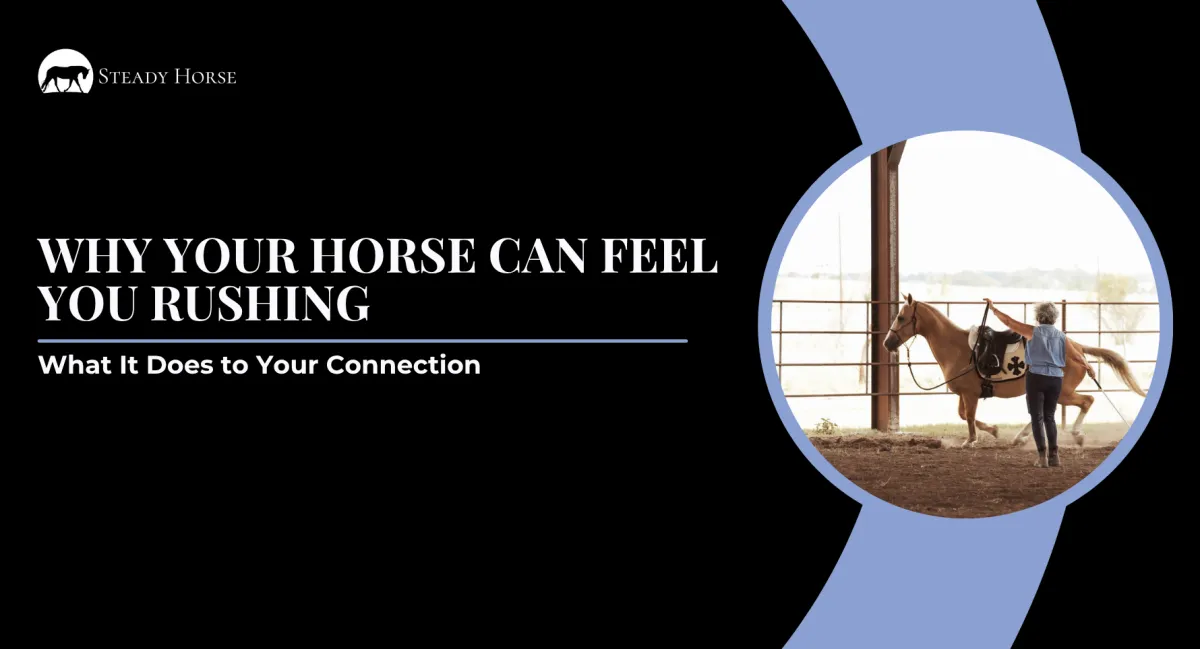
Why Your Horse Can Feel You Rushing
You had a long day. Traffic was bad. You got to the barn later than you planned. You've got about forty minutes before the sun goes down, and you wanted to get through your groundwork and maybe squeeze in a short ride.
So you walk out to your horse with a plan and a clock ticking in your head. You grab the halter, clip the lead, and start right in. You're moving a little faster than usual. Your breathing is a little shallower. Your energy is a little higher. You're not angry. You're not stressed, exactly. You're just in a hurry.
And your horse knows it before you've asked for a single thing.
Their head comes up. Their body stiffens just slightly. They're watching you a little more carefully than they normally do. Maybe they don't back up as softly as they did yesterday. Maybe they're a little sticky moving their front end. Maybe their transitions are rougher, their connection harder to find.
And you think, "What's wrong with my horse today?"
Nothing is wrong with your horse. Everything they're doing is a response to what they're reading in you. Your rushing energy is broadcasting a signal that your horse is picking up loud and clear. And that signal is making it harder, not easier, to accomplish everything you came out here to do.
Your Body Is Talking Whether You Want It To or Not
Here's something that's easy to know intellectually but hard to internalize: your horse is reading you constantly. Not just when you pick up the lead rope or give a cue. Every second you're in their presence, they are processing information about your body, your energy, your intent, and your emotional state.
Horses communicate with each other primarily through body language, energy, and awareness. They read each other's heart rates. They read each other's breathing patterns. They sense tension in each other's bodies and shifts in each other's energy from a distance. This isn't mystical. It's survival. As prey animals, the ability to read the emotional state of those around them and respond accordingly is literally what keeps them alive.
And they do the same thing with us.
When you're calm, your heart rate is lower. Your breathing is deeper and slower. Your movements are more fluid, more deliberate. Your body language says, "Everything is fine. We're safe. No rush." And your horse reads that and mirrors it. They soften. They relax. They become more willing, more connected, more open to learning.
When you're rushing, the opposite happens. Your heart rate increases. Your breathing gets shorter and shallower. Your movements become quicker, sharper, less deliberate. You might not even notice the change. But your horse does. Because to a prey animal, that shift in energy means something very specific.
It means something might be wrong. It means the person they're with is on edge. It means the environment might not be safe. And when a horse senses that kind of energy, their instincts start to activate. They don't get more cooperative. They get more guarded. They don't become easier to work with. They become harder.
You walked out to the barn wanting to save time. But the energy you brought with you is actually costing you time because now you're working against your horse's instinctive response to your body instead of working with it.
The Rush Creates the Very Problem You're Trying to Avoid
This is the part that makes rushing so counterproductive. The faster you try to go, the slower things actually move.
When you bring rush energy to a session, your horse picks up on that elevated heart rate, that shallow breathing, that tension in your body. Their own system responds by matching it. They get a little tighter. A little more reactive. A little less willing to soften and engage.
Now instead of a horse that's connecting with you in the first few minutes, you've got a horse that needs ten minutes just to settle because your energy unsettled them when you walked up. Instead of smooth transitions, you've got choppy ones because your horse is mirroring your choppy, hurried energy. Instead of a soft backup, you've got resistance because your horse is braced against the tension they're feeling from you.
So what do you do? You push harder. You try to move faster. You get a little frustrated that things aren't going the way you planned. And that frustration adds another layer of elevated energy that your horse reads instantly.
You're now in a feedback loop. Your rush energy makes your horse less responsive. Their lack of responsiveness makes you more frustrated. Your frustration makes them more guarded. And the session that was supposed to be quick and efficient turns into the longest, most difficult thirty minutes of your week.
The fix is so simple that it almost feels too easy. Slow down. Breathe. Take the first five minutes of your session to do nothing but exist with your horse. Let your heart rate come down. Let your breathing deepen. Let your body tell your horse what your words can't: "I'm here. I'm present. We're not in a hurry. We've got all the time we need."
Five minutes of intentional calm at the beginning of a session will save you twenty minutes of fighting against your own energy for the rest of it.
Patience Isn't Passive — It's One of the Hardest Skills in Horsemanship
There's a misconception about patience that needs to be addressed, because it's what keeps a lot of riders from practicing it.
Patience doesn't mean doing nothing. It doesn't mean standing around waiting for something to happen. It doesn't mean lowering your expectations or accepting poor responses from your horse.
Patience means staying engaged, staying intentional, and staying calm while you work through the process at the speed your horse needs you to go. It means repeating the exercise again and again without letting frustration creep into your body. It means sticking with it when things are hard without rushing to get past the hard part.
That takes more discipline than rushing does. Rushing is easy. Rushing is what happens when you stop being intentional. Patience requires you to override your own instinct to speed things up, to check the clock, to mentally jump ahead to where you want to be instead of staying where you actually are.
And here's what makes it worth the effort: when you practice patience with your horse, you're not just being nice. You're actually changing the physiology of the interaction. Your heart rate stays lower. Your respirations stay deeper. Your body stays softer. And your horse responds to all of that by becoming calmer, more connected, and more willing to learn.
Patience doesn't slow down your training. It accelerates it. Because a horse that feels safe and unhurried with you learns faster than a horse that feels pushed and pressured. Every single time.
The Three Rs of Patience
Rebecca often talks about three specific areas where patience shows up in meaningful ways with our horses. She calls them the three Rs: repetition, resilience, and refinement. And each one is directly connected to how your energy and presence affect your horse's ability to learn.
Repetition
Repetition is what patience looks like in action. It's doing the exercise over and over again, not because your horse is being difficult, but because that's how horses learn.
Horses don't learn by being told something once. They learn through repeated experience. They need to try, receive feedback, try again, receive more feedback, and gradually build an understanding of what you're asking. That takes time. That takes reps.
And here's where rushing kills repetition: when you're in a hurry, you don't give each rep the quality it deserves. You blow through the backup five times without pausing between each one. You ask for transitions without breathing between the asks. You move from exercise to exercise without giving your horse time to process what just happened.
Quality repetition requires patience. It requires you to do the exercise, breathe, wait, let your horse digest the ask, and then do it again. That pause between reps is where the learning happens. It's where your horse processes the experience and connects the cue with the correct response. Skip the pause and you're just going through the motions. And your horse can tell the difference.
When you're patient with repetition, each rep gets a little better. Your horse gets a little softer. Their understanding deepens. And the communication between you becomes clearer because you gave it room to develop instead of cramming it into a timeline.
Resilience
Resilience is the commitment to keep going when progress feels slow. It's the willingness to stick with your horse through the hard sessions, the stuck sessions, the sessions where nothing seems to be working.
This is where most riders lose their patience. Not because they don't care, but because they've put a timeline on their progress that their horse doesn't know about. "We should have this by now. We've been working on this for three weeks. Other people's horses get this faster."
Who came up with that timeline? You did. And you have the ability to let it go.
Horses don't operate on our schedules. Every horse is different. Some are dull and need more time. Some are sensitive and need more reassurance. Some are carrying past experiences that slow their learning. Some are young and still figuring out how to process information. Putting an arbitrary deadline on any of them is setting yourself up for frustration and setting them up for failure.
Resilience means understanding that it might take twenty minutes or it might take twenty sessions. And being okay with either one. It means showing up the next day after a rough session and starting fresh without carrying yesterday's frustration into today's work. It means believing that if you stick with it, you'll get there together.
And here's the thing about resilience that connects directly back to your horse's experience of you: a rider who is resilient carries a different energy than a rider who is discouraged. Resilience feels like steadiness. It feels like calm determination. It feels like a leader who isn't going to panic when things don't go perfectly.
Your horse can feel that. And it makes them trust you more.
Refinement
Refinement is the long game. It's the slow, gradual improvement that happens over weeks and months of consistent, patient work.
Refinement isn't dramatic. It's not a breakthrough moment. It's the day you realize your horse is responding to a lighter cue than they did last month. It's the session where you notice their transitions are just a little smoother than they were two weeks ago. It's the moment you pick up the lead rope and your horse is already soft and waiting before you've even made an ask.
Those subtle shifts are the product of patient, repeated, resilient work. And they're easy to miss if you're always looking for the big moment, the dramatic transformation, the finish line.
Refinement asks you to appreciate the small changes. To notice the subtle improvements. To celebrate the fact that what used to take ten minutes now takes five, even if it's not yet down to one.
And refinement requires patience because you can't rush it. You can't force your horse to be softer tomorrow than they are today. You can only create the conditions for softness through clear, patient, consistent work and trust that the refinement will come.
When you bring that energy to your training — the energy of someone who is content to let things develop at their own pace — your horse relaxes into it. They stop bracing against a timeline they can feel in your body. They stop rushing to get the right answer because they can feel you rushing to get it. They settle into the work because you've settled into the work. And the refinement happens naturally, almost without you noticing, because you gave it room to breathe.
What Your Horse Wants You to Know
If your horse could tell you one thing about your energy, I think it would be this: "When you slow down, I can hear you. When you rush, all I hear is noise."
Horses are so much more perceptive than we give them credit for. They can feel the change in your breathing from ten feet away. They can sense the tension in your shoulders before you've even reached for the halter. They know when you're present and when you're mentally somewhere else. They know when you're patient and when you're counting the minutes.
And they respond accordingly. Always.
A horse that is around a patient handler becomes a more willing partner. They learn faster because the communication is cleaner. They try harder because they feel safe to make mistakes. They connect more deeply because they can feel that you're invested in them, not in a timeline.
A horse that is around a rushed handler becomes instinctively nervous. Their system mirrors your elevated energy. They become reactive instead of responsive. They brace instead of soften. And the learning slows to a crawl because their survival instincts are competing with your training cues.
The difference between those two horses isn't genetics or temperament or training level. It's the energy of the person standing next to them.
That's how much your patience matters. That's how much your presence matters. Every time you walk out to the barn, you're choosing which version of your horse you're going to get. Not by what exercises you do. By what energy you bring.
A Practice, Not a Destination
Patience isn't something you master once and have forever. It's a practice. Some days you'll have it in abundance. Some days you'll feel it slipping by the third minute.
That's okay. What matters is that you recognize when the rush is creeping in and you choose to pull it back. Take the deep breath. Drop the timeline. Remind yourself that a ten-minute session done with patience and presence will always outperform an hour of rushed, frustrated, disconnected work.
Your horse would much rather have twenty calm minutes with you than sixty frantic ones. They would rather do three quality reps of an exercise with full breathing and real pauses than thirty reps crammed together with no space to process.
Give them the gift of your patience. Give them the gift of your calm, steady, unhurried presence. And watch what happens to your connection when they stop feeling rushed and start feeling safe.
Horses are more like a crockpot than a microwave. The good stuff takes time. But when it's done, it's done right. And it lasts.
Ready to Build That Foundation?
If you're looking for a place to start building the kind of patient, connected partnership that transforms everything about your horsemanship, there's a free training available right now that walks you through exactly how. It's focused on safety, confidence, and the connection your horse is waiting for. It's available for a limited time, so if it's speaking to you, take the next step.
