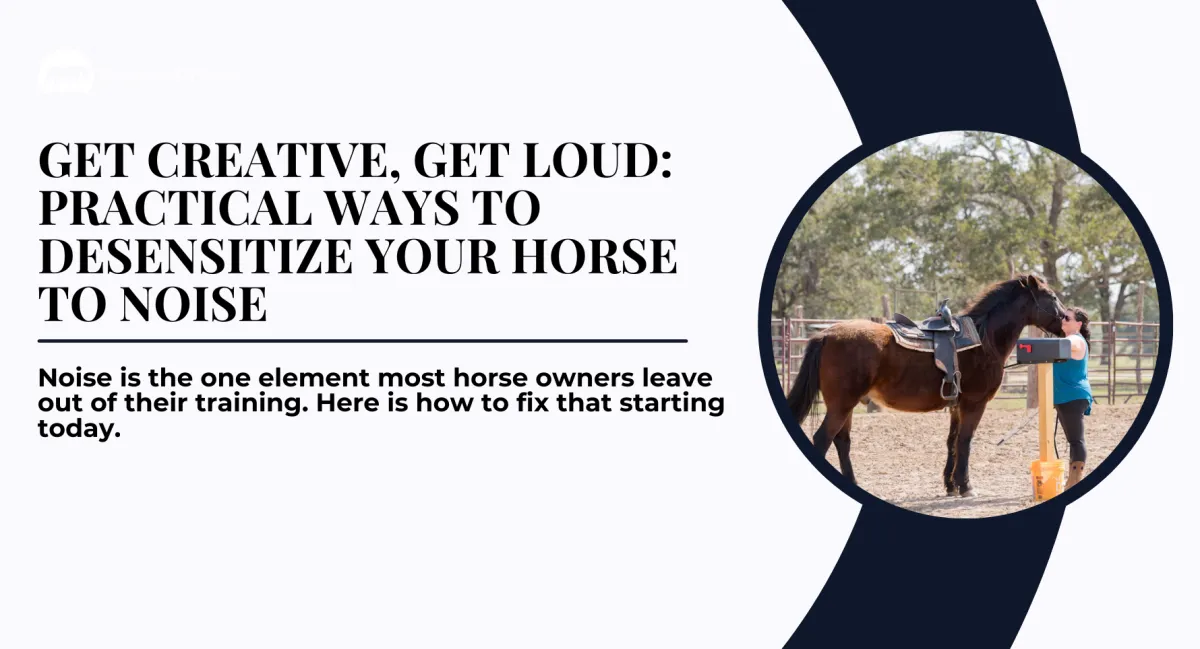
Get Creative, Get Loud: Practical Ways to Desensitize Your Horse to Noise
When most people think about desensitizing their horse, they think about objects. The flag. The tarp. The pool noodle. The cowboy curtain. They think about getting their horse comfortable with things they can see and feel. And all of that matters. It matters a lot.
But there is an element of desensitizing that gets left out of the conversation more often than it should, and it is one of the most important ones for keeping you and your horse safe. That element is noise.
Think about the last time your horse spooked. Chances are it was not because they saw something scary. It was because they heard something. A truck backfiring on the road. A tree limb cracking and falling. A tractor starting up. A chainsaw. Fireworks. Gunshots from a neighbor's property. The rattle and bang of something unexpected in the barn.
Noise triggers some of the fastest and most dramatic reactions in horses because sound hits them before they can process what it is. Their ears pick it up, their instincts fire, and their body reacts before their brain has a chance to catch up. If your horse has never been trained to handle noise, that reaction can turn into a bolt, a buck, or worse before you even know what happened.
The good news is that desensitizing your horse to noise is one of the easier things you can do. It does not require expensive equipment. It does not require a special facility. It just requires some creativity, some consistency, and a willingness to make a little racket.
Why Most People Skip Noise
Before we get into the practical side, it is worth understanding why noise gets overlooked in the first place. And the answer, for most people, is surprisingly personal.
A lot of horse owners become what you might call tiptoeers. They become so focused on not startling their horse that they go out of their way to keep things quiet. They ease the barn door shut instead of letting it close naturally. They set the feed bucket down gently instead of letting it clank. They avoid doing anything around their horse that might make a sudden or loud sound.
And here is the problem with that. When you tiptoe around your horse, you are not protecting them. You are teaching them that noise is something to be afraid of. Your nervous energy tells them there is something wrong. Your careful, quiet movements signal that you are worried about something. And because horses are prey animals that are wired to pick up on every shift in your energy, they start to believe that the quiet is the only safe state. Anything that breaks the quiet becomes a threat.
It becomes a feedback loop. You are nervous about making noise because you are afraid your horse will react. Your horse picks up on your nervousness and becomes more reactive. Their reactivity makes you more nervous. And around and around it goes until both of you are walking on eggshells every time you are together.
The way to break that cycle is simple in concept, even though it takes some courage in practice. You have to stop tiptoeing. You have to go out there and make noise. Not recklessly. Not all at once. But intentionally, gradually, and consistently.
There is a saying that captures it perfectly: if you do not want to wake the sleeping baby, you have got to wake the sleeping baby. If you have ever raised a child, you know exactly what this means. The parents who tiptoe around their sleeping baby end up with a child who wakes up every time a floorboard creaks. The parents who let life happen at normal volume end up with a child who can sleep through anything. Horses work the same way.
Start With What You Already Have
You do not need to buy anything special to start desensitizing your horse to noise. The best noise makers are probably already sitting around your barn, your house, or your property.
The flag you are already using. When you wave your flag during regular desensitizing, it is making noise. The flapping, the snapping of the material in the air. That is noise desensitizing happening right alongside the visual and tactile desensitizing. Pay attention to that. Make sure you are not unconsciously dampening the sound of the flag because you are worried about startling your horse. Let it flap. Let it snap. That sound is part of the exercise.
The tarp. Another tool most people already have. When your horse walks across a tarp on the ground, it crinkles and crunches under their feet. When you drape it over their back or rub it on their body, it makes that same crinkly noise right next to their ears. That is valuable noise exposure, and it is happening naturally as part of the desensitizing you are already doing. Do not try to minimize it. Let the tarp be loud.
A milk jug with rocks in it. This is one of the simplest and most effective noise makers you can create. Take an empty plastic milk jug, drop some rocks or pebbles inside, and attach a lead rope to the handle. Now you have a portable noise maker that you can drag around near your horse, shake while you are standing beside them, or pull along behind you while you are leading them. The beauty of this tool is that it is something you can let go of instantly if your horse overreacts. No risk of anything staying attached to them. You just drop it and it stops.
Feed buckets and barn equipment. Here is one that does not even require a separate training session. The next time you are doing your regular barn chores, stop trying to be quiet about it. Bang the buckets around a little. Drop things on the ground with some weight behind them. Let the wheelbarrow clank against the stall door. Toss a bale of hay instead of setting it down gently. Let your everyday barn routine become a noise desensitizing session without your horse even knowing that is what is happening.
Random objects from around your property. Look around and get creative. Pots and pans from the kitchen. A piece of sheet metal you can rattle. Empty cans tied together on a string. An old cowbell. A whistle. Anything that makes noise is a training tool. The more varied the sounds your horse is exposed to, the more resilient they become to unexpected noise in general.
The key is that you are not just creating one type of noise. You want variety. You want sharp, sudden sounds. You want sustained, rhythmic sounds. You want rattling, clanking, banging, and crinkling. Every different type of noise your horse learns to handle builds their confidence and adds another file to their mental cabinet that says, "Noise happened. I was okay. My person was right there."
From Standing Still to Feet Moving
There is an important progression in noise desensitizing that a lot of people miss. Most people start by making noise while their horse is standing still, and that is the right place to begin. But it cannot end there.
Most scary noises in the real world happen when your horse's feet are moving. You are out on the trail. You are walking through the barn. You are riding in the arena. Your horse is in motion, and then a sound hits them out of nowhere. If the only noise desensitizing you have ever done was with your horse standing in one spot, they are not prepared for what happens when sound and motion collide.
This is where desensitizing in motion comes in. Once your horse is solid with noise while their feet are still, you start introducing noise while they are moving. Here are a few ways to do that:
Drag the milk jug while leading them. Attach the jug with rocks to a lead rope and pull it along behind you as you walk your horse. The rattling and bouncing creates unpredictable noise that they have to process while their feet are in motion. Start at a walk and keep the jug far enough behind you that it is not right at their heels.
Drape the tarp over the lead line while sending. This is a great exercise. You drape the tarp over the lead line and hold on to it at first so it is not sliding around. Your horse can see it and hear it, but it is controlled. Over time, you let go and allow the tarp to slide up and down the lead line on its own, making noise and moving unpredictably while your horse is in motion.
Have someone make noise at a distance while you work. If you have a helper, have them bang on things, rattle equipment, or make noise at the far end of the arena while you are working your horse on the ground or under saddle. Start with the noise source far away and gradually bring it closer over multiple sessions.
Use your everyday environment. If you have a tractor, a lawn mower, or any other piece of equipment that makes noise, let it run at a distance while you are working your horse. You do not have to set up a special scenario. Just let the noise become part of the background of your training. Over time, move the noise source closer as your horse shows they can handle it.
The progression should always be gradual. You are not trying to overwhelm them. You are trying to build their tolerance and their trust one layer at a time.
The Rules That Keep It Safe
Creativity with noise is great, but it needs to happen within a framework that keeps both you and your horse safe. Here are the principles that should guide every noise desensitizing session:
Always start gradual. This is true for all desensitizing, but it is especially important with noise because sound can trigger a faster and more intense reaction than most visual stimuli. Start quieter. Start farther away. Start with your horse's feet still. Build from there.
Make sure your backup is solid first. Before you do any desensitizing, your horse needs a solid, willing backup. Every time you ask them to back up, they should do it promptly and softly. That backup is your primary safety tool. If your horse overreacts to noise, the first thing you are going to do is back them up. If that skill is not solid, you do not have the foundation you need to do desensitizing safely.
Never attach anything to your horse that could stay on them. This is a safety rule that cannot be bent. If you are using a noise maker like the milk jug, do not tie it to your horse or to the saddle. If they panic and take off, a noise maker that is attached to them will chase them, terrify them, and could cause serious injury. Always use tools that you can drop or release instantly.
Watch for the threshold and respect it. You are looking for that point where your horse just starts to become uncomfortable. Not panicking. Not wigging out. Just starting to notice and feel uneasy. That is where you work. You stay at that level of pressure until they relax, and then you release everything. If they blow past the threshold into full panic, you have gone too far too fast.
Release at the right moment. The instant your horse shows a sign of softening or relaxation during noise desensitizing, all pressure stops. You lower the noise maker. You stop the rattling. You take a deep breath. You give them space to process what just happened. That release is what teaches them that relaxation makes the scary thing stop. Without proper timing on your release, the whole exercise loses its meaning.
Do not ease into being loud. Just be loud. This sounds counterintuitive, but there is a difference between being gradual with your approach and being timid with your volume. You can start the noise at a distance while keeping the volume at a realistic level. If you try to slowly increase the volume from a whisper to full noise, you are just drawing out the process and giving your horse time to build anxiety about what is coming next. Be at a realistic volume. Just control the distance and duration instead.
Make It Part of Your Life, Not a Separate Session
One of the most effective things you can do for noise desensitizing has nothing to do with a formal training session. It is simply making noise as part of your normal daily routine with your horses.
Stop being quiet in the barn. Stop setting things down gently. Stop easing doors shut. Stop whispering when you are around your horse. Just live your life at normal volume and let your horse exist in that.
Bang the buckets around when you are feeding. Let the wheelbarrow rattle down the barn aisle. Toss things instead of placing them. Talk to your horse in a full voice, not a careful whisper. If something falls, let it fall. If something clanks, let it clank.
When you treat noise as normal, your horse starts to treat noise as normal. When you treat noise as something to be managed and minimized, your horse learns that noise is a threat that even their leader is worried about.
The more your horse experiences noise as just another part of the background of their daily life, the less any individual noise is going to rattle them. And that is the goal. Not a horse that has been specifically trained on every possible sound, because that is impossible. But a horse that has learned, through hundreds of small daily exposures, that noise is just noise. It is not a threat. It is not a reason to panic. It is just part of life.
It Was Never About the Noise
At the end of the day, noise desensitizing is about the same thing all desensitizing is about. Connection. Trust. The unbreakable bond between you and your horse.
You cannot desensitize your horse to every sound they will ever hear. There will always be a noise out there that is new, unexpected, and startling. What you can do is build a horse that trusts you so deeply that when that noise hits, they choose to stay with you instead of running from it.
Every time you desensitize your horse to a noise and they make it through, you are adding to their file of evidence that says, "Something scary happened. I stayed with my person. I was okay." That file is what they draw on when the next unexpected sound comes along. And when that file is thick enough, your horse stops needing to know what the noise is. They just need to know that you are there.
That is the horse you are building when you get creative and get loud. Not a horse that has heard every sound. A horse that trusts you through every sound.
Ready to start building that kind of trust and confidence with your horse? There is a free training available right now that walks you through the foundation of creating safety, connection, and a real partnership with your horse. It will not be available forever. Head over to https://steadyhorse.com and check it out while you can.
