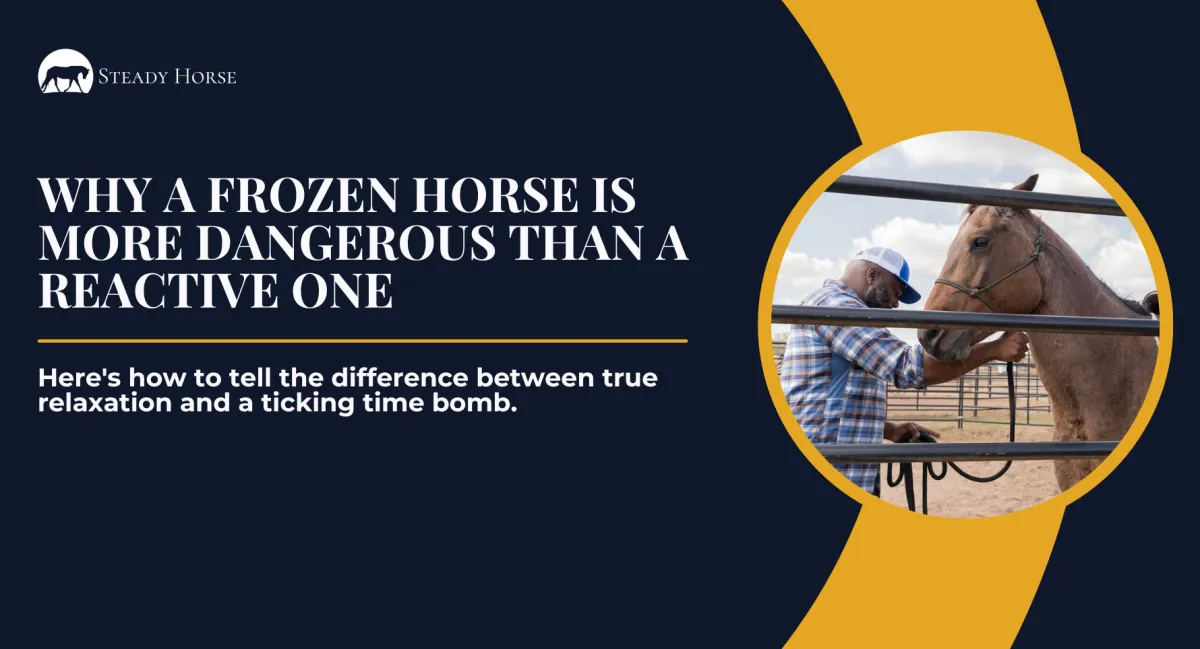
Why a Frozen Horse Is More Dangerous Than a Reactive One
There's a horse that scares me more than the one who's snorting, wide-eyed, and dancing sideways.
It's the one who's standing perfectly still.
I know that sounds backwards. Most people look at a horse who's frozen in place during a scary situation and think, "What a good horse. So calm. So well trained." Meanwhile, the horse next to them who's fidgeting and looking around gets labeled as the problem horse. The reactive one. The one who needs more work.
But here's what most people don't see.
That frozen horse isn't calm. They're terrified. They've learned that moving gets them in trouble. That reacting brings more pressure. That the safest thing they can do is shut down, go internal, and wait for it to be over. They look quiet on the outside, but inside, their nervous system is screaming.
And one day, when the pressure exceeds what they can contain, they don't just react. They explode. Seemingly out of nowhere. With no warning. And that's when people get hurt.
The reactive horse? At least they're talking to you. At least they're telling you something's wrong. You can see it. You can work with it. You can help them through it.
The frozen horse has gone silent. And silence in a horse is not peace. It's a warning.
How We Accidentally Create Frozen Horses
This is the part that's hard to hear, but it's important.
Most frozen horses didn't start that way. We made them that way. Not on purpose. Not with bad intentions. But through a style of desensitizing that prioritizes compliance over connection.
You've seen it. Maybe you've even done it. You bring out a flag or a tarp or a plastic bag, and the goal is to keep waving it, keep exposing your horse to the stimulus, until they stop moving. Until they stand still. Until they "accept" it.
The old way of desensitizing is built on one idea: make the horse stop reacting. Flag them. Sack them. Don't let them move. Keep going until they give up. And when they finally stand there, motionless, we call it progress.
But what actually happened?
The horse didn't learn that the flag is safe. They learned that moving gets them in more trouble than standing still. They didn't develop confidence. They surrendered. And there's a world of difference between a horse who's relaxed because they trust you and a horse who's frozen because they've learned that resistance is futile.
There's actually a term for this. It's called flooding. And it has a dark history.
The concept of flooding came from a South African psychologist working with soldiers who had PTSD. The military needed to get soldiers back into the battlefield faster. So they developed a technique of overwhelming exposure. Put the soldier back in high-stimulus situations, force them through it, and when they stopped reacting visibly, declare them "fixed" and send them back out.
In the short term, it looked like it worked. The soldiers appeared functional. They weren't visibly panicking anymore.
But over time, the consequences were devastating. Psychosis. Breakdown. Skyrocketing suicide rates. The trauma didn't go away. It just went underground. And when it surfaced again, it came back worse than before.
We do the same thing to horses when we flood them. We overwhelm their nervous system with stimulus until they shut down. And then we mistake that shutdown for acceptance. For relaxation. For trust.
It's none of those things. It's a horse who has given up trying to communicate with us because communication didn't work.
What a Truly Relaxed Horse Looks Like
So how do you tell the difference? How do you know if the horse standing quietly in front of you is genuinely calm or just frozen?
You look at the details.
A horse who's truly relaxed will show you specific physical signs that can't be faked. And they tend to show up in a sequence. Not all at once, but gradually, as the horse processes what's happening and decides they're safe.
Lowering the head. A relaxed horse drops their head. Not because you pulled it down. Not because they're exhausted. But because their nervous system has shifted out of fight-or-flight and into a state where they feel comfortable enough to let their guard down. A frozen horse may have their head low, but it's stiff. Static. There's no softness in it.
Licking and chewing. This is one of the most commonly misunderstood signs. A lot of people think licking and chewing means "my horse agrees with me" or "they're thinking about it." What it actually indicates is a release of tension. The jaw is one of the first places horses hold stress, and when they start working that mandible, softening through the jaw, it means something is letting go internally.
Softening of the eyes. A horse in true relaxation will have soft, blinking eyes. Not wide. Not hard. Not staring. Soft. A frozen horse often has a glassy, distant look. Like they've checked out. Like nobody's home. That's not calm. That's dissociation.
Cocking a hind foot. When a horse shifts their weight and cocks a hind leg, they're telling you they feel safe enough to take weight off one of their escape legs. That's significant. A frozen horse will typically stand square, weight evenly distributed on all four feet, ready to launch in any direction if they need to.
Softening of the tail carriage. A relaxed tail hangs naturally. It swings a little with movement. It's not clamped down and it's not flagging. A tense horse, even one standing still, will often have a tail that's either pressed tight against their body or elevated and rigid.
Expansion of the rib cage. This is one people miss. When a horse truly relaxes, they take deeper breaths. You can actually see their barrel expand as their breathing shifts from the shallow, rapid pattern of a stressed horse to the slow, full breaths of one who feels safe.
Here's the critical thing. A frozen horse may show none of these signs. Or they may show a version of them that looks close but feels wrong. The head may be low, but there's no softness through the poll. The eyes may be half-closed, but they're glazed, not soft. The body is still, but it's rigid still, not relaxed still.
Learn to feel the difference. Because your safety depends on it.
Why the Reactive Horse Is Actually Talking to You
Now let's flip this around. Because the horse that most people want to "fix" is actually the one doing exactly what we should want them to do.
A reactive horse is communicating. They're saying, "I'm worried about this. I don't understand this. I'm not sure I trust this situation." That's not bad behavior. That's honesty.
Think about it from their perspective. Horses are prey animals. Their survival for thousands of years has depended on one thing: noticing change and responding to it. When your horse sees something new, something different, something that wasn't there yesterday, and they react, they're doing exactly what nature designed them to do.
The problem isn't the reaction. The problem is that we don't know how to help them through it.
When we see that reaction and our response is to shut it down, to flag harder, to demand stillness, to punish the movement, we're telling our horse that their communication doesn't matter. That when they're scared, the answer is to be quiet about it. And so they learn to be quiet about it.
Until they can't be quiet anymore. And then it all comes out at once.
The better approach is to see that reaction as information. Your horse just told you something. They said, "I'm not comfortable with this." Great. Now you know where the work is. Now you can help.
That's the fundamental shift between the old way and the new way of desensitizing. The old way says, "Make the horse stop reacting." The new way says, "Recognize that the reaction is telling you something, and help your horse build the trust and understanding they need to move through it."
Building Connection Under Pressure
So what does the new way actually look like in practice?
It starts with understanding that desensitizing isn't about the stimulus at all. It's not about the flag. It's not about the tarp. It's not about the plastic bag or the mailbox or the tractor or the deer in the tree line.
It's about your horse learning that no matter what's happening around them, you are their safe place.
When you approach desensitizing this way, everything changes. You're not trying to prove that the scary thing won't hurt them. You're proving that being with you is better than being anywhere else. Even when things are changing. Even when their instincts are firing. Even when every part of their brain is telling them to run.
Here's how you build that.
You start with your tools and your body position. Before you ever introduce a flag or a tarp or any external stimulus, your horse needs to be comfortable with you. With your movement. With you stepping to one side and the other. With you raising your hand. With you changing position around their body.
If your horse can't stand still while you walk around them, you have no business bringing out a flag. If they're dancing, anticipating, blocking you from moving to one side, that's where the work starts. Not with the scary object. With you.
And you might spend an entire session just stepping in and out of different positions around your horse until they can stand quietly and wait for you. That's not wasted time. That's the foundation everything else gets built on.
Then you introduce stimulus gradually. Not by flooding. Not by overwhelming. You bring the flag out at a distance. You let them see it. You watch their response. And you look for those signs of relaxation before you bring it any closer.
Maybe the flag is twenty feet away and your horse's head goes up. That's information. Stay there. Breathe. Wait. Watch for the head to lower, for the eye to soften, for the jaw to release. When you see those signs, take the flag away. Let them rest.
Then bring it back. Maybe eighteen feet this time. Same process. Watch. Wait. Reward the relaxation. Remove the stimulus.
You're building layer by layer. And at every layer, you're asking one question: "Are you still with me?" Not "Are you tolerating this?" Not "Have you stopped moving?" But "Are you connected to me right now?"
Because a horse who's connected to you can handle anything. A horse who's merely tolerating you is one bad moment away from proving that.
The Four Levels of Desensitizing
Just like with every other exercise, desensitizing has a progression. And just like always, the riders who skip levels end up paying for it later.
Level One: Understanding. Your horse demonstrates a basic understanding that the stimulus is not going to hurt them. They may not be relaxed. They may still be a little wide-eyed. But they're starting to get it. They're not panicking. They're processing. That's all you're looking for at this level.
Level Two: Relaxation. Now your horse isn't just tolerating the stimulus. They're showing you physical signs that they're settling in. The head is lowering. The jaw is softening. The breathing is slowing. They're starting to believe, not just understand, that they're safe.
Level Three: Connection. This is where it shifts from your horse being okay with the scary thing to your horse being okay with you during the scary thing. Their ear tips toward you. Their nose starts to orient in your direction. They're not just relaxing. They're reaching for you. That connection piece is what separates a desensitized horse from a truly brave horse.
Level Four: Consistent Bravery. This is the horse who, the moment pressure goes up, immediately looks for you. Not for the exit. Not for another horse. For you. "Where's my person? Where's my north star? Okay, I see you. We're good." That's the horse you can take anywhere and feel safe. That's the horse who has replaced panic instinct with relational instinct.
You Can't Desensitize Your Horse to Everything
I want to be direct about this because a lot of riders get caught in the trap of thinking that if they just expose their horse to enough things, they'll eventually be "bombproof."
There's no such thing as a bombproof horse.
You can desensitize your horse to a Walmart bag, and then a Target bag blows by and they act like they've never seen plastic before. You can ride past the same mailbox a hundred times, and on the hundred and first pass, the sun catches it at a different angle and your horse is convinced it moved.
You cannot prepare your horse for every possible thing they'll encounter. But you can prepare them for what to do when they encounter something they weren't prepared for.
And what you want them to do is look for you.
That's why connection is the goal. Not tolerance. Not acceptance. Not "standing still because I'm afraid of what happens if I move." Connection. The kind where your horse's first instinct when something scary shows up is to check in with you.
Think about how horses handle fear in a herd. When something spooks them, they don't scatter in random directions. They join up. They run toward each other. They look for their herd mates. They find safety in proximity.
You are your horse's herd. And the work you do with desensitizing, when done right, builds that same instinct. Not "run from the scary thing." Not "freeze and hope it goes away." But "find my person. Stay with my person. My person will keep me safe."
That's the horse who's truly brave. Not the one who doesn't react. The one who reacts by coming to you.
What This Means for Your Safety
Let me bring this all the way back to why it matters.
If you have a horse who freezes, who stands still during scary situations, who looks "quiet" and "well behaved" while their internal pressure is building, you have a horse who is going to blow on you one day. And when they do, it's going to feel like it came out of nowhere.
It didn't come out of nowhere. It was there the whole time. You just couldn't see it because the horse had learned to hide it.
If you have a horse who reacts, who shows you when they're worried, who communicates through movement and tension and elevated energy, you have a horse who's being honest with you. And an honest horse is a horse you can work with.
The goal isn't to eliminate the reaction. The goal is to build enough trust and connection that when the reaction happens, your horse works through it with you instead of against you. That they spook and then look at you instead of leaving. That they get worried and then soften instead of shutting down.
Every time your horse gets scared and you help them through it, you're overwriting a bad file with a good one. You're stacking experiences. You're proving, one moment at a time, that being with you leads to good outcomes. And eventually, those good files outnumber the bad ones. The fear doesn't disappear. But it stops being the first thing your horse reaches for.
That's real desensitizing. Not making your horse tolerate scary things. Teaching them to trust you through scary things. And it starts with recognizing that the quiet horse isn't always the safe one.
Sometimes the safest horse in the barn is the one who's brave enough to tell you when something's wrong.
If you're ready to start building the kind of trust that creates genuinely brave, connected horses, I've put together a free training that walks you through exactly where to begin. It's available for a limited time and it's designed for riders at every level who want to feel safer and more connected with their horse.
