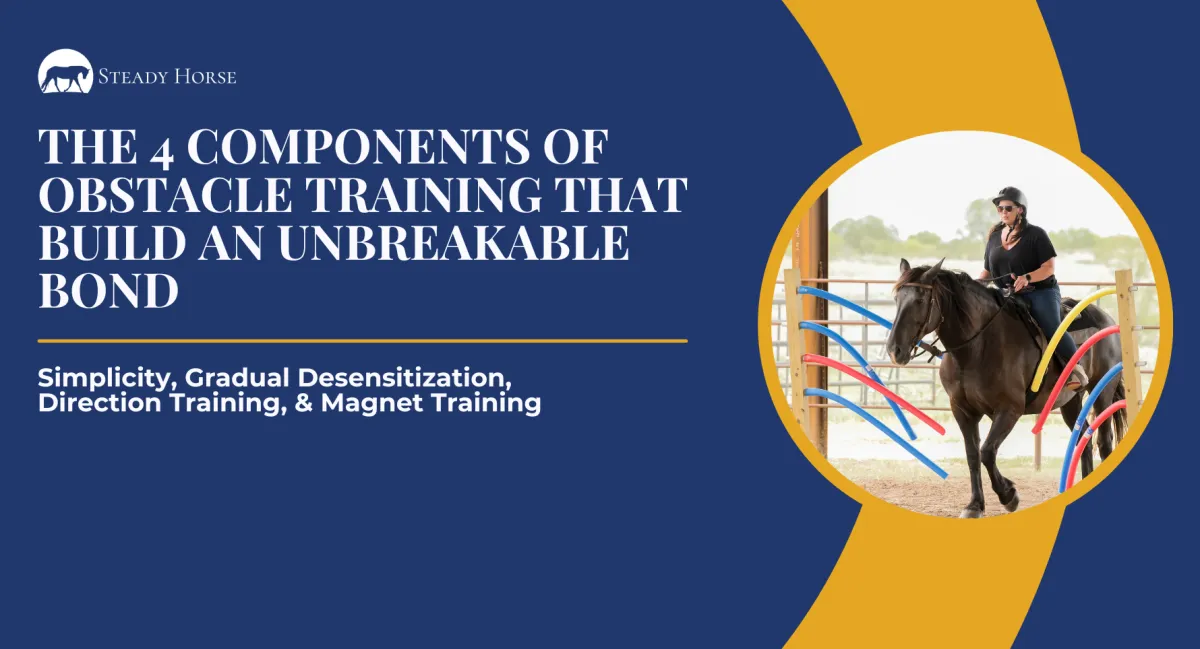
The 4 Components of Obstacle Training
When most people think about obstacle training, they picture tarps, bridges, cowboy curtains, and trailer loading. They think about getting their horse over something, through something, or past something. And while all of that is part of it, the real purpose of obstacle work goes so much deeper than that.
Obstacle training is not about the obstacle. It never has been. Every tarp on the ground, every bridge you build, every pool noodle dangling from a cowboy curtain — those are just tools. What you are really doing when you work your horse through obstacles is building a relationship rooted in trust, safety, and connection. You are showing your horse that no matter what is in front of them, beside them, or underneath them, you are their safe place to land.
Think about that for a second. There is no way on this earth you can desensitize your horse to every single thing out there. Close your eyes and try to picture all the millions of things in this world that could be scary to a horse. You would never finish the list. That is why the goal was never to eliminate every fear. The goal is to become the kind of leader your horse trusts so deeply that fear does not control them anymore. The obstacle is just the opportunity to prove that.
So how do you actually do this well? There are four core components to effective obstacle training. When you understand and apply all four, you stop chasing problems and start building something that lasts — an unbreakable bond with your horse.
Component One: Simplicity
This is where everything begins, and it is the component that most people underestimate. Simplicity means starting small. Not kind of small. Really small. Whatever obstacle you are introducing your horse to, you need to break the exercise down into a minimum of three to five steps. And if your horse is struggling, you break it down even further.
You might be thinking, "I can't possibly make this any simpler." But you can. You always can. There is always a smaller step, a quieter ask, a gentler introduction. The question you should always be asking yourself is this: how many steps can I break this into?
Here is why this matters so much. You are the one who sets the expectation, not your horse. You determine whether or not your horse is going to succeed. And success is not about getting the whole thing done in one session. Success is about finding a way to set your horse up so they feel good about themselves, so their confidence grows in who they are and in who you are as their leader.
Breaking Down Trailer Loading Step by Step
Let us use trailer loading as an example because it is one of the most common obstacles horse owners face, and it perfectly illustrates why simplicity is so important.
Getting into a trailer is a massive ask. Your horse was not born hopping up into trailers. Think about what you are really asking them to do. Trailers rattle. They make noise. They tend to be darker than whatever is outside. They are narrow. Horses are naturally claustrophobic. They do not like feeling confined or trapped. So when you walk your horse up to a trailer and expect them to just hop in, you are skipping about fifteen steps they needed first.
Here is what a simplified progression might look like:
Flat plywood on the ground — Just get them comfortable walking over something solid and unfamiliar beneath their feet.
The bridge — A couple of hardwood pallets with a piece of plywood screwed down over top. They learn to step up, stand, and step off.
The teeter-totter — Place a landscape timber or railroad tie underneath the bridge so it rocks gently, mimicking the motion of a trailer.
The chute — Use corral panels to create a narrow walkway. Start wide and gradually make it narrower. The panels are open so your horse can still see out, but they are learning to move through a confined space without panicking.
Tying — Before you ever ask your horse to load, make sure they are solid with being tied. A huge number of trailer issues actually start here. A horse might load fine but panic the moment you tie them, and that panic becomes associated with the trailer itself.
Each one of these steps builds on the last. Each one gives your horse a chance to succeed before you raise the expectation. That is simplicity in action.
One step closer to any obstacle is a big deal. For a lot of horses, that single step represents a huge leap of faith. And every single step closer to the obstacle is one step closer to your horse trusting you. Remember that. Celebrate the small wins because they are not small to your horse.
Component Two: Gradual Desensitization
The second component of obstacle training is desensitizing your horse to the obstacle itself, and the key word here is gradual. We never want to overload our horses and create panic. If you have ever seen a horse in full panic mode — and most of us have, because most of us have made this mistake at some point — you know what that looks like. You can see the fear in their eyes. That is not where trust gets built. That is where trust gets broken.
The approach is simple in concept but requires patience and awareness in practice. You increase the pressure just to the point where your horse starts to become uncomfortable, and then you work them through it right there before adding anything more. There is a fine line between pushing them out of their comfort zone, which they need in order to grow, and pushing them into panic, which is unfair and counterproductive. Your job is to find that line and respect it.
The Tarp Progression
Take the tarp as an example. A tarp is a classic desensitizing obstacle, and it pairs beautifully with the simplicity component we just talked about.
Lay it flat — Start by placing the tarp on the ground and sending your horse across it. That alone might be a big deal for some horses.
Fold it small — Fold the tarp into a quiet, contained square. Not big and flappy — small. Rub it on them gently. Let them investigate.
Unfold gradually — A little more each session, always watching for that threshold where they begin to get uncomfortable.
Once your horse is comfortable with desensitizing while their feet are standing still, you can move into what is called desensitizing in motion. This is critical because most scary things in the real world happen when your horse's feet are moving. Think about the trail. Things pop up beside them, behind them, above them, and they are in motion when it happens. They need to be okay with that.
Desensitizing in Motion Exercises
Here are a few practical ways to introduce desensitizing in motion:
The milk jug drag — Take an empty milk jug, put some rocks inside, and drag it around while leading your horse. The beauty of this tool is you can let go of it instantly if your horse panics.
Tarp on the lead line — Drape a tarp over your lead line while sending your horse around at a walk. Hold on to the tarp at first so it stays controlled. Over time, let go and allow it to slide, flap, and move as your horse travels.
The cowboy curtain — Build an upside-down U-shaped frame using T-posts and PVC pipe. Hang pool noodles, ribbons, plastic streamers, shiny dollar store decorations — whatever you can find. Make sure the items are long enough that your horse actually has to push through them, feeling them on their face, neck, and sides.
The cowboy curtain is one of the most effective desensitizing obstacles you can build because it mimics what your horse encounters on the trail — branches, vines, brush, unexpected things touching them from all angles. When your horse can walk calmly through a cowboy curtain full of dangling distractions, you have built a horse that handles real-world surprises with confidence instead of fear.
The important thing to remember through all of this is that desensitization and obstacle work go hand in hand. You are not just getting your horse used to a thing. You are building their confidence in themselves and deepening their trust in you as the leader who keeps them safe through uncomfortable moments.
Component Three: Direction Training
The third component is called direction training, and it is a powerful tool for working your horse through obstacles of all kinds — trailers, gates, logs, pedestals, bridges, anything. Simply put, direction training is guiding your horse in a specific direction as you work them around or near the obstacle.
Here is how it works. Let us go back to the trailer example. You lead your horse as close to the trailer as you can get them. When they start to resist, when you see that discomfort rising, you do not force them forward. Instead, you put them to work. You start sending them around the trailer, getting them used to simply being in close proximity to it.
That is all you are doing at first. You are not asking them to go in. You are not even asking them to put a foot on the ramp. You are just getting them comfortable being near the trailer, moving around it, working beside it. You are connecting with them while the trailer is right there in their awareness.
As they get more comfortable, you will naturally be able to get them closer and closer. And through this process, you are watching for the subtle signs that they are connecting and softening. Maybe their head drops a little. Maybe their breathing changes. Maybe their ear flicks toward you. These signs tell you that your horse is starting to trust the situation because they trust you.
Direction training works because it removes the pressure of the direct ask. Instead of pointing your horse at the trailer and saying "get in," you are saying, "Let us just work near it. Let us just get comfortable being around it." That shift in approach changes everything for a horse that is anxious or unsure.
Component Four: Magnet Training
Magnet training is the companion to direction training. Think of it as part B of the same process. If direction training gets your horse comfortable working near the obstacle, magnet training is what makes your horse actually want to be on or in the obstacle.
Here is how it works. As you are sending your horse around the trailer — or the bridge, or the pedestal, or whatever the obstacle is — you are watching closely. You are looking for those subtle signs of softening. And here is one of the most important things to watch for: your horse slowing down as they approach the obstacle.
When they start slowing down near it, when you see them tilt their head toward it, even just slightly — stop sending. Give them the chance to investigate. See if you can get them to put just one foot on it. If they do not put a foot on it but they take one step closer than they were before, that is a win. That one step matters. It matters enormously.
When they do step on the obstacle or get closer to it, pause. Let them rest for a few seconds. Take a deep breath. Let them take a deep breath. Then put them right back to work. Send them around again and repeat the process.
The Core Principle
Here is where the magic happens. You are teaching your horse one simple equation:
On the obstacle = rest. Standing in the trailer, on the bridge, at the pedestal — that is where they get to breathe, relax, and stand still.
Off the obstacle = work. Everything else is where they have to move and put in effort.
You are not being harsh or cruel with the work. You are simply creating a clear association. And once they get on, you take them right back off. People always ask, "Why would you do that? You worked so hard to get them on." But this is exactly the point. You want your horse to truly understand the pattern. When that clicks in their mind, the obstacle becomes a magnet. They want to be there. They choose to be there. Nobody forced them. Nobody scared them into it. They went willingly because you built a habit of trust and created a place where they feel safe.
This is what separates real horsemanship from the old way of doing things. You are not making your horse do anything. You are setting things up so that your horse genuinely wants to do it because they trust you and they understand the expectation.
Where Else Magnet Training Works
Magnet training applies to so much more than trailer loading. Any situation where your horse does not want to be somewhere or will not stand still is an opportunity to use this approach:
The hitching post — Horse will not stand still? Put them to work away from it. When they start to incline back toward it, let them rest there.
The mounting block — Same principle. Take them away, put them to work, and let the mounting block become the place where rest happens.
Herd-bound behavior — Horse will not leave their buddy? Let them go see their buddy, but that is where the work happens. Rest happens with you.
It does not take long before your horse figures out that being with you is the best place to be.
The Bond That No Trainer Can Build for You
Here is something important that ties all four of these components together. The relationship you are building through obstacle work — through simplicity, desensitization, direction training, and magnet training — that relationship is yours to build. Only yours.
There is nothing wrong with having a trainer. A good trainer is a second set of eyes. They give you guidance and help you see things you cannot see while you are up on your horse or working on the ground. But the bond itself, that deep trust and connection, has to come from you. A trainer cannot create it for you. No one can.
It is easy to take a horse that performs well and give them confusion if you have not taken the time to build a true connection. A horse that does everything right out of a sense of duty is not the same as a horse that does everything right because they trust you and want to be your partner. Performance without connection is hollow. But when you put in the work to build that bond, when your horse chooses to follow you through something that scares them because they know you have their back, that is when horsemanship becomes something real. That is the unbreakable bond.
It Was Never About the Scary Thing
At the end of the day, there will always be scary things out there. Always. No matter how much desensitizing you do, no matter how many cowboy curtains and tarps and bridges you build, something new will show up eventually. A plastic bag blowing across the trail. A deer crashing through the brush. A piece of farm equipment they have never seen before.
That is why the four components of obstacle training matter so much. They are not about conquering individual fears. They are about building a horse that is so deeply connected to you that fear does not get the final word. Your horse might see something that worries them. They might hear something that makes them tense. But because you have proven to them — through countless small moments of patience, consistency, and leadership — that you are their safe place, they work through it. They trust you. They choose you over fear.
That is the whole point. Not a perfect horse. A connected horse. And that connection is something you build one step, one obstacle, one moment of trust at a time.
Ready to start building that kind of trust with your horse? Right now, there is a free training available that walks you through how to create safety, confidence, and real connection with your horse — no matter where you are in your journey. It will not be available forever, so if this is something you have been looking for, now is the time. Head over to https://steadyhorse.com and check it out.
