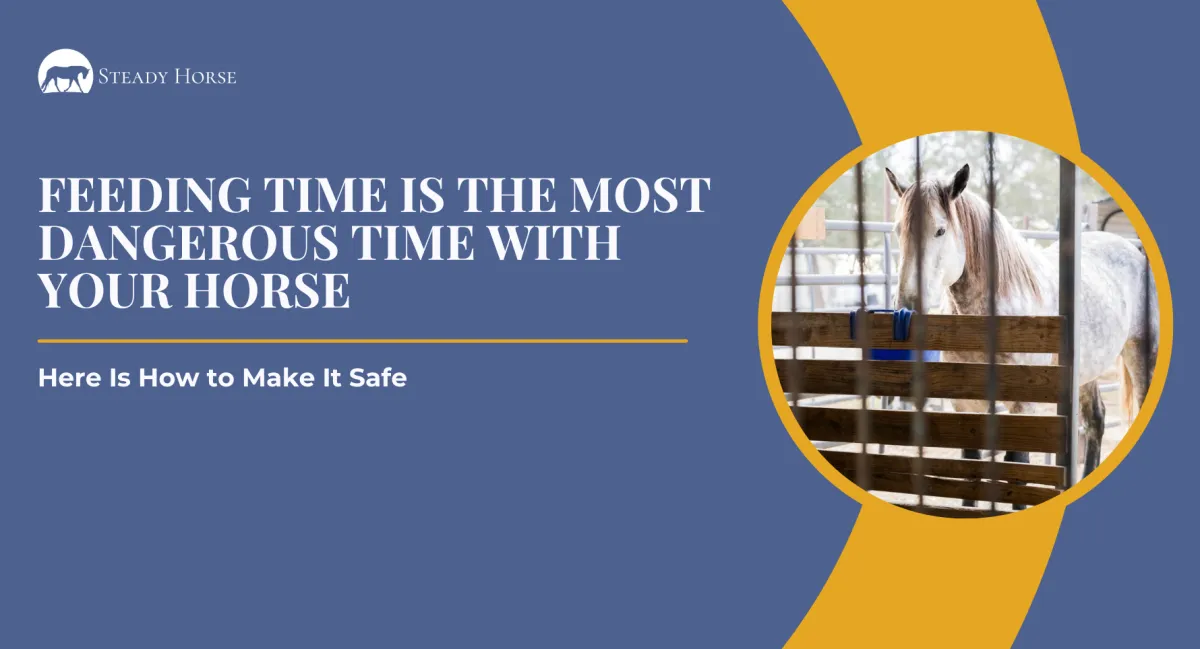
Feeding Time Is the Most Dangerous Time With Your Horse — Here Is How to Make It Safe
If someone asked you to name the most dangerous moment in your day with your horse, you would probably think about riding. Maybe a spooky trail. Maybe a fast canter that got out of control. Maybe a bolt or a buck you were not expecting.
But here is something that surprises a lot of people. Some of the most common and most dangerous moments with horses have nothing to do with riding at all. They happen at feeding time. They happen when you are carrying a bucket of grain to the stall. They happen when you are dumping feed into a trough in the pasture. They happen in those everyday, routine moments when your guard is down and your horse's instincts are turned all the way up.
A horse that gets pushy, aggressive, or kicks out at feeding time is not just being rude. They are putting you in real danger. And because it happens during such a normal part of the day, most people do not give it the attention it deserves until something goes wrong.
The truth is, feeding time is where some of the most important boundaries in your relationship with your horse are either established or ignored. And those boundaries are not just about manners. They are about your safety.
Why Feeding Time Brings Out the Worst
To understand why horses can become aggressive around food, you have to think about how horses are wired. In the wild, food is survival. Access to food is tied directly to the social hierarchy of the herd. The lead horse eats first. The lead horse decides who gets close and who stays away. Every horse in that herd knows exactly where they stand, and they know it because boundaries have been set clearly and enforced consistently.
When a horse in the pasture gets pushy around food with another horse, what happens? The dominant horse fires off a kick or pins their ears and drives the offender away. No hesitation. No second guessing. Just a clear, immediate response that says, "You do not get to come in here like that." And here is the interesting part: five minutes later, those same two horses are standing side by side like nothing happened. No hard feelings. The boundary was communicated, it was understood, and life moved on.
That is how horses communicate. A kick between horses is no big deal to them. It is just language. But when that same kick is directed at a person, it can break bones, crack ribs, or worse. What is casual communication between horses becomes a life threatening event when we are on the receiving end.
This is why it is so important to understand that your horse is not being mean when they get aggressive around food. They are operating on instinct. They are doing what horses do. The problem is not their instinct. The problem is that no one has set the boundary that tells them they cannot behave that way around people.
The Boundary You Cannot Skip
Here is a principle that applies to every interaction with your horse, but it is especially critical at feeding time: a horse can only kick you if you let them.
Read that again. A horse can only kick you if you allow them to come within kicking range of you before they have earned that right. If you do not let them get close enough to kick, they cannot kick you. It is that simple in concept, even though it takes intention and consistency to practice.
A horse that has a tendency to kick or get pushy at feeding time has to earn your trust and your respect before they are allowed anywhere near you with their hind end. They do not get to come crowding into your space. They do not get to rush the feed bucket. They do not get to swing their hindquarters toward you while you are pouring grain. Those are hard boundaries, the same way forward is never an option unless you specifically ask, and biting is never acceptable under any circumstances.
If we put our horse in a position where they can kick us, that is not their fault. That is on us. We set them up to fail by not establishing the boundary in the first place. And that is a hard pill to swallow for a lot of people because it means taking responsibility for something that feels like it should be the horse's problem. But it is not their problem. Setting boundaries is the leader's job. And at feeding time, you are the leader.
What Safe Feeding Actually Looks Like
So what does it look like in practice to set a feeding time boundary? It starts with one simple expectation: your horse does not approach the food until you say so.
Picture this. You walk into the stall or up to the feed trough with the bucket. Your horse is right there, pushing into your space, ears pinned, head tossing, maybe even swinging their hindquarters in your direction. Most people just try to get the feed into the bucket as fast as possible and get out of the way. They are managing the danger instead of addressing the behavior.
The leading with love approach looks completely different. If your horse is pushy and aggressive, that horse does not get to come anywhere near where you are feeding them until they can do so with manners. You back them up. You back them away from the feed area and you make it clear: you do not get to come in here until I say so.
You can use whatever tools you have available. Your steady stick. Your voice. Your energy. Your arms. Whatever it takes to communicate clearly that they need to move back and stay back. If you do not have a tool handy, get big. Wave your arms. Use your body language. Step into their space with intention and authority. You are not being mean. You are being clear. You are being the leader that your horse needs you to be.
Once they back up and show you that they can stand there with some self control, then and only then do you allow them to approach. And if they come in hot again, you send them right back. The cycle repeats until they understand the expectation: I approach food calmly and with manners, or I do not approach food at all.
Over time, your horse will start to be preemptive about it. They will see you coming with the feed and take a step back on their own. Not because they are afraid of you, but because they understand the boundary and they respect it. That is what clear leadership looks like.
Back Them Up Like You Mean It
Backing up is one of the most powerful tools you have for dealing with food aggression and kicking behavior, and there is a specific reason for that. It is physically difficult for a horse to kick when they are backing up because their hind end is engaged. When a horse is moving backward, they are thinking with their hind end, and that mental engagement makes it much harder for them to fire off a kick.
This is why backing up is always your first response when a horse is getting pushy, aggressive, or positioning their hind end toward you. You are not just creating distance. You are putting them in a state where the behavior you are trying to prevent becomes physically difficult to execute.
But here is where a lot of people fall short. They ask for the backup too softly. They wiggle the rope or tap the chest and their horse just stands there staring at them like nothing is happening. Sound familiar?
If that is your horse, you need to get bigger. You need to give them the pressure they actually require to understand what you are asking. That might mean tapping their chest with your steady stick with some real intention behind it. That might mean tapping their leg where they are going to feel it. That might mean using your voice, your body, your energy in a way that feels bigger than what you are used to.
You are not hurting them. You are being clear. And being clear is one of the kindest things you can do for your horse because confusion is what leads to dangerous situations. When your horse understands exactly what you are asking and exactly what the boundary is, they feel safer. You feel safer. Everyone is better off.
Start with one step back. Even a half step. The instant they give it to you, release all the pressure. Take a deep breath. Let them process. Then ask for more. Over time, you build up to where they back up promptly and willingly every single time you ask, regardless of the situation, regardless of whether there is food involved or not.
Move the Hind End When It Matters Most
Backing up addresses the behavior broadly, but when a horse is specifically turning their hind end toward you, you need to go directly to the source. Moving the hind end over is a more targeted correction, and it communicates something very specific: you are not allowed to point that end at me. Ever.
When you apply pressure to the hind end and make your horse move it away from you, you are addressing the kicking issue at its root. You are telling them in the clearest possible terms that positioning their hindquarters toward you is not acceptable. And the pressure you apply should be enough that they might even take more steps than you asked for. That is a good thing. That tells you they understood the message.
This is also where a lot of people get tripped up emotionally. They worry that if they apply that much pressure, their horse is going to be scared of them. They worry they are going to ruin the relationship. They worry their horse will never come up to them again.
That is not going to happen. Think about how horses handle this exact situation with each other. That lead mare in the pasture does not worry about hurting feelings when she fires off a kick at a horse that gets too close. She sets the boundary, the other horse understands it immediately, and five minutes later they are grazing side by side. No grudges. No damaged relationship. Just clarity.
Your horse needs that same clarity from you. And when you give it to them, they do not resent you for it. They respect you for it. They feel safer because they know exactly where the line is. Horses do not want to guess about boundaries. They want to know.
Be Preemptive, Not Reactive
One of the most important skills you can develop around feeding time is preemptiveness. Horses always give you a hint before they do something. Always. Before they kick, before they bite, before they crowd your space, there is a signal. It might be a pinning of the ears. It might be a slight shift of weight toward their hind end. It might be a dropping of the head or a tightening in their body. The signs are there if you are paying attention.
Your job is to catch those signs before the behavior happens and address them immediately. If you see your horse even thinking about swinging their hind end toward you, you do not wait to see what happens next. You apply pressure right then. You move that hind end over. You back them up. You make it clear that the thought itself is not acceptable, let alone the action.
This is the difference between being reactive and being proactive. Reactive means you wait until something bad happens and then you respond. Proactive means you read the signs, you intervene early, and you prevent the situation from ever escalating. Proactive keeps you safe. Reactive puts you at risk.
And here is something to keep in mind. You want to approach feeding time with awareness, not fear. There is a big difference. Fear makes you tentative, and tentative energy tells your horse that something is wrong. If you are afraid, your horse picks up on that instantly, and now they are wondering what they should be afraid of too. That does not make the situation safer. It makes it more volatile.
Awareness means you are paying attention. You are reading your horse. You are positioned safely. You know where the hind end is at all times. And you are ready to set a boundary the instant it is needed. That calm, confident awareness is exactly the kind of leadership energy your horse needs from you at feeding time and every other time.
Your Horse Corrects to You
There is a mindset shift that ties all of this together, and it is one of the most important concepts in safe horse handling. Your horse needs to correct to you. You should not be correcting to them.
What does that mean? It means you should never be the one tiptoeing around your horse, adjusting your position to stay safe, backing away to avoid being kicked. If your horse is too close, you do not back up. You make them back up. If their hind end is pointed at you, you do not walk around them. You move their hind end away from you. The adjustments always come from the horse, not from you.
This applies at feeding time, in the stall, in the pasture, in the arena, everywhere. You are the leader. You set the boundaries. And your horse moves to accommodate those boundaries. When you start operating from that mindset consistently, everything changes. Your horse begins to understand that you are someone who means what you say and says what you mean. And that kind of clarity is exactly what they need to feel safe, to trust you, and to stop testing the boundaries that keep both of you out of danger.
Feeding time does not have to be a dangerous part of your day. It can be one of the most powerful opportunities you have to practice leadership, set boundaries, and reinforce the connection and trust that makes everything else in your partnership possible. It starts with one simple decision: my horse does not get to come into my space at feeding time until they can do so with manners. Everything else follows from there.
If you are ready to start building the kind of trust and leadership that keeps you and your horse safe, there is a free training available right now that can help. It walks you through the foundation of creating safety, confidence, and real connection with your horse. It will not be available forever. Head over to https://steadyhorse.com and check it out while you can.
