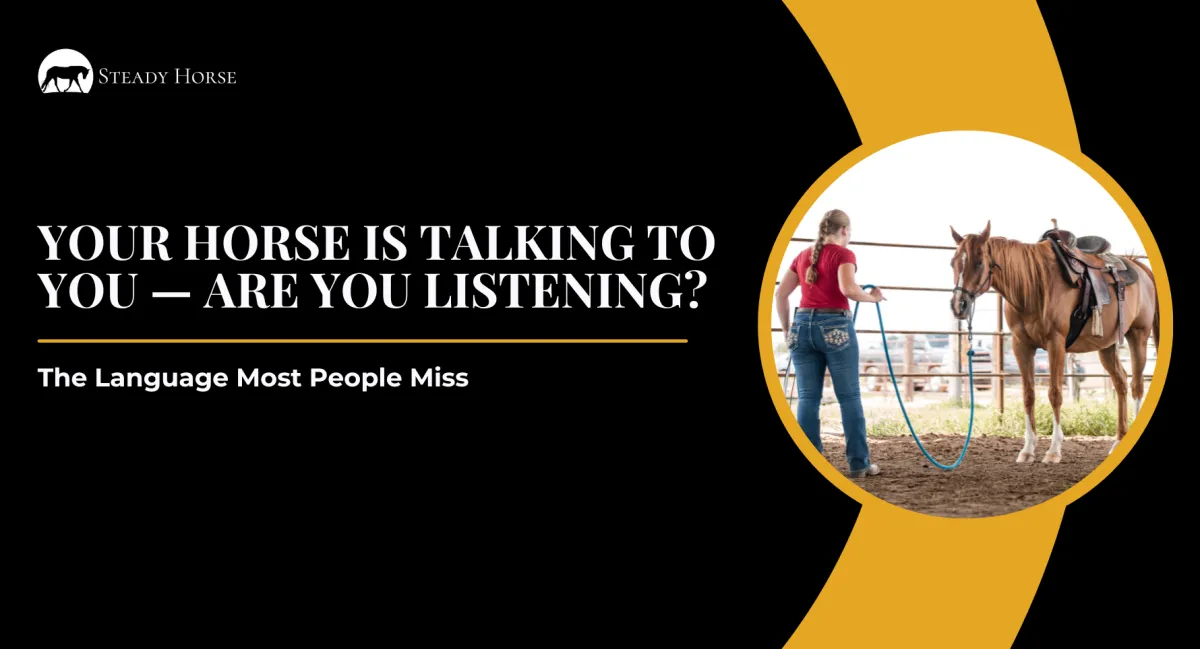
Your Horse Is Talking to You — Are You Listening?
There is an old story from the Bible about a man named Balaam who saddled up his donkey and headed down the road on a mission. Along the way, the donkey suddenly veered off into a field. Balaam could not understand why, so he beat the donkey to get him back on the road. A little further along, the donkey squeezed against a stone wall, crushing Balaam's foot. Balaam beat him again. Then the donkey simply laid down in the middle of the road and refused to move. Balaam beat him a third time.
What Balaam could not see — what he was completely blind to — was the angel of the Lord standing in the road with a drawn sword. The donkey saw it every single time. Every veer, every squeeze, every time he laid down, that donkey was trying to protect his rider from danger. And every single time, Balaam punished him for it.
When God finally opened Balaam's eyes and he saw the angel, the donkey's words hit hard: "Am I not your very own donkey whom you have always ridden to this day? Have I been in the habit of doing this to you?"
In other words — you know me. I have been faithful to you. I am not doing this to make your life difficult. I am trying to tell you something.
That story is thousands of years old, but it could have happened in your barn this morning. Because your horse is talking to you every single day. The question is whether you are listening or whether you are too caught up in your own agenda to hear what they are saying.
They Are Always Communicating
Horses do not use words, but they never stop communicating. Every flick of an ear, every shift of weight, every brace in their body, every time they drop their head or raise it, every time they lean toward you or away from you — that is language. It is constant and it is specific.
The problem is not that our horses are not talking. The problem is that most of us were never taught how to listen. We were taught to focus on what we want the horse to do. We were taught to correct the behavior. We were taught to see resistance as disobedience and confusion as stubbornness. And so we miss what is right in front of us — a horse that is trying desperately to communicate something we are not picking up on.
Balaam's donkey had never once given him trouble. Not once in all the years Balaam had ridden him. So when the donkey started acting out of character, that should have been the first clue that something was going on. Instead of stopping and asking why, Balaam got frustrated and punished his faithful companion for doing exactly what a faithful companion should do — trying to keep him safe.
How many times have we done the same thing with our horses? They start resisting something they have done before, and our first reaction is frustration. We think they should know this by now. We think they are being difficult. But what if they are trying to tell us something we are not seeing?
The Language Most People Miss
One of the most important shifts you can make as a horse owner is learning to see your horse's struggles not as something negative but as something incredibly valuable. When your horse is confused, when they are resistant, when they are not doing what you think they should be doing, they are giving you information. They are telling you exactly where the gap is — and most of the time, that gap is not in their understanding. It is in your communication.
Here is a real example. A horse owner was working on sending her mare around to the right. To the left, beautiful. Smooth, responsive, no issues at all. But to the right, the mare kept turning in. Over and over. The owner was getting more and more frustrated, thinking her horse was being stubborn or defiant. She knew how to do this. She had just done it the other direction.
Then came the moment of truth. The owner realized that every time she sent her horse to the right, she was inadvertently taking a tiny step backward. Just a baby step. Almost imperceptible. But to the horse, that step back was a clear signal: come toward me. The mare was not being disobedient. She was doing exactly what her owner was telling her to do. The owner just could not see it.
That is what your horse's "misbehavior" looks like most of the time. It is a mirror reflecting your own communication back to you. And when you finally see it, when you finally understand what they have been trying to tell you, it changes everything.
Put Yourself in Their Place
There is a phrase we use a lot in this kind of work: see things through the lens of your horse's eyes. It sounds simple, but it requires a real shift in how most people approach training.
Instead of standing in your own frustration and asking, "Why won't my horse do what I want?" you step into their perspective and ask, "What is my horse experiencing right now?"
Think about what it is like to be a horse for a moment. You are a prey animal. Your survival depends on reading your environment with extraordinary precision. You are constantly scanning for threats, constantly processing signals from every direction. And your human — the one you depend on for leadership and safety — is giving you signals too. Every shift in their body position. Every change in their energy. Every tightening of their hands on the lead rope.
Now imagine your human is asking you to do something, but the signals do not match. Their body is saying one thing, their energy is saying another, and their hands are doing something else entirely. You do not know which signal to follow. So you guess. And you guess wrong. And now your human is frustrated with you, and you have no idea why because you were doing the best you could with the information you were given.
That is what it feels like to be a horse who is not getting clarity from their leader. They are not being bad. They are not being stubborn. They are confused, and they are looking to you to make it make sense.
Here are some of the most common things to check when your horse seems to be struggling:
Your body position — Are you accidentally blocking their movement? If you are standing at their shoulder when you want them to go forward, you are telling them to stop. If you are leaning back when you want them to continue on the circle, you are inviting them to turn in.
Your energy — Does your energy match what you are asking? If you want your horse to move out and your energy is flat and quiet, your horse does not know you mean business. If you want them to relax and your body is tense and rushed, they cannot settle because you have not settled.
Your pressure — Are you giving your horse the pressure they actually need, or the pressure you are comfortable giving? Some horses need more energy and bigger asks to understand what you want. That is not being mean. That is being clear.
Your timing — Are you releasing pressure at the right moment? If your horse gives you the right answer and you are late with the release, they do not know they got it right. Timing is everything in their world.
Every single one of these things is something your horse is responding to whether you realize it or not. They are reading you with a level of precision that most people drastically underestimate. So when something is not working, before you look at your horse, look at yourself. Nine times out of ten, the answer is there.
Meet Them Where They Are — Not Where They Were
Here is another piece of this that trips people up. Just because your horse did something perfectly yesterday does not mean they are in the same place today. Horses are living, feeling beings. They have good days and harder days, just like we do. They can be affected by weather, by herd dynamics, by how they slept, by something that happened on the trail last week that is still sitting in their mind.
So when you go out to work with your horse and they seem to have forgotten everything they knew yesterday, resist the urge to get frustrated. Meet them where they are in that moment. Not where they were last week. Not where you think they should be. Where they actually are right now.
This is one of the hardest things for people to accept because we want forward progress. We want to build on what we did last time. And we will get there. But sometimes getting there means taking a step back and rebuilding confidence in something your horse was solid on two days ago. That is not failure. That is good horsemanship. That is the kind of leadership your horse needs from you — someone who pays attention to where they are and adjusts accordingly rather than plowing ahead with their own agenda.
Think about it this way. If you went to work one morning feeling off — maybe you did not sleep well, maybe something was weighing on your mind — and your boss immediately started piling on tasks and getting frustrated that you were not performing at your usual level, how would that feel? Now imagine instead your boss noticed something was different, checked in with you, and adjusted the day's expectations. Which boss would you trust more? Which one would you work harder for in the long run?
Your horse is asking the same question every time you show up.
Two Types of Horses, One Principle
Something worth understanding is that horses generally tend toward one of two categories in how they communicate. Some horses are what we call dull or lazy — the Eeyore types. They are lower energy, they need bigger asks, and they can seem like they are tuning you out. These horses need you to bring more energy and be willing to match the pressure to what they actually require. Tapping lightly on a horse that needs a firm ask is not being kind. It is being unclear. And unclear is unfair.
On the other end of the spectrum, you have the reactive, sensitive horses. These are the ones that do not need much pressure at all. If you come in with the same energy you would use on a dull horse, you are going to send a reactive horse into orbit. They need you to be softer, quieter, and more precise.
Neither type is better or worse. But knowing which type your horse is — and adjusting your communication accordingly — is one of the most important things you can do. This is part of listening. This is part of seeing through their eyes. Your horse is telling you what they need from you if you are willing to pay attention.
And here is where connection checks come in. Whether you are on the ground or in the saddle, it is important to regularly check in with your horse and make sure they are still with you mentally. On the trail, that might look like a random circle, a change of direction, asking for a few steps of backup, or moving the front end over. On the ground, it might mean asking for a response after a rest period to make sure your horse has not mentally checked out.
These are not tests. They are conversations. You are saying, "Hey, are you still with me?" And your horse's response tells you everything you need to know about where their mind is in that moment.
Your Horse Is Not the Problem
If there is one thing that every horse owner needs to hear, it is this: there is no such thing as a bad horse. Horses are not created bad. They are innocent. They are born needing leadership and direction, and when they do not get clear guidance, they come up with their own answers. Sometimes those answers look like bucking, bolting, running off, or refusing to move. But those are not behavior problems. Those are communication breakdowns.
Your horse does not mind doing what you ask. They really do not. What they mind is not understanding what you are asking. They mind getting punished for giving you exactly what your body language told them to do. They mind being asked the same confusing question over and over with increasing frustration and no additional clarity.
Balaam's donkey said it perfectly: "Have I been in the habit of doing this to you?" In other words, you know me. I do not act like this without reason. Something is going on that you are not seeing.
Your horse is saying the same thing every time they resist, every time they brace, every time they seem to shut down or act out. They are not being difficult. They are being honest. And that honesty is a gift if you are willing to receive it.
Grace Changes Everything
There is one more piece of this that matters deeply, and it is not about your horse at all. It is about you.
When you start learning to see things through your horse's eyes, when you start recognizing that many of the struggles were actually communication gaps on your end, it is easy to spiral into guilt. The woulda, coulda, shouldas can eat you alive if you let them. You start thinking about all the times you got frustrated when your horse was just confused. All the times you pushed when you should have paused. All the years you did things the old way because you simply did not know there was a better way.
Here is what you need to hear. You were doing the best you could with what you knew at the time. Every single one of us was. And the fact that you are here now, learning and growing and trying to be better for your horse, that is what matters. Not what happened before. What you are doing now.
Horses are incredibly forgiving creatures. That is one of the most beautiful things about them. You can have twenty years of doing things a certain way, and when you show up differently, your horse will meet you there. It might take time. It might take patience. The horse you have had for two decades might be a harder reset than the young horse you are starting fresh with. But they will get there because horses do not hold grudges. They respond to what is happening right now.
So give yourself the same grace you are learning to give your horse. Recognize where you need to grow, commit to doing better, and then let go of the rest. You cannot lead your horse with love if you are beating yourself up every time you fall short. And you will fall short. We all do. That is part of being human. The important thing is that you pick up, you learn, and you keep going.
Start Listening
Your horse is talking to you right now. Not with words, but with everything they have. Every ear, every eye, every muscle, every breath. They are telling you what they need, how they feel, and whether or not your communication is landing.
The question is not whether your horse is speaking. The question is whether you are willing to slow down, step out of your own perspective, and truly listen. Because when you do — when you finally see what your horse has been trying to show you all along — that is when the real connection begins. That is when trust stops being a concept and starts being something you can feel between the two of you.
Your horse has been waiting for you to hear them. They have been faithful. They have been patient. And just like Balaam's donkey, they have been doing their best to tell you the truth even when you could not see it.
It is time to open your eyes. It is time to listen.
If you are ready to start building that kind of connection with your horse, there is a free training available right now that can help you get there. It is all about creating safety, confidence, and a real relationship with your horse — and it will not be available forever. Head over to https://steadyhorse.com and see what it is all about.
