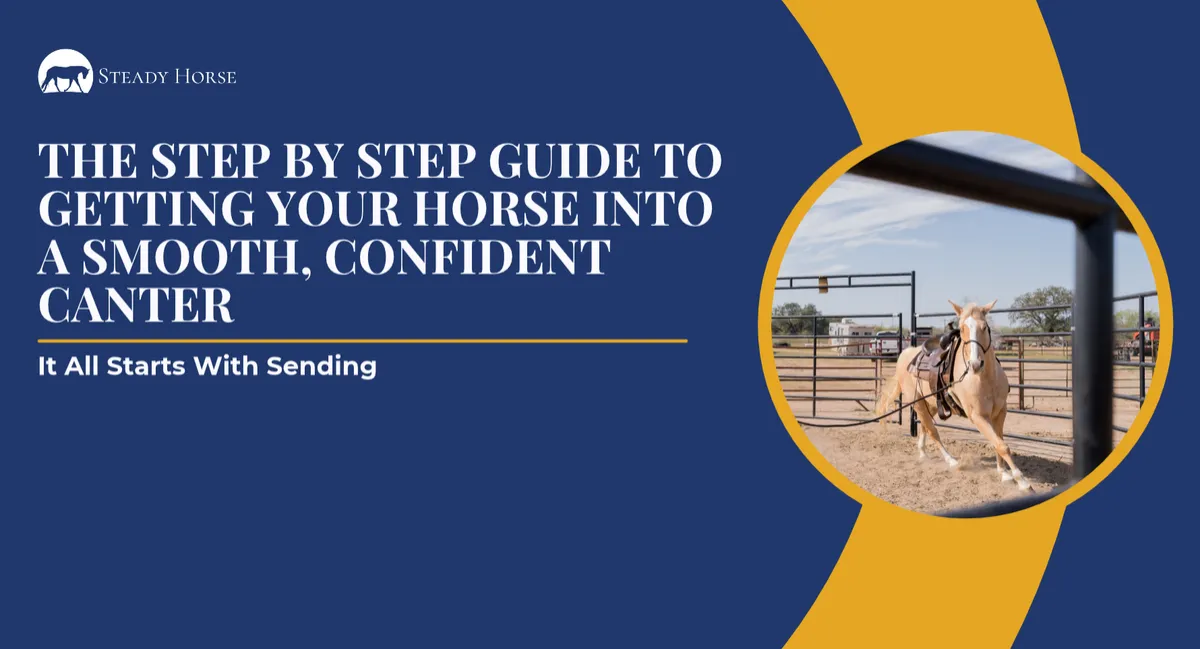
Step by Step Guide to the Canter
It does not happen by accident. It happens through a progression that most people skip.
There is a belief in the horse world that goes something like this: all horses know how to canter. They run around in the pasture. They canter when they play. They canter when they spook. So of course they know how to do it. Why would you need to teach a horse something they already do on their own?
Here is the problem with that thinking. Just because a horse can run does not mean they can canter smoothly, balanced, and on your terms. A horse running through the pasture with their legs going in four different directions is not the same as a horse cantering calmly and responsively because their rider asked for it. One is instinct. The other is training. And the gap between those two things is where people get hurt.
A horse that has not been properly set up for the canter is going to be rough. They are going to be unbalanced. They might kick out. They might buck. Not because they are being bad, but because their body is not prepared for what you are asking and they do not have the balance or the muscle memory to do it well. They are trying to figure it out in the moment, and that is not a position you want to be in when you are sitting on their back.
The good news is that teaching your horse to canter well is not complicated. It is methodical. It follows a clear progression that starts on the ground and builds step by step until your horse can depart into a canter smoothly, hold it confidently, and come back down when you ask. Every horse can get there. It just takes the right steps in the right order.
Why Cantering Matters More Than You Think
Before we get into the how, it is worth understanding the why. Because a lot of people convince themselves they do not need to teach their horse to canter. They are happy walking and trotting. They do not show. They do not need speed. So why bother?
There are a few reasons, and some of them are about safety more than anything else.
First, you never know when you are going to need your horse to canter. You might be on a trail and a thunderstorm rolls in and you need to get off that mountain. You might need to move quickly to get out of a situation that is becoming dangerous. If your horse does not know how to canter in a balanced, collected way, that moment is going to be chaotic instead of controlled.
Second, an unbalanced canter is one of the most common causes of bucking and kicking out. When a horse is asked to canter before their body is ready, they scramble. Their legs go everywhere. They lose their balance and react by kicking out or throwing in a buck. That is not defiance. That is a horse whose body cannot do what you are asking because the prep work was never done.
Third, a smooth canter shows a level of connection and confidence between you and your horse that nothing else quite replicates. When your horse can depart into a canter calmly because you asked, hold it because they are balanced, and come back down because you breathed them down, that is a partnership operating at a high level. That is trust in motion.
And if you are not riding yet, none of this is wasted. Every step of this progression starts on the ground. You are building the foundation now so that when the time comes to canter under saddle, your horse is already prepared.
It All Starts With Sending
The foundational groundwork for the canter is sending. If you are not familiar with that term, a lot of people call it lunging. But sending is lunging with a purpose. You are not just running your horse in mindless circles until they are tired. You are doing intentional work with specific steps and lots of transitions.
Sending has three basic steps that set your horse up for everything that follows:
Step one: the backup. You back your horse up first, putting them on their hind end. This develops balance and prepares them for the departure, which is the moment they propel off into the next gait. The backup engages the hind end, and an engaged hind end is what makes a smooth departure possible.
Step two: moving the front end over. After the backup, you pivot their shoulder, moving the front end over so they step onto the circle. Their hind end stays relatively in place while the front end moves, positioning them to travel around you.
Step three: driving them forward and around. Your lead rope arm stretches out, giving them direction. Your pressure goes to the hind end, driving them forward onto the circle. And they go.
Those three steps are the launch sequence for everything. Every transition, every departure, every progression toward the canter starts with this foundation. If your horse is not solid on these three steps, this is where you stay until they are.
The Progression Through the Walk
Once your horse is sending, you start at a walk. Not a trot. Not a canter. A walk. And you do not rush past it.
Here is what the full walk progression looks like:
The walk. Just get your horse walking on the circle when you ask. If they only make it partway around, that is fine. You are not looking for perfect. You are looking for response. If your horse wants to give you more, let them. Do not stop them for doing the right thing. But do not demand a full circle when they are still learning.
The sustained walk. Once they are walking, you build up to them holding that walk. One lap around. Two laps. Three. They are staying in the walk without trying to stop. If they give you an indication they want to slow down or quit before you ask, be preemptive. Raise your steady stick, raise your lead rope arm, keep the pressure present so they understand the expectation: keep going until I tell you otherwise.
The working walk. This is where you add pressure to get more energy out of the walk. Your horse is still walking, but they are moving with purpose. More speed, more drive, more engagement. This is the point just before the trot. You can feel it building. They are at a good clip, but their head is not up high and they are not wired. They are just walking with energy.
Every one of these stages has the same focus: the departure. You are not worried about sustaining anything yet. You are focused on how cleanly and willingly your horse moves from one stage to the next. That transition, that moment of departure, is where everything is built.
The Progression Through the Trot
Once your horse is solid through all three stages of the walk, you add pressure to get the trot. Same progression. Same principles. Same patience.
The trot departure. You add more pressure from the working walk and your horse steps into a trot. You are only looking for a few strides. Maybe just the departure itself. If they give you more, let them go. If they fall out of it after three strides, that is fine. You draw them in, send them out again, and get another departure. That is the repetition that builds everything.
The sustained trot. Your horse holds the trot around the circle without trying to quit. Same principle as the sustained walk. If they start to slow down, be preemptive. Apply pressure before they actually stop, not after. You want to keep that momentum going rather than having to restart it every time.
The working trot. More energy. More drive. Your horse is trotting at a good clip, building speed, but still calm and responsive. Not panicky. Not rushed. Just moving with purpose. This is the ideal setup for the canter departure.
Something important to understand here: your horse is going to look different from every other horse doing this. All horses have variations of every gait. Your horse’s trot is not going to look like anyone else’s. That is normal. You are not comparing. You are reading your horse and building their individual progression at their individual pace.
The Canter Departure
And now we arrive at the word you are going to get very tired of hearing: departure.
The canter departure is the single most important thing in this entire progression. It is more important than sustaining the canter. It is more important than how many laps your horse can hold. It is the moment your horse propels off the trot and into the canter, and it is what you are going to practice over and over and over again.
Here is how it works. Your horse is in that working trot. You add more pressure. Maybe you tap the ground behind them with your steady stick. Maybe you tap them on the hind end. Maybe you raise your energy. Whatever your horse needs to understand that you are asking for more. And they step into the canter.
You are only looking for a couple of strides. That is it. If they give you two clips of canter and fall out of it, that is a win. You draw them in, let them rest for a moment, send them back out, build through the trot, and ask for another departure. And another. And another.
This is where the repetition matters most. Lots and lots and lots of departures. Not sustained cantering. Departures. You are building muscle memory. You are building mental memory. You are teaching your horse that the departure is smooth, it is predictable, it is something they know how to do, and it is nothing to be worried about.
A few things to expect during this phase that are completely normal:
Your horse might speed up into a faster and faster trot instead of stepping into the canter. That is okay. Keep the pressure on. They are trying to figure out what you want. Eventually they will find the canter because the trot is not making the pressure stop.
Your horse might kick out when you ask. That is frustration, not defiance. They are working hard and they are not sure what the right answer is yet. Do not stop the pressure when they kick. If anything, add more. You are telling them that kicking is not going to make this stop. Finding the canter will.
Your horse might pick up the wrong lead or crossfire. Do not worry about it. Do not even think about it. They will find their balance and their correct lead through repetition. That is not your job to manage right now. Your job is departures.
From the Ground to the Saddle
Everything you do on the ground translates directly to what happens under saddle. The progression is identical. Walk, sustained walk, working walk, trot, sustained trot, working trot, canter departure. The only difference is the tools.
On the ground, your pressure comes from your steady stick, your lead rope, your energy, and your body position. Under saddle, your pressure comes from your body in a specific succession:
Start by squeezing your thigh. Then your knee. Then your calf. Then your heel. Then bumping with your heel. Then adding a kiss or a cluck. That is the escalation ladder. You start at the lightest pressure and only increase if your horse does not respond. Most horses will not need all of those steps. That is just the full progression if you need it.
When you feel that lift in their body, that rocking chair feel where their hind end engages and they rock up into the canter, release the pressure immediately. That is the departure. That is what you have been building toward. And it feels incredible.
One of the most common mistakes riders make at this stage is pulling back on the reins while asking for the canter. It happens instinctively. You are nervous. Things are about to speed up. Your hands tighten. Your body braces. And now you are telling your horse to go faster with your legs while telling them to slow down with your hands.
That confusion can cause rearing, bucking, or a horse that simply will not canter because the signals are contradicting each other. You have to give them their rein. Give them their head. Let them have somewhere to go. If you have done the groundwork and you have those solid departures on the ground, your horse knows what to do. Trust them. Trust the process. And let them go.
It Is a Process, Not an Event
The canter does not happen in one session. It does not happen in one week. For some horses, it might take a couple of weeks of consistent work. For others, it might take a couple of months. One rider spent two months just on the walk and trot transitions before ever asking for the canter, and when she did, her horse stepped into it beautifully because the foundation was that solid.
That is the payoff of patience. When you do not rush the progression, when you give each stage the time and the repetitions it deserves, the canter shows up almost naturally. Your horse has built so much balance, so much confidence, so much understanding of the transitions that stepping into the canter is just the next logical step. It is not scary for them because every stage before it was handled with care.
And here is the part that should encourage you if the canter feels intimidating right now. Once your horse has the departure, you can always get it back. If they fall out of the canter, you are not starting over. You just ask again. Because you have practiced so many departures on the ground, and then so many more under saddle, the pathway is burned into their muscle memory. It is there whenever you need it.
Do not let fear keep you from teaching your horse something this important. Work the progression. Trust the steps. And when the time comes, give them their rein, sit deep in the saddle, and let them show you what you built together.
If you are ready to start building the kind of foundation that makes the canter possible, there is a free training available right now that can help. It walks you through the fundamentals of creating safety, confidence, and real connection with your horse from the ground up. It will not be available forever. Head over to https://steadyhorse.com and take the first step.
