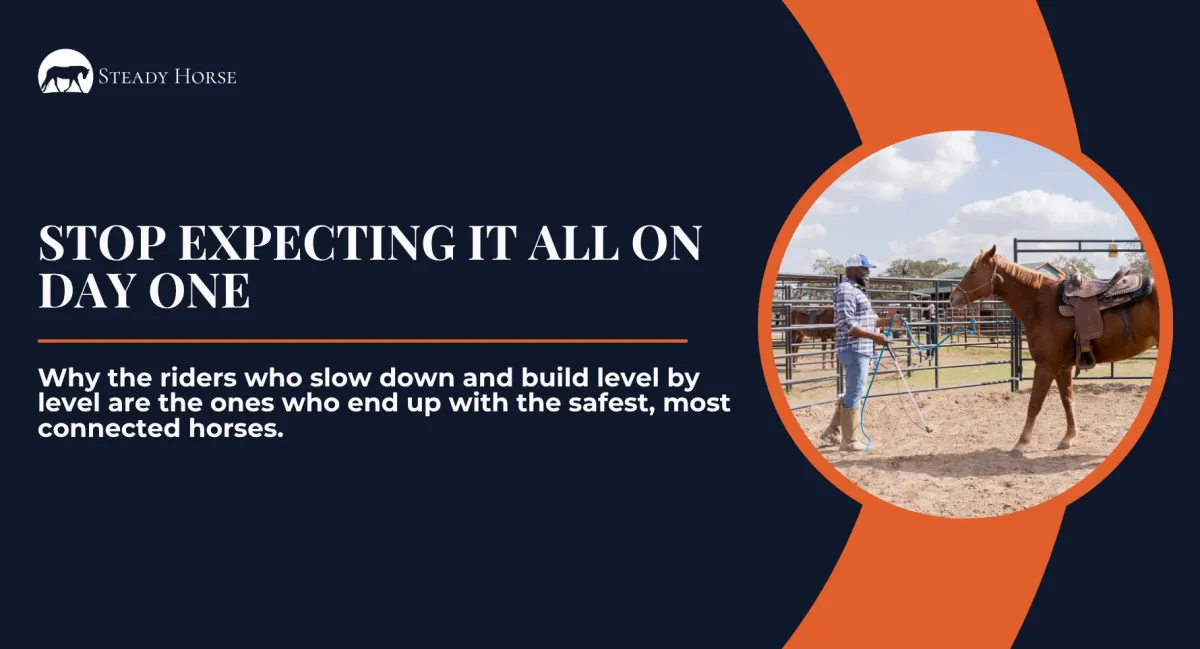
How to Build a Horse Who Stays With You
I see it all the time.
Someone starts working on backing up with their horse, and within the first session, they're frustrated. "Why won't he lower his head?" "How come she keeps walking forward after I back her up?" "He backed up once, but then he just checked out and looked at the barn."
And I get it. When you watch someone work with a well-trained horse, it looks effortless. The horse backs up soft and light, head low, eyes locked on their person. No resistance. No wandering. No drama. And you think, "That's what I want." So you go out there and expect your horse to give you all of that on day one.
But here's the truth that nobody wants to hear.
That horse you admire didn't get there in a day. They got there because someone was patient enough to build it one level at a time. One step at a time. One repetition at a time. And the rider who built that horse? They weren't in a hurry. They were committed to the process.
If you want a horse who truly stays with you — not because you're holding a lead rope, but because they've chosen you — you have to earn it. And earning it means slowing down long enough to build real understanding.
What "Staying With You" Actually Means
When I talk about a horse who stays with you, I'm not talking about a horse who stands next to you because you feed them treats. I'm not talking about those pocket horses who crowd your space because they've learned that being close to you means cookies.
I'm talking about something much deeper.
A horse who stays with you is a horse who chooses you even in the midst of chaos. When something scary happens. When their instinct is telling them to run, to flee, to kick, to buck, to take off. When every fiber of their being is screaming "get out of here" — they look at you instead. They trust that being with you is safer than being anywhere else.
That kind of connection doesn't come from a single groundwork session. It doesn't come from watching a video and trying something once. It comes from hundreds of small moments where you showed your horse, through consistent and clear communication, that you are worth trusting.
And two of the most powerful tools you have for building that trust are also two of the most overlooked — backing up and leading.
Why Backing Up Is the Foundation of Everything
Most people think backing up is just a maneuver. You ask your horse to go backwards, they go backwards, and that's the end of it. Maybe it's practical — you come up on something on the trail and you need to back away from it. Sure. That's part of it.
But backing up is so much more than that.
When I back my horse up, I'm not just looking at whether they move their feet backwards. I'm measuring four things:
Connection — Is my horse mentally with me right now, or are they somewhere else? Are they locked in on me, or are they scanning the environment for the gate, the barn, or another horse?
Attentiveness — How quickly can I get my horse's focus? If they drift, how fast can I bring them back? Are they paying attention to me, or am I competing with everything else in their world?
Responsiveness — When I ask, how quickly do they answer? Is it half a second? Two seconds? Five seconds? The speed of their response tells me exactly how tuned in they are.
Restraint — After I back them up, can they stay there? Or do they immediately creep forward because their brain is telling them that forward is the way out of pressure?
Those four qualities — connection, attentiveness, responsiveness, and restraint — are the same four things that keep you safe in the saddle. A horse who is connected, attentive, responsive, and shows restraint on the ground is going to give you those same qualities when you're riding.
And it all starts with the backup.
The Levels Most People Skip
Here's where most riders go wrong. They look at backing up as one thing — either your horse backs up or they don't. But backing up is actually a progression. There are levels to it, and each level builds on the one before it. When you skip levels, you create holes. And holes are where people get hurt.
Level One: One Consistent Step
That's it. That's the whole goal. Can you ask your horse to take one step backwards, and do they give it to you? Not sometimes. Not when they feel like it. Every single time you ask.
If you have a young horse or a green horse or a horse who's never really been asked to back up with intention, this is where you start. And you stay here until it's solid. You're looking for that step to come quicker, with less pressure, more consistently.
Don't rush past this. A lot of riders get one decent step and immediately start asking for five. But if that one step isn't happening ten out of ten times, you don't have a foundation. You have a suggestion your horse sometimes agrees with.
Level Two: Attention Stays on You
Now it's not just about the step. It's about what happens after the step. Does your horse keep their attention on you, or do they immediately look away?
This is where it gets exhausting for a lot of people. Because some horses will back up and then immediately check out. They'll look at another horse. They'll stare at the gate. They'll drop their head to sniff the ground. And every single time they lose that attention, you have to back them up again.
Not as punishment — as clarity. You're teaching them that the best place for their focus is on you. And every time they choose something else, they get redirected right back to the work.
With some horses, you might feel like you're backing them up until the cows come home. That's okay. That's the work. Stick with it.
Level Three: Multiple Steps, Softly, With Attention
Once you have one solid step with attention that's reliable ten out of ten times, now you can start asking for two steps. Then three. Then four. And you're looking for those steps to come softly — without a big fight, without heavy resistance, without your horse bracing against you.
This is where the patience really pays off. A horse who was given time to master level one and level two will move into level three almost naturally. They understand the game. They know what you're asking. And because the foundation is solid, the multiple steps feel like a natural extension rather than a brand new demand.
Level Four: Immediate Departure, Zero Resistance, Low Headset
This is mastery. This is where your horse backs up the moment you ask. There's no hesitation. No resistance. And their head is low and relaxed.
Now, here's something critical that most people get wrong. The low headset comes last. Not first. Last. And yet it's usually the first thing riders worry about.
"But his head is so high when I back him up." "She looks like a giraffe." "He's so tense."
Of course they are. They're learning something new. When anything is new to a horse — anything they don't fully understand yet — that head goes up. That's self-preservation. That's their nervous system doing exactly what it was designed to do.
A low headset is not something you manufacture. It's not something you force or pull down. A low headset is a demonstration of understanding. It shows up when your horse truly gets what you're asking, when they feel comfortable with the exercise, when they trust the process. It comes with repetition. It comes with time. And if you chase it before the other levels are solid, you'll end up with a horse who has their head down but isn't actually connected, attentive, responsive, or showing restraint.
Let the headset come on its own. Focus on the foundation.
Leading Is the Other Half of the Equation
Everything I just said about backing up applies to leading too — just in the other direction.
When you lead your horse, you're measuring the same four qualities. Are they connected? Are they attentive? Are they responsive? Are they showing restraint — coming forward without running you over or crowding your space?
And leading has its own levels too.
Level One is simply getting one step forward when you ask. For a young or green horse, this might involve holding pressure on the lead rope until they take that first step toward you. The moment they step, you release. That's the conversation.
Level Two is stringing multiple steps together. They're not just giving you one step — they're walking with you. They're keeping up.
Level Three is where the magic starts. They're following your feel. You don't have to hit the end of the lead rope to get them moving. You just walk, and they walk with you. There's no tension on the line because they're staying with you voluntarily.
Level Four is the full picture — multiple steps forward, no pulling on the lead, no crowding, and a low calm headset. They're soft, attentive, connected, and respectful of your space all at the same time.
And just like with backing up, if you try to jump straight to level four, you'll create holes. You'll end up with a horse who walks beside you sometimes but runs you over other times. A horse who follows you to the barn but balks on the way to the mounting block. A horse who seems fine until one day they're not — and you can't figure out why.
The "why" is almost always a skipped level.
Why Repetition Matters More Than You Think
I know this isn't the sexy answer. Nobody wants to hear "do it a hundred times." We want the shortcut. We want the three-step fix. We want to feel like we've got it figured out after one session.
But horses don't learn that way.
Your horse's brain is a prediction machine. It's constantly making subconscious predictions about what's going to happen next and what they need to do to stay safe. When you back your horse up and they immediately walk forward, that's not them being stubborn or disrespectful. That's their brain predicting that forward is the way out of pressure.
Because in the wild, forward is always the way out. Run. Flee. Move. Get away. That's how horses have survived for thousands of years.
You are literally rewriting survival programming. And that doesn't happen in five repetitions. It might not happen in fifty. But somewhere around that hundredth time, something shifts. Their brain starts to predict differently. Instead of "forward gets me out of this," it becomes "staying here with my person gets me out of this." And that's when everything changes.
So don't try something seven times and decide it's not working. Give your horse the gift of repetition. Give them enough tries to actually learn.
The Mistake That Costs You the Most Time
Here's something that might sting a little, but it's important.
The biggest time-waster in horse training is not being preemptive.
What I mean by that is this: most riders wait too long to correct. They see their horse start to drift forward, or lose attention, or crowd their space, and they wait. They watch it happen. Maybe they're hoping the horse will self-correct. Maybe they're not sure what to do. Maybe it happens so fast they feel like they missed it.
But here's what your horse experiences during that delay.
In those seconds between the moment they made the wrong choice and the moment you finally stepped in, your horse was learning. They were learning that drifting forward is okay. That looking away has no consequence. That crowding your space works.
Every second you wait is a second your horse spends practicing the wrong thing.
Being preemptive means knowing what your horse is going to do before they do it. You know they're going to look away — so you're ready before they do. You know they're going to creep forward — so you catch the weight shift before the foot moves. You know they're going to crowd your space — so you correct the lean before it becomes a push.
This is where the real speed comes from. Not from rushing through the levels, but from being sharp and immediate within each level. When your timing is clean, your horse learns faster because the conversation is clearer. There's no confusion about what you're asking. There's no gray area. Just clear, consistent communication that says, "I see you, I'm paying attention, and I've got expectations."
The Crockpot, Not the Microwave
I love this analogy because it's so true for everything we do with horses.
Good food takes time. Nobody ever pulled a Thanksgiving turkey out of the microwave and said, "This is the best meal I've ever had." The good stuff — the stuff that falls off the bone, that makes the whole house smell incredible — that takes hours. It takes patience. It takes trusting the process even when it feels like nothing's happening.
Building a bond with your horse is the same thing.
Slower is faster. I know that sounds contradictory, but hear me out. When you take the time to get level one absolutely solid before moving to level two, you don't have to go back and fix it later. When you build level two on top of a rock-solid level one, level three comes easier and faster than it would have if you'd rushed.
The riders who take the longest to develop their horses are usually the ones who moved the fastest at the beginning. They skipped steps. They assumed their horse "got it" after a few good tries. They chased the low headset before the connection was there. And now they're circling back to patch holes that shouldn't have been there in the first place.
The riders who end up with the safest, most connected, most responsive horses? They're the ones who were boring. Who did the same thing over and over until it was bulletproof. Who didn't move on until they had ten out of ten. Who let the headset come when it was ready.
When Your Horse Struggles, That's the Gift
I want to leave you with this because it's a mindset shift that changes everything.
When your horse balks on the way to the mounting block, when they look away during backing up, when they crowd you while leading, when they resist going forward — that is not a setback. That is your horse trusting you enough to show you where the holes are.
A horse who pretends everything is fine and then comes unglued seemingly out of nowhere? That's the dangerous horse. That's the horse who never felt safe enough to show you they were struggling.
A horse who pushes back, who tests, who shows you exactly where their understanding breaks down — that horse is communicating. They're giving you the roadmap. They're telling you, "I need more help here. I need more repetition. I need you to slow down and meet me where I am."
Your job is to listen. To meet them at the level they're actually on — not the level you wish they were on. To build the foundation one step at a time, one level at a time, with enough patience and repetition that your horse doesn't just comply with what you're asking.
They understand it.
And a horse who understands is a horse who stays with you. Not because they have to. Because they want to.
If you're ready to start building that kind of connection with your horse — the kind that's based on real understanding, not just obedience — I've put together a free training that shows you exactly where to begin. It's available for a limited time and it's designed for riders at every level who want to feel safer and more confident with their horse.
