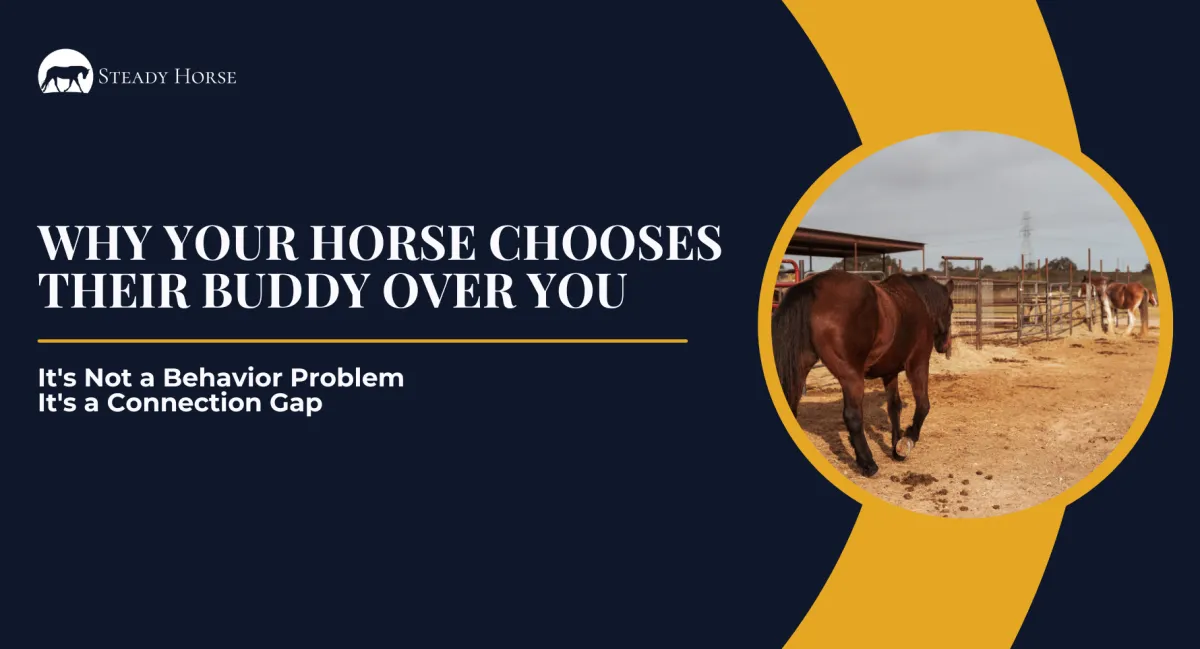
Why Your Horse Chooses Their Buddy Over You
You walk out to the pasture, halter in hand, feeling good about the session you've got planned. But the moment you start leading your horse away, it begins. The head goes up. The whinnying starts. Your horse is looking everywhere except at you — locked onto their pasture mate, the barn, the gate, anything but the person holding the lead rope.
You're not leading your horse anymore. You're dragging them. And they're making it very clear they'd rather be somewhere else.
If this sounds familiar, you're not alone. This is one of the most common frustrations riders and horse owners face, and it goes by a few names — buddy sour, barn sour, herd bound. But here's the thing most people miss: the label doesn't matter nearly as much as what's actually going on underneath it.
Your horse isn't broken. They're not being disrespectful just to ruin your day. They're making a choice. And right now, that choice isn't you.
The good news? That can change. And it doesn't require force, tricks, or gimmicks. It requires connection.
It's Not a Behavior Problem — It's a Connection Gap
Here's where a lot of well-meaning horse owners get stuck. They see the buddy sour behavior — the whinnying, the pulling, the frantic pacing — and they think, "I need to fix this behavior."
But buddy sourness isn't really a behavior problem. It's a relationship indicator.
Think about it this way. We, as people, are most comfortable around the people we feel the strongest connection to. The people we love. The people we trust. The people who make us feel safe. When we're with those people, we're relaxed. We're present. We're not looking for the exit.
The same is true for your horse.
When your horse chooses their buddy over you, they're telling you something important: "I don't feel connected enough to you to choose you right now." That's not an insult. It's information. And once you understand that, you can actually do something about it.
If you only address the surface behavior — if you just try to force your horse to stay with you, or punish them for calling out — you might suppress the symptom temporarily. But the underlying issue stays. And it doesn't just show up as buddy sourness. Today it's their pasture mate. Tomorrow it might be the barn, the gate, or one side of the arena. The location changes, but the root cause is the same: the connection between you and your horse isn't strong enough for them to choose you over everything else.
That's the real work. Building a connection so deep and so meaningful that your horse genuinely wants to be with you.
What Connection Actually Looks Like
Before you can build connection, you need to know what it looks like. Because connection with a horse isn't some abstract, feel-good concept. It shows up in very specific, observable ways.
When your horse is truly connected to you, you'll notice their nose tips in your direction. Their eye is on you. Their ear is turned toward you. These are physical indicators that your horse is engaged, focused, and present with you — not scanning the horizon for their herd mate.
When their nose is tipped away from you, when they're looking in another direction, when both ears are locked onto something in the distance — they're not connected. They're checked out. And that's the moment most riders start to feel that sinking feeling of "I'm losing them."
The key is learning to recognize those moments early, before your horse escalates from mildly distracted to full-on frantic. Because buddy sour behavior rarely starts at a ten. It builds. It's gradual. Maybe it begins with a slight head turn. Then some restlessness. Then the whinnying starts. And before you know it, your horse has completely lost their mind and you're just trying to hold on.
The earlier you catch the disconnect, the easier it is to redirect. And that's where specific training exercises come in.
Three Exercises That Rebuild the Connection
There are three key training exercises that work incredibly well for the buddy sour horse. Each one addresses the issue from a slightly different angle, but they all serve the same purpose: getting your horse more focused on you than on whatever else has their attention.
Exercise 1: Direction Training (The Pattern Interrupt)
Direction training is your first line of defense when you feel your horse starting to disconnect. The concept is simple but powerful: you direct your horse's feet through a series of transitions to interrupt their fixation on whatever has pulled their attention away from you.
Here's what that looks like in practice.
Say you have your horse on the lead rope and a trailer pulls up nearby. Your horse starts whinnying. They're getting frantic because there's a horse on that trailer — a horse they might not even know — and suddenly you don't exist anymore.
This is not the time to just send your horse out on a circle and let them run. That's a common mistake. If you just send them out without purpose, they'll run circles while becoming more frantic, not less. The movement itself isn't the fix. The transitions are.
So instead of just letting them go, you direct. Walk. Trot. Canter. Trot. Walk. Stop. You're walking your horse through upward and downward transitions deliberately. Increase your energy to push them into a faster gait. Breathe them down to a slower gait. Ask for a stop. Draw them in. Back them up. Send them out again.
Changes. Lots of changes. That's what breaks the fixation.
What you're doing is initiating a pattern interrupt. For those unfamiliar with the term, a pattern interrupt is exactly what it sounds like — you're interrupting the mental pattern your horse has locked into. Instead of spiraling deeper into anxiety about their buddy, your horse now has to think about what you're asking them to do. What direction are you sending them? What speed do you want? Are you asking for a stop?
When your horse starts anticipating your next request — when they begin looking to you for information instead of scanning the horizon — that's when you know the pattern interrupt is working. You'll see it in their body. Their nose tips in. An ear flicks toward you. They give a snort. Their head starts to lower. They're beginning to relax.
That is your moment. Draw them in. Stand with them. Rub on them. Let them rest.
And make sure when you do the direction training, you really get them moving. This shouldn't be a walk in the park. Get them breathing, huffing, working. Because that effort creates a bigger contrast when you finally invite them to rest with you. The rest becomes more meaningful. The connection becomes more valuable.
Exercise 2: Magnet Training (Become the Place They Want to Be)
Magnet training builds directly on what you just accomplished with direction training. The idea is that you are creating a magnet — a draw — and in this case, that magnet is you.
In other training contexts, you might build a magnet to an object. For example, in trailer loading, you create a magnet to the trailer so your horse finds their rest inside it. On an obstacle course, you might build a magnet to a bridge your horse wants nothing to do with.
But with a buddy sour horse, the object you're magnetizing to is yourself.
Here's how it works. After you've done your direction training — after your horse has been moving, thinking, working through transitions, and starting to show those signs of connection and softness — you breathe, draw them in, and ask them to stand with you. And then you rub on them. You love on them. You let them rest.
This is the magnet. Your horse is learning that you are the place where rest happens. You are the safe space. You are the reward.
But here's the critical piece that makes it work: if you draw your horse in and they rest with you for a moment but then their attention drifts back to their buddy — if they start looking away, if they check out — you put them back to work. Immediately. Send them out. Ask for transitions. Get them moving again. Change gaits. Change direction. Then, when they reconnect, draw them back in and let them rest again.
You're not convincing your horse to stay with you. You're not tricking them. You're giving them a clear, fair choice: you can work, or you can rest with me. It's up to you.
And when they make the right choice — when they choose to be present with you — that's when you release the pressure. That's when you breathe, rub, and allow time for your horse to digest and understand that being with you is the best place to be.
This is what makes it meaningful. You're not forcing the outcome. You're allowing your horse to arrive at the right decision on their own. And a decision your horse makes for themselves is always going to be more powerful than one you imposed on them.
Once you get your horse standing, connected, resting, and relaxed with you — call it a day. Don't push for more. Let that win be the win.
Exercise 3: Threshold Training (For Horses That Share a Pasture)
Threshold training is specifically designed for buddy sour horses that share a pasture and panic when separated from their pasture mate. If you've ever pulled one horse out of a field only to have the other one lose their mind running the fence line and screaming, this exercise is for you.
The concept is about building your horse's threshold of tolerance for being separated — slowly, carefully, and without flooding them with more than they can handle.
Here's the process, step by step.
Start by taking one horse out of the pasture on a lead line. As you walk toward the gate, notice the pastured horse's reaction. Are they still calm? Are they starting to get anxious? You're gauging how far you can take their buddy before the pastured horse starts to panic.
Say the pastured horse is still okay at the gate. Good. Walk your horse through the gate. Now watch. If the pastured horse starts panicking — running the fence, calling out — stop right where you are on the other side of the gate. Don't go any farther. Just wait.
Wait for the pastured horse to stop panicking. Wait for them to stop looking for your horse. Wait until they settle, maybe even start to graze. The moment that happens, bring your horse back through the gate and into the pasture.
Then repeat. Walk out of the gate again, but this time go a few more feet. How is the pastured horse handling it? If they're still calm, keep going. If they panic, stop and wait for them to settle, then bring your horse back.
You're reassuring the pastured horse that their buddy will always come back. You're building that threshold of tolerance gradually, over time.
The same principle applies in reverse. If it's your horse on the lead line who's getting frantic about leaving their buddy, work them in the pasture first, near the other horse. Do your direction training. Get them focused on you. Then move your horse a short distance away from their buddy. Let them rest. If they're calm, that's the threshold for today. If they get anxious, work them, then let them rest when they soften.
This exercise takes time. It takes patience. It takes repetition. It will not be fixed overnight. But every session where you push that threshold just a little further is a session where you're building your horse's confidence in being separated — and building their trust that you are a safe, reliable leader worth staying with.
The Mindset Shift That Changes Everything
Here's what I want you to walk away with tonight.
We can't stop our horses from being buddy sour. That pull toward the herd is instinctive. It's natural. And honestly, it's a sign of a healthy, social animal. The goal isn't to eliminate that instinct. The goal is to build a connection with your horse that is so strong, so reliable, and so meaningful that they choose you — even when the pull of the herd is calling.
And to make that connection meaningful, your horse has to figure it out themselves. You can't force understanding. You can't trick them into trust. But you can be there to guide them through it. You can set up the situation. You can give them the choice. And you can be the best possible answer when they're ready to make it.
That's what building trust with horses really looks like. Not dominance. Not control. Leadership. Safety. A partnership where your horse knows that being with you is the best place to be.
If your horse is choosing their buddy over you right now, don't take it personally. Take it as a starting point. Take it as your invitation to do the work that builds an unbreakable bond with your horse — the kind of bond where they tip their nose toward you, put their eye on you, and say, "I'm with you."
That's the connection we're all after. And it's absolutely within your reach.
Your Quick Reference: Three Exercises for the Buddy Sour Horse
Direction Training — Move your horse's feet through upward and downward transitions (walk, trot, canter, trot, walk, stop). Use this as a pattern interrupt to break fixation on their buddy. Draw them in when they show signs of connection — nose tipping in, ear on you, lowering head, relaxing.
Magnet Training — Make yourself the magnet. After direction training, draw your horse in and let them rest with you. Rub and love on them. If they check out, put them back to work. When they choose to stay connected, reward with rest. You are the safe place.
Threshold Training — For horses sharing a pasture. Gradually increase the distance of separation, always waiting for the anxious horse to settle before pushing the threshold further. Reassure them their buddy always returns. Build tolerance over time with patience and repetition.
You Don't Have to Figure This Out Alone
If you've been struggling with a buddy sour horse — or any challenge where you feel like your horse just isn't connecting with you — there is a free training available right now that walks you through how to build that foundation of safety, trust, and confidence with your horse. It's available for a limited time, and it might be exactly what you and your horse need to take that next step together.
