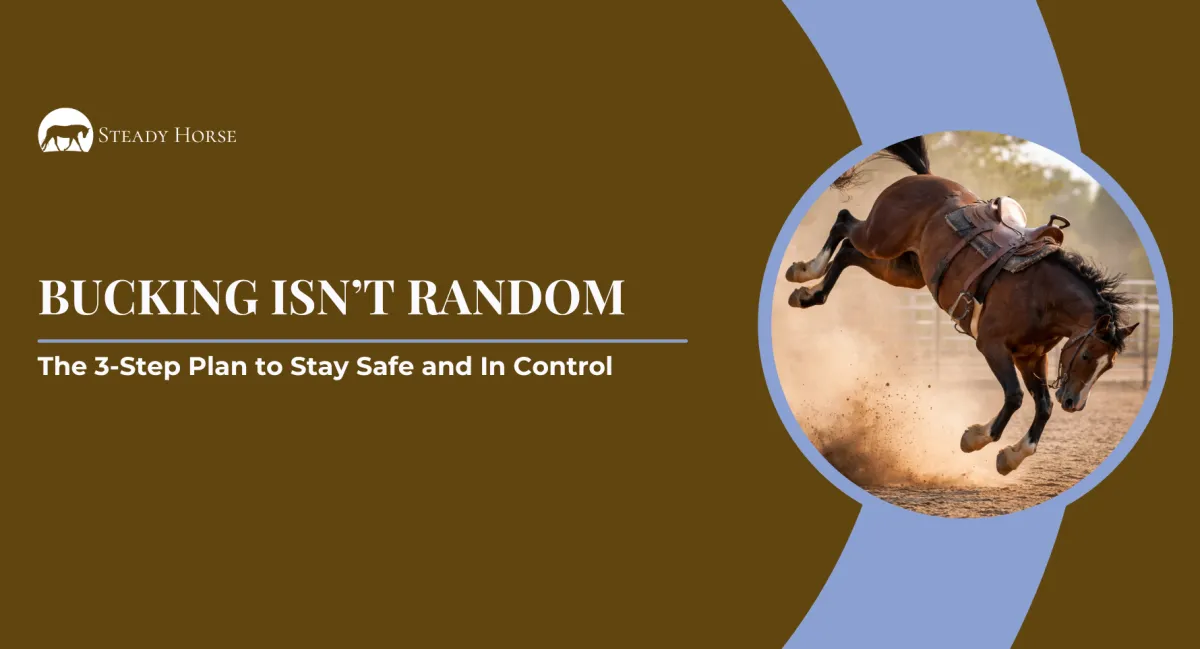
Bucking Isn’t Random
Nobody wants to find themselves sitting on a bucking horse.
It doesn’t matter if it’s a little crow hop or a full-out rodeo moment — when your horse drops their head and launches their hind end, your heart jumps into your throat. Your instincts kick in. And suddenly you’re not thinking clearly.
For many riders, that moment changes everything.
Confidence cracks. Trust wavers. Fear creeps in.
And too often, the advice riders receive is this:
“Just ride it out.”
The old way of doing things has led to more broken bones, more broken confidence, and more broken partnerships than most people want to admit.
Bucking isn’t random chaos.
It’s not unpredictable magic.
And it’s not something you simply muscle through.
There is a better way.
If you want to stay safe in the saddle and build real equestrian confidence, you need to understand the Three Ps for handling a bucking horse:
Prepare
Practice
Persist
Let’s walk through what that really means — and how it changes everything.
Why Horses Buck (It’s Not What You Think)
Before we talk about solutions, we need clarity.
Horses don’t wake up thinking, “How can I throw my rider today?”
Bucking can stem from:
Feeling scared or uncertain
Lack of confidence in themselves or their rider
Frustration during training
Imbalance, especially during transitions into the canter
An ill-fitting saddle
Physical stiffness or discomfort
Spooking during motion
Or yes — sometimes an unexpected “happy buck”
The common thread?
Instability.
Whether it’s mental, emotional, or physical instability, bucking often shows up when a horse doesn’t feel secure in their body or in their leadership.
And that’s where most riders miss it.
They try to fix the explosion instead of building stability beforehand.
That’s why we start with P number one.
P #1: Prepare
Preparation is everything.
A large portion of what we teach inside our horse training courses and equestrian confidence building programs revolves around preparing your horse so they don’t want to buck in the first place.
Can you completely eliminate bucking? No.
But you can drastically reduce the likelihood.
Preparation Means:
Being intentional
Being fair
Being consistent
Building a meaningful connection
It means doing the groundwork exercises for horses that create softness, balance, and clarity.
Focus on Transitions
Many horses buck during the canter transition.
Why?
Because they’re:
On the wrong lead
Counter cantering
Losing balance
Unsure where their feet belong
If a horse doesn’t understand how to place their body correctly, they can react with tension — and tension can turn into a buck.
That’s why transitions are so critical.
You don’t want a 5 out of 10 response.
You don’t want “good enough.”
You’re striving for a 10 out of 10 correct response.
Walk to trot.
Trot to canter.
Canter to halt.
Over and over.
When transitions are clean and balanced on the ground and under saddle, you dramatically reduce confusion.
And confusion is a common trigger for bucking.
Desensitizing in Motion
Some horses don’t buck from imbalance — they buck from a spook.
They’re moving. Something startles them.
Energy spikes. Hind end lifts.
That’s why horse desensitization techniques in motion are so important.
Desensitizing while standing still is helpful.
Desensitizing while moving builds trust.
When your horse learns to stay mentally connected while their feet are moving, you are building:
Safe horse handling practices
Building trust with horses
Stronger equine partnership development
The Flanking Exercise
If you have a horse that tends to buck, flanking is powerful.
Flanking teaches your horse to stay soft and connected even when you apply significant pressure near their flank — an area that often triggers defensive reactions.
You are teaching:
“I can apply pressure here, and you stay with me.”
That kind of preparation builds deep confidence.
And confident horses are far less likely to explode.
Don’t Skip the Five Ways
Preparation also includes the foundational movements:
Backing up softly
Moving the front end
Moving the hind end
Ground driving
Directional control
When your horse can move each part of their body with softness and clarity, they feel more secure.
Security reduces panic.
Panic reduces bucking.
The Truth About Preparation
The old way was:
“Get on and ride through it.”
The new way is:
Do the work beforehand so you rarely have to ride through chaos at all.
Preparation is not weakness.
It’s leadership.
And leadership builds rider confidence and horse confidence at the same time.
P #2: Practice
Let’s say you’ve prepared.
You’ve done your groundwork.
Your transitions are improving.
Your horse is soft.
But what if something still happens?
This is where practice comes in.
Horses are naturally stronger and more athletic than we are. You cannot muscle your horse into compliance.
So what do you do?
You override instinct with repetition.
The Flex to Stop (Also Called the One Rein Stop)
This is one of the most powerful tools in horse behavior training — but only if you practice it correctly.
Some call it:
One rein stop
Emergency stop
Pulling stop
We call it the flex to stop.
And here’s the part most riders miss:
It must be practiced 1,000 times.
Not once.
Not twice.
Not only when you’re scared.
What It Looks Like
If your horse bolts or begins to escalate:
Sit deep on your horse’s hind end.
Legs slightly forward, heels down.
Shoulders over your hips.
Lift your outside (off) hand up.
Slide your inside hand down the rein.
Pull that inside rein to your hip.
Lower the off hand so your horse can bend.
Lock it in.
Wait for softness.
Release immediately when your horse stops and flexes.
That release is everything.
You’re teaching your horse that softness brings relief.
Why Most Riders Fail With It
There was a rider who once said:
“I tried the one rein stop during a bolt. It didn’t go well.”
She didn’t fall off — thankfully — but her horse just kept spinning.
And she admitted something powerful:
“I gave up too soon.”
This is common.
If you release before your horse fully softens, you teach them that resistance works.
If you abandon the exercise mid-crisis, your horse learns nothing.
Practice at the walk.
Practice at the trot.
Practice at the canter.
Thousands of repetitions.
Eventually, your horse learns:
“When that off hand lifts, I stop.”
Predictability overrides panic.
That’s how you build horseback riding confidence.
Muscle Memory Saves You
When fear hits, you don’t rise to the occasion.
You fall to your level of training.
If you haven’t practiced the flex to stop consistently, your body won’t default to it under pressure.
But if you’ve done it hundreds — even thousands — of times, your hands will move without hesitation.
That’s equestrian skill development done right.
P #3: Persist
This is where many riders struggle.
We give up too soon.
Your horse bolts.
You flex once.
They keep moving.
You release.
Or they circle tightly, and you panic.
Persistence means seeing it through.
If your horse keeps moving — flex again.
If your horse circles — maintain the flex.
Release only when they soften and stop.
You are creating predictability of movement.
Pull left? They go left.
Pull right? They go right.
That clarity builds leadership.
And horses crave clear leadership.
Persistence Builds Confidence
Imagine knowing — truly knowing — that your horse will stop and stay with you in an unexpected moment.
Imagine riding with:
Less tension in your body
Less anxiety in your mind
More trust in your hands
That’s what persistence creates.
It’s not force.
It’s consistency.
And consistency is the foundation of:
Horse training for fearful riders
Overcoming fear of riding
Building rider confidence
Building equine trust and respect
From Chaos to Predictability
Bucking feels chaotic.
But training should never be chaotic.
When you prepare, practice, and persist, you create structure.
Structure builds safety.
Safety builds confidence.
Confidence builds connection.
And connection is what prevents most problems in the first place.
Your Takeaway
If you’re dealing with a bucking horse — or afraid you might one day — here’s where to start:
1. Go Back to Preparation
Clean up transitions.
Improve softness.
Desensitize in motion.
Work the flank intentionally.
Master groundwork.
2. Practice the Flex to Stop
At every gait.
On a horse you trust.
Hundreds of times.
Release only on softness.
3. Persist
Don’t give up mid-exercise.
Stay consistent.
See it through.
The goal is not to “ride through it.”
The goal is to build a horse who doesn’t want to buck — and a rider who knows exactly what to do if they try.
A great horse will change your life.
The truly special ones will define it.
But the partnership you build is not accidental.
It’s intentional.
And it starts with the Three Ps.
Ready to Feel Safe Again?
You don’t have to live with fear in the saddle.
There is a simple, proven process to build confidence, connection, and control with your horse — and it starts before the buck ever happens.
🎥 Watch the free training here: https://steadyhorse.com
It’s available for a limited time and walks you step-by-step through the framework we use to help riders stop reacting and start leading.
Your horse is waiting for clarity.
And you deserve to ride with confidence.
