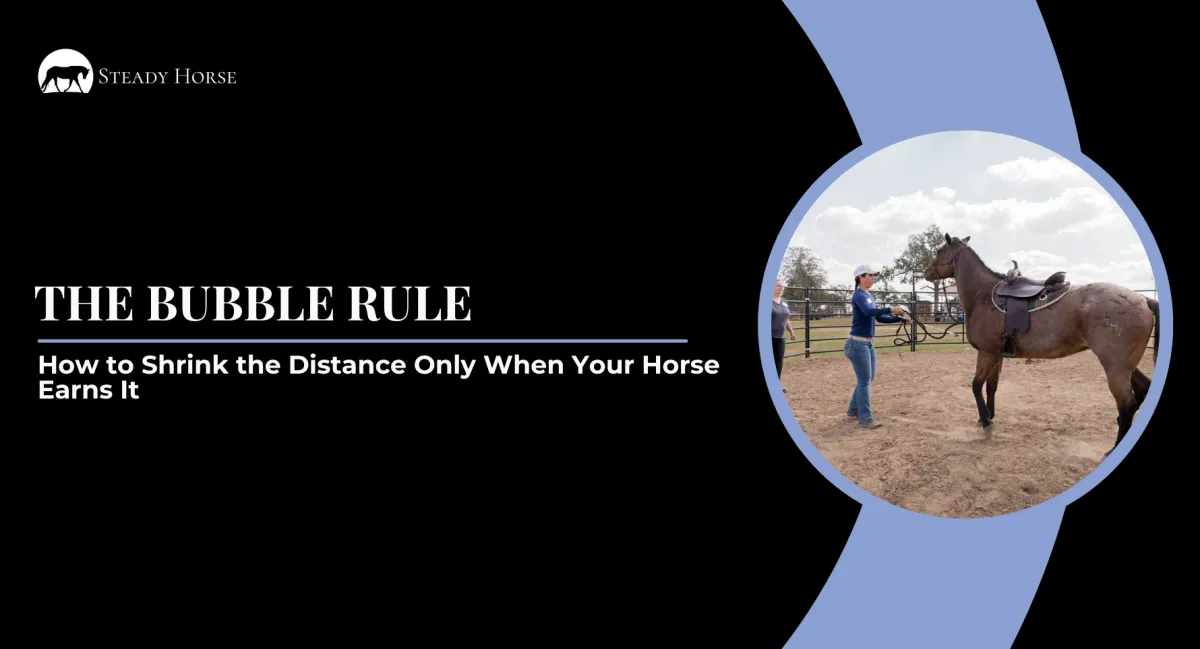
The Bubble Rule
Your horse doesn't get to be close to you because they want to be. They get to be close because they've proven they can handle it.
There's a moment that happens with almost every horse owner. Your horse walks up to you, nuzzles into your chest, maybe drops their head against your shoulder. And it feels good. It feels like connection. Like trust. Like love.
And maybe it is.
But maybe it isn't. Maybe what you're actually looking at is a horse who has never been taught where the line is. A horse who comes into your space whenever they feel like it because nobody ever told them they couldn't. A horse who crowds you, leans on you, pushes past you, and occasionally puts their teeth on you because to them, your space is their space. There's no boundary. There's no bubble. There's no earning it.
And that's where people get hurt.
Not from malice. Not from a "bad" horse. From a horse who was never given clarity about how close is too close and when they've earned the right to come in closer.
I use something I call the bubble rule. It's simple, it's effective, and it changes the entire dynamic between you and your horse. And the core idea is this: your horse has to prove themselves at every distance before they're allowed any closer.
Why Proximity Has to Be Earned
Most people let their horse into their space by default. The horse walks up, the person starts rubbing and loving on them, and the boundary is wherever the horse decides it is. Sometimes the horse is right on top of them. Sometimes the horse is pulling on their shirt. Sometimes the horse is standing on their feet.
And the person allows it because it feels good. Because they love their horse. Because they don't want to be "mean."
But here's what your horse is actually learning in those moments. They're learning that closeness is free. That they can come and go as they please. That your space belongs to them just as much as it belongs to you. And when closeness is free, it has no value. There's no earning it. There's no respecting it. There's no understanding that being near you is a privilege that comes with expectations.
Think about it from a herd perspective. In a herd, proximity to the lead horse is earned. Lower-ranking horses don't just walk up and crowd the lead mare whenever they feel like it. There's a hierarchy. There's communication. There's an understanding of who gets to be where and when. The lead horse sets that boundary, and the other horses respect it because the boundary is consistent and clear.
When you let your horse crowd you without earning it, you're not being the lead horse. You're being the horse who gets pushed around. And your horse knows it, even if you don't.
What the Bubble Rule Looks Like
The bubble rule is straightforward. You establish a distance between you and your horse, and they stay at that distance until they can demonstrate, ten out of ten times, that they can be patient, attentive, soft, and respectful at that distance. Only then do they earn the right to come closer. And if at any point they break the rules at the new distance, they go right back to the previous one.
Here's how it works in practice.
If you have a horse who's pushy, mouthy, chargy, or just doesn't respect your space, you start at maximum distance. The end of your lead rope. Fourteen feet. Whatever your line allows. That's their bubble. That's where they live until further notice.
At that distance, the expectations are clear. Can you stand here without leaning forward? Can you keep your attention on me? Can you resist the urge to drift toward me? Can you hold your feet and not creep in? Can you lower your head and show me that you're relaxed and patient?
If the answer is yes, ten out of ten times, then we can talk about bringing you in a little closer. Maybe ten feet. Same expectations. Same standard. Can you be patient here? Can you keep your attention on me? Can you stand without yo-yoing forward every time I release the pressure?
Then eight feet. Same questions. Then six. Then four. Then three.
Every inch of closeness is earned through demonstrated understanding. Not given because it's convenient. Not granted because they're being cute. Earned.
Why Ten Out of Ten Matters at Every Distance
I talk about the ten out of ten standard constantly, and I know some people wonder if I really mean it. I do. And with the bubble rule, it matters even more.
Here's why. If your horse can be patient and attentive at fourteen feet seven out of ten times, that means three out of ten times, they can't. That's a 30% failure rate. And if you bring them in closer with a 30% failure rate, you're bringing a horse into tighter proximity who hasn't fully proven they can handle the distance they're already at.
Those three failures at fourteen feet become something much more significant at four feet. At fourteen feet, a horse who breaks the boundary might drift forward a couple steps. At four feet, a horse who breaks the boundary is in your lap. Or on your foot. Or putting their teeth on your arm.
The ten out of ten has to be consecutive too. Not ten good responses scattered across fifty attempts. Ten in a row. Because ten in a row tells you something that ten out of fifty doesn't. It tells you your horse has consistent understanding, not occasional compliance.
So be patient at each distance. It might take three sessions at fourteen feet before you get ten consecutive good responses. That's fine. It might take a week at ten feet. That's fine too. The timeline doesn't matter. What matters is that when you do bring them in closer, you know with certainty that they've earned it. And your horse knows it too.
The Release at Distance
One of the most powerful things about the bubble rule is what happens when your horse finally gets it at a distance.
When your horse is standing at the end of the lead rope, patient, attentive, soft, relaxed, and you take a deep breath and just let them be there, something shifts. They start to realize that standing back and being calm is actually a really good place to be. There's no pressure. There's no obnoxious waving. There's no backing up. There's just peace.
And that peace becomes the reward.
This is the opposite of how most people reward their horses. Most people reward by bringing the horse in closer, rubbing on them, giving treats, pulling them into their space. But with a horse who has boundary issues, that kind of reward creates confusion. "Wait, you spent the last ten minutes telling me to stay back, and now you're pulling me in? Which one is it?"
Instead, let the reward be the distance itself. Let them enjoy standing there with no pressure. Breathe with them. Let them lick and chew. Let them cock a hind foot. Let them experience what it feels like to be in their own space, self-regulated, not dependent on being on top of you to feel okay.
That builds something that closeness can't. It builds self-carriage. A horse who can stand at a distance and regulate themselves is a horse who's developing independence. They're learning that they don't need to be in your pocket to feel safe. And that independence is what makes the eventual closeness meaningful.
When they do earn the right to be near you, it's because they've demonstrated that they can handle it. They've proven that being close won't turn into crowding. That being near you won't become pushing. That proximity is something they respect, not something they take for granted.
What Breaks the Bubble (And What Happens When It Does)
The bubble gets broken. It's going to happen. Your horse is going to test it. They're going to lean forward. They're going to creep in. They're going to let their curiosity get the better of them and drift toward you when you didn't invite them.
That's not a failure. That's the work.
When the bubble breaks, the correction is immediate. Not angry. Not punitive. Just clear. You back them up. Not one step. Several steps. Back to the distance they just came from, or even further. And you hold them there until they're calm, attentive, and settled again.
There has to be a cost to breaking the bubble. If your horse drifts in and all you do is stop them and hold them where they are, they haven't learned anything. They got closer for free. Even if they didn't get all the way to you, they gained ground without earning it.
But if drifting in results in losing ground, in being backed up further than where they started, in having to put in more work to get back to where they were, now there's a real consequence. Not a punishment. A natural result. "You tried to come in without earning it, and now you're further away than before. That decision cost you."
Horses are brilliant at this math. They figure out very quickly that unauthorized forward movement gets them the opposite of what they wanted. And authorized patience gets them everything.
The key is consistency. The bubble exists every single time you're with your horse. Not just during training sessions. Not just when you're feeling assertive. Every time. When you're grooming. When you're leading. When you're tacking up. When you're standing at the hitching post talking to a friend.
If the bubble is sometimes enforced and sometimes ignored, your horse has no idea what the rules are. And a horse without clear rules will always default to what's natural for them, which is coming in close, investigating, mouthing, and testing. That's not bad behavior. That's a horse doing exactly what a horse does in the absence of clear boundaries.
Inviting Them In vs. Them Inviting Themselves
There's an important distinction I want to make here because it's where a lot of people get confused.
There is absolutely a time and place to have your horse close to you. Sharing space. Rubbing on them. Scratching their favorite spot. Standing together quietly. Those moments are valuable and important for building the bond.
The difference is who initiates it.
When your horse decides to come into your space uninvited, that's them setting the terms. They're saying, "I want to be here, so I'm coming in." There's no question being asked. There's no permission being granted. They just show up.
When you invite your horse into your space, that's you setting the terms. You're saying, "I'd like you to come in. You've been patient. You've been soft. You've earned this. Come here." And your horse steps in knowing that this closeness was offered, not taken.
That distinction matters more than you think. A horse who is always invited in learns to wait for the invitation. They learn that closeness comes from you, not from their own impulse. And that waiting, that patience, that deference to your leadership, carries over into everything else you do together.
A horse who invites themselves learns something different. They learn that they set the schedule. That their impulse is what matters. That if they want to be somewhere, they can just go there. And that same attitude shows up when you're leading (they push past your shoulder), when you're riding (they ignore your cues and go where they want), and when things get scary (they run through you instead of to you).
The bubble rule teaches your horse that closeness is a dialogue, not a demand. And that changes the entire relationship.
How the Bubble Translates to Safety
Everything I've described so far sounds like it's about manners. About having a polite horse who doesn't crowd you. And yes, it is that. But it's also about something much more important.
It's about what happens when your horse gets scared.
A horse who has never been taught boundaries will, when frightened, do what they've always done. They'll charge into your space. They'll crowd you. They'll push against you. They'll try to climb into your lap because that's where they've always gone when they needed security. And a thousand-pound animal climbing into your lap when they're panicking is how people end up in the hospital.
A horse who has been taught the bubble rule will do something different. They might still feel the urge to come to you. That's natural. That's the bond. But they've been trained to find their security at a distance. To stand back on their haunches and regulate themselves. To wait for your invitation instead of stampeding into your space.
They'll look for you without running over you. And that's the difference between a horse who's connected and a horse who's dangerous. Connection with boundaries. Trust with clarity. A bond that doesn't put you at risk.
Starting Today
If you've been letting your horse into your space without earning it, you can change that today. You don't need a round pen. You don't need special equipment. You just need your lead rope and the willingness to hold a standard.
Start at the end of the rope. Back your horse up until there's distance between you. Then hold it. Don't let them drift in. Don't let them lean. Don't let them creep. If they try, back them up again. Further than before.
When they stand there, patient and soft, let them enjoy it. Breathe. Let the peace of that distance be the reward.
Work at that distance until it's solid. Until you know, without a doubt, that they understand the expectation. Then bring them in a little. Same standard. Same expectations. Same consistency.
Build it inch by inch. Let every bit of closeness be something they earned through patience, attention, and softness. Not something they took because you weren't paying attention.
Because here's what happens when you build proximity this way. When your horse finally earns the right to stand next to you, shoulder to shoulder, head low, breathing with you, that closeness means something. It's not the default. It's not an accident. It's the result of trust built through clarity and consistency, one layer at a time.
And that's the kind of closeness that keeps both of you safe.
If you're ready to start building the kind of clear, consistent boundaries that create real trust with your horse, I've put together a free training that walks you through exactly where to begin. It's available for a limited time and it's designed for riders at every level who want to feel safer and more confident every time they're with their horse.
