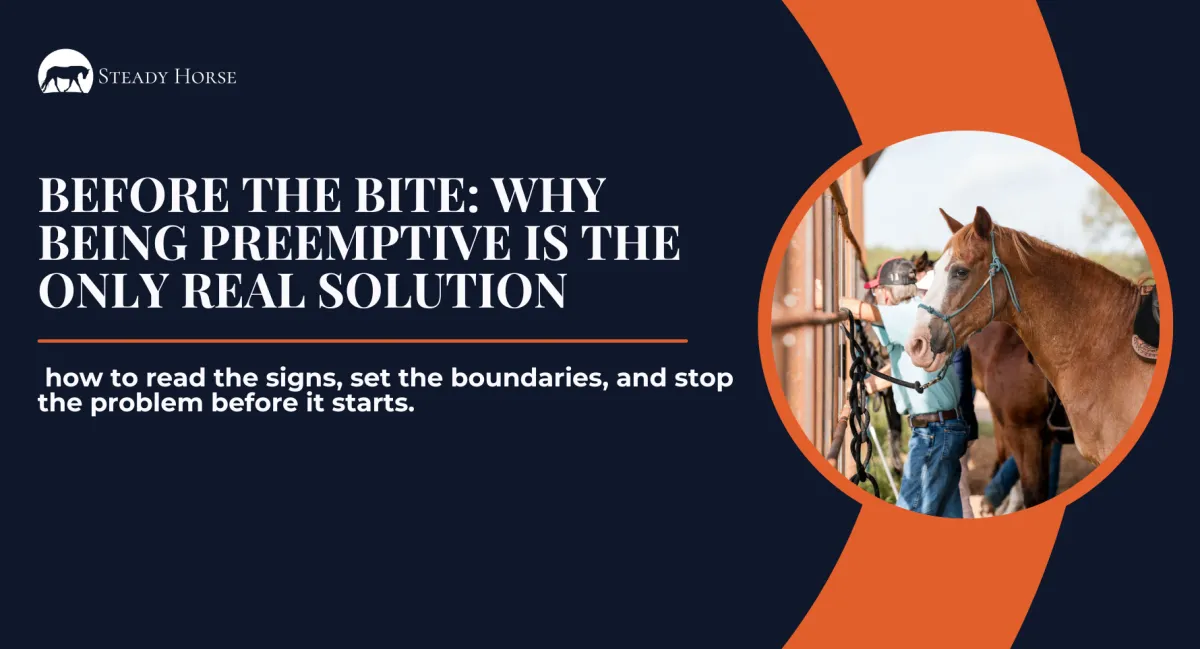
Before the Bite: Why Being Preemptive Is the Only Real Solution
Let me say something that might sting a little.
If your horse bites you, it's not your horse's fault. It's yours.
I know. That's not what most people want to hear. We want to blame the horse. We want to call them mouthy, disrespectful, pushy, dominant. We want to believe that we have a "biting horse" and that's just who they are.
But here's the truth. A horse can only bite you if you let them get close enough to do it. And if you know your horse is mouthy, if you've seen the pattern, if this isn't the first time, then every bite that lands is a boundary you didn't set.
That's not meant to make you feel bad. It's meant to empower you. Because if the problem is your horse's personality, there's nothing you can do about it. But if the problem is your boundaries, your awareness, your timing? You can fix that today.
And it starts with one concept that changes everything: being preemptive.
Why Punishing the Bite Never Works
Let's get the old way out of the way first, because I know a lot of people are still doing it.
Horse bites you. You whack them. Maybe you smack their nose. Maybe you elbow them in the jaw. Maybe you yell. And for about three seconds, they back off. Then five minutes later, they're right back at it. Nipping at your sleeve. Reaching for your arm. Playing the same game they were playing before you "corrected" them.
The reason whacking doesn't work is simple: you're too late. By the time the bite happens, the decision was made ten seconds ago. Your horse thought about coming into your space. They leaned forward. They shifted their weight. They stretched their neck. They opened their mouth. And then they bit you.
The bite is the last step in a chain of events. And if you're only correcting the last step, you're not teaching your horse anything except that this is a fun game where they nip and you swat and they come back for more.
Because that's exactly what horses do with each other. Go watch geldings play in a pasture. They bite each other. They kick. They rear up. They smack each other around. And then they do it again because it's play. It's how they interact. It's fun for them.
When you whack a horse for biting, you're not punishing them. You're playing with them. And you just told them the game is on.
What "Preemptive" Actually Means
Being preemptive with your horse means seeing the problem before it becomes a problem. It means recognizing patterns and acting on the thought, not the action.
If you have a mouthy horse, you already know they're mouthy. This is not new information. You've been bitten before. You've seen them reach for your shirt. You've felt them crowding your space. You know the pattern.
So why does it keep catching you off guard?
Usually, it's because we're not paying attention. We're on our phone. We're talking to a friend who just showed up at the barn. We're adjusting our tack. We're thinking about dinner. We're doing anything other than being fully present with an animal who weighs a thousand pounds and communicates entirely through body language.
Being preemptive means you walk into that interaction with your eyes open and your awareness turned on. You know this horse is going to test the boundary. You're not hoping they won't. You're expecting it. And because you're expecting it, you're ready.
Here's what that looks like in practice. You're leading your mouthy horse from the stall to the arena. You know from experience that about halfway there, they start getting a little chargy. Their nose creeps past your shoulder. They get a little close. And if you don't do anything, the next thing you feel is teeth on your arm.
The old way: you wait for the bite and then react.
The new way: you feel them starting to crowd before the nose even reaches your shoulder, and you back them up immediately. Not one step. Four or five steps. Enough that there's a real cost to pushing forward into your space.
You're not correcting a bite. You're correcting a thought. And that's the difference that changes everything.
Your Horse Tells You Before They Bite
Horses are not subtle. They really aren't. They wear every emotion, every intention, every thought right on their body where you can see it if you're looking.
A horse who's thinking about biting will show you before it happens. The signs are there. Every single time. The question is whether you're paying enough attention to catch them.
Weight shift. Before a horse moves into your space, they shift their weight forward. You can see it. You can feel it through the lead rope. They're loading up the front end, leaning toward you, preparing to step into your bubble. That weight shift is your first signal.
The nose creep. Their nose starts drifting toward you. Maybe toward your pocket. Maybe toward your arm. Maybe just generally in your direction. They're not there yet, but they're heading there. That's your window.
The ear position. A horse who's getting playful or pushy or mouthy will often have their ears forward and interested, locked onto you like you're the most fascinating thing in the world. Because to them, you are. You're a chew toy that sometimes has treats in its pockets.
The neck stretch. They extend their neck toward you without moving their feet. This is the classic "I'm going to see if I can reach you without actually stepping closer" move. If you see the neck stretching, the mouth is about to follow.
Every one of those signals happens before the bite. If you catch any of them, you have time to respond. Back them up. Create distance. Reestablish the boundary. And your horse learns that even thinking about coming into your space uninvited gets them redirected.
That's preemptive horsemanship. You're not waiting for the problem. You're solving it while it's still just an idea in your horse's mind.
The Boundary Is the Solution
A lot of people hear "set boundaries with your horse" and they think it means being tough or aggressive or mean. That's not what I'm talking about.
A boundary is simply a clear expectation that never changes. It's not punishment. It's not anger. It's not dominance. It's clarity.
Think about it like this. If you have a friend who always shows up at your house uninvited, you have two options. You can get mad every time they knock on the door. Or you can have one clear conversation that says, "Hey, I love you, but call first." That's a boundary. It's not mean. It's actually kind of you, because now your friend knows the rules and can't accidentally cross a line they didn't know existed.
Your horse needs the same thing. They need to know exactly where the line is so they can stay on the right side of it. And the clearer you make that line, the easier it is for them to succeed.
With a mouthy or biting horse, the boundary is distance. They don't get to be in your space unless you invite them in. Period. No exceptions. Not on Tuesdays. Not when they're being cute. Not when you feel bad because it's cold and you want to snuggle. The boundary exists all the time or it doesn't exist at all.
Inconsistency is what creates biting horses. When the rule is sometimes yes and sometimes no, your horse has no idea what's expected. So they default to what's natural for them, which is investigating, mouthing, and playing. And then they get in trouble for doing exactly what you allowed them to do five minutes ago.
That's not fair. And it's not their fault.
Backing Up: Your Most Powerful Boundary Tool
When it comes to establishing boundaries with a mouthy horse, backing up is your go-to. It's the most effective pattern interrupt you have, and it works on multiple levels at once.
Physically, backing up creates distance between you and your horse. It moves them out of biting range. Simple as that.
Mentally, backing up loads your horse onto their haunches and shifts their thinking. A horse who's leaning forward, thinking about coming into your space, is thinking "forward." When you back them up, you interrupt that forward thought and replace it with something else entirely. You redirect their brain.
Emotionally, backing up establishes your leadership without escalating the situation. You're not hitting. You're not yelling. You're simply saying, "Not here. Back up. Find your peace over there."
But here's the key. The backing up has to mean something. It can't be a half-hearted wiggle of the rope where your horse takes one lazy step back and then immediately yo-yos forward again.
If you back your horse up and they immediately lean back toward you, they're not actually thinking backwards. They're just moving their feet to get you off their case so they can come right back for another nibble. That's a horse who's still thinking "num num" and not "yes, ma'am."
I want enough energy in that backup that when you release, you get one or two more steps. I want your horse to stay on their haunches. Maybe lower their head. Take a deep breath. Show you that they're actually settled, that they're thinking the same thing you're thinking. That's when the pattern interrupt has done its job.
And if they yo-yo right back? Back them up again. And again. And again. A hundred times if that's what it takes. Because every time you back them up and hold that boundary, you're overwriting the old pattern with a new one. You're teaching their brain that forward into your space doesn't get them what they want. Standing back and being patient does.
Speak Clearly With Your Feet
This is something I want every horse owner to understand, whether they have a biting horse or not. Every step you take when you have a lead rope in your hand means something to your horse.
Every step. Not just the intentional ones. Every single step.
When you shuffle around trying to get into position, that's noise. When you walk past your horse to grab something and then walk back, that's a signal. When you step backwards while you're trying to back them up, that's a contradiction.
Your horse reads your feet the way you read a text message. They're constantly interpreting what your movement means. And if your movement is cluttered, confusing, contradictory, your horse is getting a message that sounds like static.
With a biting horse, this matters even more. Because a horse who's mouthy is already looking for any signal that says, "Okay, you can come in now." And meaningless steps, the kind where you're wandering around without purpose, can easily be misread as an invitation.
Here's the rule. If your feet are moving, it needs to mean something. If you're stepping toward your horse, you're backing them up or moving a body part. If you're stepping away, you're creating intentional distance. If you're standing still, you're standing still on purpose, not because you forgot what you were doing.
The same applies to your steady stick. Don't just hold it up in the air for no reason. Don't point it at your horse unless you're about to use it. Think of it like a tool that only comes out when it has a job to do. When it's in your hand and it's not doing anything, it's creating background noise that dulls your horse to its presence. And then when you actually need it, they don't take it seriously.
Quiet your body. Make every movement intentional. The less noise you create, the louder your real signals become.
The Bubble Rule
Here's a practical framework that works beautifully with mouthy horses. I call it the bubble rule, and it's built on one principle: your horse has to earn proximity.
If you have a horse who bites, they start at the end of the lead rope. Maximum distance. That's their bubble. They stay out there until they can demonstrate, ten out of ten times, that they can be patient, attentive, and soft at that distance.
Then you bring them in a little closer. Maybe ten feet. Same expectations. Can you be patient here? Can you keep your attention on me? Can you resist the urge to crowd? Ten out of ten. Good. Now you can be eight feet away.
Then six. Then four. Then three.
Every inch of proximity is earned, not given. And if at any point your horse breaks the boundary at the new distance, you send them right back to the previous one and start over.
This does a few things. First, it gives your horse absolute clarity about what's expected. There's no guessing. The rules are the same at every distance, and they only get closer when they've proven they can handle it.
Second, it protects you. A horse at the end of a fourteen-foot lead rope can't bite you. You've removed the opportunity entirely. And you've done it without punishing them, without hitting them, without any conflict at all. You've simply said, "You haven't earned the right to be this close yet."
Third, and this is the part most people miss, it builds trust. Because when your horse finally does earn the right to be close to you, that proximity means something. It's not random. It's not accidental. It's a reward they worked for. And they're much less likely to blow it by doing something that gets them sent back to the end of the rope.
The Mistake That Creates Biting Horses
I want to address one more thing because it comes up constantly.
No treats. If you have a biting horse, no hand-fed treats. None. Not sometimes. Not as a reward for being good. Not because they had a great session and you feel like celebrating. None.
Here's why. When a mouthy horse takes a treat from your hand, something instinctive kicks in. Their mouth is engaged. They're reaching toward you. They're associating your hand with food. And the line between "taking a treat" and "taking a chunk of your finger" is razor thin for a horse who already has boundary issues.
You're trying to teach this horse that coming into your space uninvited is not okay. And then you're literally inviting their mouth to your open hand. That's a mixed signal that no amount of backing up can overcome.
If you want to give treats, put them in a bucket. But your hand should never be a vending machine for a horse who struggles with mouth boundaries.
The only exception, and I want to be very specific here, is a horse like a rescue or a formerly untouchable horse who needs the treat to build the courage to engage with a human hand at all. That's a different situation with a different goal. For every other mouthy horse, the treats go away entirely.
This Is What Leadership Looks Like
At the end of the day, a biting horse is a horse who doesn't have clear enough boundaries to know what's expected of them. They're not bad. They're not mean. They're not dominant. They're confused.
And confused horses do what all confused animals do. They default to instinct. And instinct says investigate, mouth, chew, play. That's what horses do in the wild. It's how they explore their world. It's how they interact with each other.
Your job isn't to punish the instinct. Your job is to provide enough clarity, enough consistency, enough leadership that your horse doesn't need to rely on instinct when they're with you. They know the rules. They know the boundaries. They know that being patient and staying back earns them peace, and charging into your space earns them more work.
Boundaries build trust. And trust ends the biting. Not because your horse is afraid to bite. But because they no longer feel the need to. They know where they stand. They know what's expected. And they know that you're going to be the same, every single time, no matter what.
That's what it means to be preemptive. Not reacting to what your horse just did. Seeing what they're about to do and giving them the leadership they need before it becomes a problem.
Your horse will thank you for it. Probably not with a hug. But definitely not with a bite.
If you're ready to start building the kind of clear, consistent leadership that creates trust and ends dangerous habits, I've put together a free training that walks you through exactly where to begin. It's available for a limited time and it's designed for riders at every level who want to feel safer and more confident with their horse.
