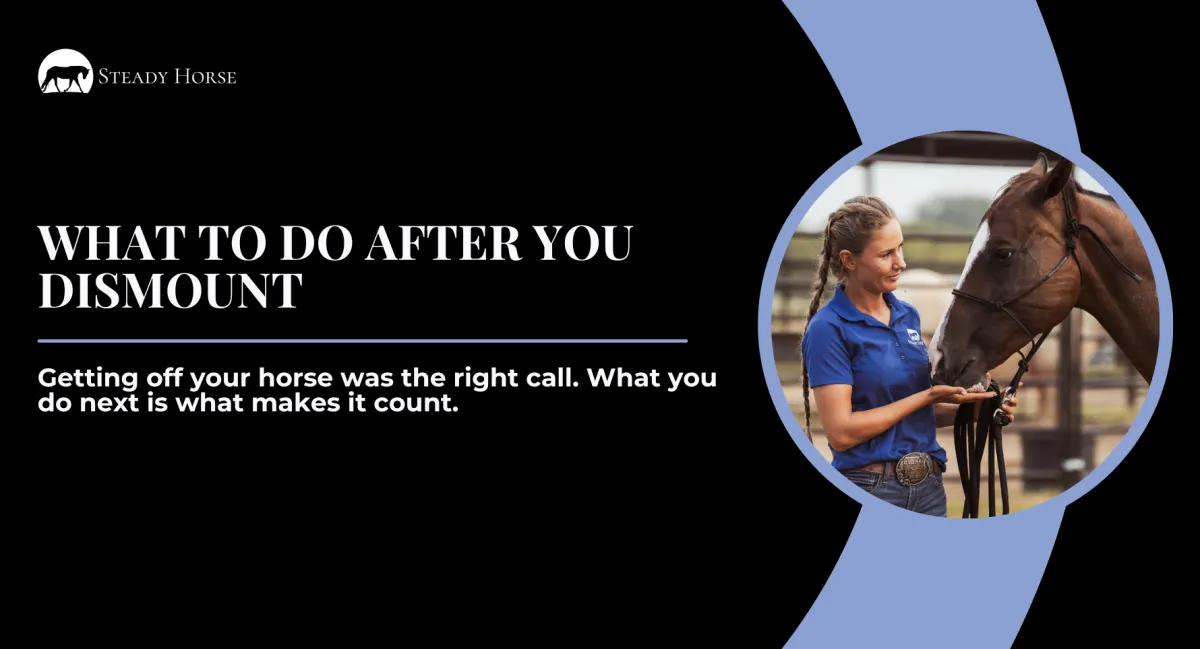
What to Do After You Dismount
Here's the blog:
What to Do After You Dismount (Because Just Putting Them Up Is Not the Answer)
Getting off your horse was the right call. What you do next is what makes it count.
There is an old way of thinking in the horse world that says you should never get off your horse. That if you dismount, your horse wins. That getting down teaches them a bad habit and they will remember it forever.
That way of thinking has gotten people hurt. It has kept riders in the saddle when every instinct they had was telling them to get off. It has turned manageable moments into wrecks because someone was too afraid of looking weak to prioritize their own safety.
The truth is, there are absolutely times when dismounting is the smartest, safest, and most connected decision you can make. When your horse is in pain or something feels off. When the terrain becomes dangerous. When you discover a hole in your training that you do not have the tools to address under saddle. When you feel yourself slipping back into old, pressure based habits out of frustration. When your horse is acting up and you genuinely do not feel safe.
In all of those situations, getting off is not a loss. It is a win. Every single time.
But here is the part that most people miss. What you do after you dismount matters just as much as the decision to get off in the first place. Because if you dismount and immediately put your horse up, walk them back to the stall, load them on the trailer, and call it a day, you have left the conversation unfinished. And an unfinished conversation is a missed opportunity to turn a difficult moment into real progress.
Why You Cannot Just Put Them Up
When something goes wrong under saddle and you make the decision to dismount, there is a reason it happened. Maybe your horse spooked and started bolting. Maybe they were jigging and crow hopping and you could not get them settled. Maybe they refused to move forward. Maybe they were pulling toward other horses and ignoring your direction entirely.
Whatever the issue was, it did not disappear the moment your feet hit the ground. The anxiety, the confusion, the hole in the training that caused the problem is still right there. Your horse is still carrying whatever was going on in their mind when things went sideways.
If you just walk them back to the barn and put them away, here is what your horse files in their mental cabinet: things got hard, and then we stopped. There was no resolution. There was no working through it. There was no moment where they found softness, connection, or clarity on the other side of the struggle. The last thing they experienced was the problem, and that is what they carry into the next session.
That does not mean you need to fix everything right then and there. It does not mean you need to spend two hours on the ground after a bad ride. But it does mean you need to do something meaningful before you end the session. Something that relates to the issue. Something that gives your horse a chance to find success and feel good about themselves before you put them up.
Match the Ground Work to the Problem
The key to making your post dismount work effective is connecting it to whatever was happening under saddle. You are not just doing random exercises to fill time. You are doing intentional, purposeful work that addresses the specific issue your horse was having.
Here is what that looks like for some of the most common scenarios.
Your Horse Was Herd Bound and Wanted to Follow Other Horses
This is one of the most common trail riding issues, and it is one of the most frustrating. You are riding with a friend and your horse is fighting you the entire time because they want to be up front with the other horses. Or you get back to the trailer and your horse is pulling toward your friend's trailer instead of staying with you.
If you dismount because of this, do not just tie your horse at the trailer and call it done. This is the perfect time for direction and magnet training. Let your horse go toward where they think they want to be, but that is where the work happens. Send them around. Get their feet moving. Get their heart rate up. Then, when they start to soften and show interest in being with you instead, let them rest. Let them stand with you quietly. Let them learn that being with you is where the peace is.
You are teaching them that the other horse is not the safe place. You are the safe place. And that lesson is so much more powerful when it comes right after the moment where they were trying to choose the other horse over you.
Your Horse Spooked or Was Nervous Under Saddle
Maybe something startled them on the trail. Maybe they were on high alert in the arena and you could feel them ready to blow at any moment. Maybe they actually bolted and you made the smart decision to get off before things escalated.
When you dismount after a spook or a nervous ride, go back to desensitizing exercises. Work on whatever will expose them to the type of pressure that was causing the anxiety. If it was noise, make some noise from a distance and work them through it on the ground. If it was a visual trigger, find something similar and do your flag work, your tarp work, whatever tool fits the situation.
The point is to give them a controlled version of what scared them and let them work through it successfully with you on the ground. You are rebuilding the file in their mind that says, "Something scary happened, but my person was right there. I made it through. I was okay."
Your Horse Refused to Move Forward
This one can be incredibly frustrating. You are asking your horse to go forward and instead they plant their feet. Or worse, they start backing up. You try everything you know from the saddle to get them moving and nothing is working. Maybe they even start hopping or getting agitated because the pressure is building with no release.
If you dismount because of this, the ground work you want to do is driving them forward. Send them through a gate. Work on the sending exercise. Drive them forward on the ground where you have more tools and more control over the situation. You are addressing the exact same issue, forward movement on your terms, but in an environment where you can give clearer direction and where the pressure dynamics are different.
This also gives you a chance to check yourself. Were you inadvertently blocking their forward movement with your body position? Were you giving mixed signals with your reins and your legs? Sometimes the answer to "my horse would not go forward" is actually "I was not making myself clear." The ground work gives you a chance to find that out.
You Felt Yourself Reverting to the Old Way
This one is not about a specific training problem. It is about you recognizing that your mindset is heading somewhere it should not go.
Maybe your horse was not responding and you could feel yourself getting frustrated. Maybe you caught yourself using more pressure than necessary, fighting with your horse instead of guiding them. Maybe you realized that you were trying to make them do something instead of allowing them to choose the right answer.
That moment of recognition is huge. Most people do not catch themselves before they have already gone too far. If you felt it happening and made the decision to dismount and reset, you did exactly the right thing.
In this case, the ground work does not have to be anything complicated. Just do something simple that you know your horse can succeed at. Back them up. Move the front end. Do a connection check. Something easy that lets both of you decompress, reconnect, and end the interaction on a positive note.
The goal is not to fix the original problem in that moment. The goal is to recognize that you were heading down a path that was not going to end well, stop yourself, regroup, and get back to a place where you can interact with your horse from a position of patience and fairness instead of frustration.
Always End on a Good Note
No matter what caused you to dismount and no matter what ground work you do afterward, there is one rule that should never be skipped. End on a good note.
That means finishing the session with something your horse is confident doing. Something that makes them feel good about themselves. Something they can succeed at without struggle so that the last thing they carry into the next session is a feeling of accomplishment, not frustration.
This matters more than most people realize. If the last thing your horse experiences before going back to the stall or the pasture is confusion, defeat, or frustration, that emotional state does not just vanish overnight. It sits with them. It colors how they show up the next time you work together. It can make them hesitant, anxious, or resistant before you have even started.
But if the last thing they experience is success, softness, and connection with you, that is what they carry forward. They go back to the barn feeling good. And the next time you show up, they are starting from a better place mentally and emotionally.
This does not mean you have to manufacture some big dramatic win. It can be as simple as asking for a nice backup and getting a soft, willing response. It can be a quiet moment of connection where you take a deep breath together and your horse drops their head and licks and chews. It can be a clean send in both directions. Anything that lets them feel, "I did that. My person was happy. I am good."
You Do Not Have to Solve It in One Session
Here is something that takes the pressure off once you truly accept it. You do not have to find the answer in one session. If you dismount, do some related ground work, and your horse is still struggling with the issue, that is okay. It does not mean you failed. It does not mean the training is not working. It just means this particular issue needs more time.
Step back and think through the problem. Replay what happened in your mind. If you are a visual learner, picture the whole scenario and pick it apart. What was happening right before things went wrong? What was your body doing? What was your energy like? What was your horse telling you with their body language that you might have missed in the moment?
Journaling can be incredibly helpful here. Write down what happened, what you did, how your horse responded, and what you think might have contributed to the issue. Over time, those journal entries become a goldmine of information. You start to see patterns. You start to notice things that you would have missed otherwise. And when you look back months later at entries from the early days, you get to see in black and white just how far you and your horse have come.
The point is, dismounting and doing ground work is not about instant resolution. It is about making sure every session, even the tough ones, moves you and your horse one step closer to where you want to be. Some steps are big. Some are tiny. But as long as you are taking them, you are making progress.
Never Let Anyone Tell You It Is Wrong
One more thing that needs to be said, and it needs to be said clearly. Never let anyone convince you that dismounting is the wrong decision.
Not your riding buddy who tells you to just get back on. Not the clinician who looks at you sideways when you step down. Not the voice in your own head that says you should have been tougher or braver or better.
Your safety comes first. Always. And after your safety, the most important thing is what you do with the moment. If you dismount and do nothing, the moment passes and the issue stays. But if you dismount and turn that moment into meaningful ground work, into a conversation with your horse about trust and clarity and connection, you have not lost anything. You have gained something that staying in the saddle out of stubbornness never would have given you.
Getting off your horse is not the end of the session. It is the beginning of the most important part.
If you are ready to start building the kind of safety, confidence, and connection that makes every moment with your horse count, there is a free training available right now that can help. It will not be available forever. Head over to https://steadyhorse.com and take the first step.
