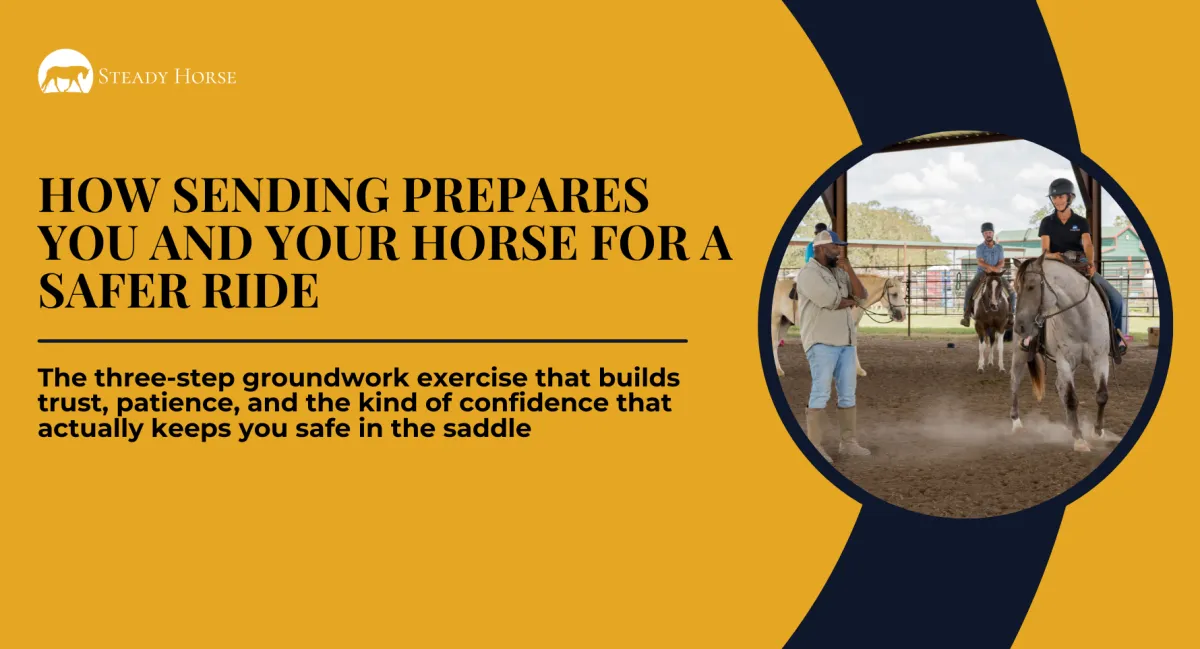
How Sending Prepares You and Your Horse for a Safer Ride
If I could only do one exercise with my horse before I ever swung a leg over, it would be sending.
That might surprise some of you. It's not the flashiest exercise. There's no trick to it. No crowd-pleasing spin or sliding stop. But sending — done right, done with intention — covers more ground in your relationship with your horse than almost anything else you can do on the ground.
And here's the thing most people miss: sending isn't just about getting your horse to move in a circle. It's about finding out whether you and your horse are actually ready to ride together safely.
Let me explain what I mean.
Your Horse Was Built to Hate Change
Before we get into the mechanics of sending, I need you to understand something fundamental about your horse's brain.
Horses are patterned animals. They are wired — down to their DNA — to seek consistency. They want the same path to the water trough. The same corner of the pasture. The same routine, day in and day out. If you've ever watched your horse in turnout, you've probably noticed they wear a track in the grass because they walk the same route every single time.
That's not laziness. That's survival instinct.
In the wild, consistency means safety. If a horse walks the same trail to water every day and nothing bad happens, that trail is "safe." Anything different — a leaf out of place, a shadow that wasn't there yesterday, a glimmer off a mailbox — registers as a potential threat.
Now here's where it gets interesting for us as riders.
Everything we do with our horses involves change. We ask them to change directions. Change gaits. Change speed. Change environments. We trailer them to new places. We ride past things they've never seen. We ask them to leave the barn, leave their buddies, leave their comfort zone.
We are constantly asking an animal that fundamentally craves consistency to embrace change.
And that is exactly why sending matters so much.
What Sending Actually Teaches Your Horse
When most people think about lunging or sending, they think about exercise. Blowing off steam. Getting the bucks out before they ride. And sure, there are moments where your horse needs to move and get some energy out. I'm not going to pretend that doesn't exist.
But sending — the way we teach it — isn't about running your horse in circles until they're tired. It's about slowing your horse's mind down in the midst of change.
Think about what you're asking when you send your horse. You're asking them to back up away from you. Then you're asking them to reposition their body. Then you're asking them to move forward. You're asking them to speed up, slow down, change directions. You're asking them to navigate transitions — from walk to trot, trot to canter, canter back to trot.
Every single one of those asks is a change. And every single one of those changes is an opportunity for your horse to either think through it calmly or react instinctively.
Sending, done with intention, teaches your horse to think through change instead of reacting to it. And that is the foundation of a safer ride.
The Three Steps That Change Everything
There are three basic steps to sending, and every one of them matters. If you skip a step, you lose clarity. If you rush through them, your horse learns to rush too. So write these down if you haven't already.
Step One: Back Your Horse Up
This is where it starts. You back your horse up away from you — not just a step or two, but enough distance that they're positioned safely on the circle you're about to send them on.
Here's what most people don't realize about the backup. Yes, it creates physical distance between you and your horse so they're not right on top of you when they start moving. That's the safety piece, and it matters. I don't want your horse launching forward from two feet away and nearly running you over.
But the backup also does something even more important. It gets your horse's attention.
When your horse is backed up away from you, they have options. They can look past you. They can stare at another horse across the arena. They can check out mentally. The further away they are, the harder it is for them to stay focused on you. So when you back them up and they maintain their attention on you — ears forward, eyes soft, waiting — that tells you something critical.
It tells you they're mentally with you.
Take a deep breath after the backup. Count to three. See if your horse holds their attention on you. If they look away, back them up again. Not as punishment, but as a pattern interrupt. It's your way of saying, "Hey, I need you here with me."
Step Two: Move the Front End Over
After the backup, you're going to reposition your horse so they're facing the direction you want to send them. If you're sending to the left, you'll move their front end over to the left. If you're sending to the right, you move it to the right.
This step is deceptively important. You're not just pointing your horse in a direction. You're teaching them to wait for instruction before they move their feet.
Here's where a lot of horses will try to anticipate. They'll feel you start to move their front end and think, "Oh, I know what's coming — time to go!" And they'll try to launch forward before you've even asked.
When that happens, you bump them back. You say, "Nope. Stand here. I didn't ask you to go yet."
You might have to do this four, five, six, maybe a dozen times. That's okay. That's the work. Every time you push that front end back over and ask them to wait, you're building patience. You're building a horse who is waiting on you instead of guessing.
And here's the bonus: every time you push that front end back over from a standstill, you're building a button. A tool. So that later, when you're sending and your horse starts to collapse inward or turn into you, you can use your rope hand to push that face back out toward the circle. You've already practiced it. Your horse already understands what that pressure means.
Take another deep breath between step one and step two. Count to three. Let the pause do its work.
Step Three: Drive Forward
Now — and only now — you drive your horse forward into the circle. You show them the direction with your hand, and if they need more encouragement, you escalate your cues. Maybe a cluck. Maybe a kiss. Maybe you pick up your stick and add some energy behind them.
But here's the critical piece that most people miss.
The moment your horse goes forward — the very moment they give you effort and take that first step into the walk or the trot — you lower your hand. You lower your stick. Everything comes down to your side. The tip of your stick touches the ground.
Why? Because even if you're holding that stick just a couple inches off the ground, your muscles are tense. Your hand is gripping. And your horse feels that. They feel every ounce of pressure you're carrying. If you want them to relax into the movement, you have to show them there's nothing to be tense about.
This is where sending separates itself from mindless lunging. You're not just chasing your horse around in a circle. You're communicating. You're saying, "I asked, you answered, and now I'm going to leave you alone." That's how trust gets built.
Why the Pause Between Steps Matters More Than the Steps Themselves
I want to camp on this for a moment because it's that important.
Horses love to anticipate. They love to guess. They're pattern-recognition machines, and the moment they think they know what's coming next, they want to jump ahead to it. And sometimes it's cute. "Oh, my horse is so smart — they already know what I'm going to ask!" But here's the problem: most of the time they don't actually know. They think they do.
When a horse is guessing instead of listening, they're operating on instinct instead of intention. And instinct is what gets people hurt.
The pause between each step of sending — that deep breath, that count to three — is what teaches your horse to stop guessing and start waiting. It cultivates patience. It cultivates a horse who is looking to you for direction instead of rushing forward to find their own release.
And here's a rule I want you to tattoo on your brain: forward is never the answer unless you specifically asked for it.
We never want our horse to believe that if they just push forward — run forward, lean forward, bolt forward — that's what's going to get them out of pressure. That's what's going to get them out of the situation. No. We want a horse who is thoughtful. Methodical. Patient. Waiting on us.
That's a horse you can trust with your life in the saddle.
What Your Horse's Transitions Tell You About Your Safety
One of the most powerful things about sending is what it reveals through transitions — both upward (speeding up) and downward (slowing down). These transitions are a direct window into how your horse is going to respond when you're riding.
Upward Transitions: Getting the Departure Right
Let's say you have a lazy horse who doesn't want to move out. You're asking for the canter, and it's taking every ounce of energy you have — kissing, clucking, tapping the ground — and finally you get one stride of canter.
Here's what I want you to do: the second you get that stride, lower your hand. Lower your stick. Stop clucking. Reward that departure immediately.
I know what you're thinking. "But I want them to stay in the canter!" And you're right — eventually you do. But you have to start with the ask. You need the departure to be solid before you worry about sustaining the gait.
Get the departure consistent. Ten out of ten times, when you ask your horse to pick up the canter, they give it to you. Crisply. Cleanly. Immediately.
Once you have that button, sustaining becomes easy. If they slow down, you just push the button again. And again. And pretty soon your horse figures out, "It's actually more work to keep slowing down and starting back up. I might as well just stay in this canter until he tells me to slow down."
But the ask has to come first.
Downward Transitions: Breathing Your Horse Down
This is where the magic happens. The goal — the absolute dream — is to be so connected with your horse that you can take a deep breath and they mirror you. They slow their cadence. They soften. They come down to the lower gait just because you exhaled.
Not every horse starts there. And that's okay.
If you send your horse out and they're trotting with some energy — head high, a little snorty, maybe some bucks and kicks — let them go. Don't try to shut it down. Let them blow that energy off. Let them move until they show you they're ready to connect.
What does "ready to connect" look like? They start looking to the inside — toward you. They slow down on their own. Maybe you see their head lower. Maybe their tail softens. Maybe they take a deep breath. I like to see at least three to five of those indicators before I offer them the opportunity to slow down.
And I want you to notice the language I just used. I said "offer them the opportunity." Because that's exactly what it is. You're not forcing the downward transition. You're presenting it as a reward. "Oh, you want to slow down? You've been looking for me, breathing, softening? Okay. Yeah, I guess we can do that."
That is how you develop a horse who is hunting for the release. Hunting for the rest. Hunting for connection with you. And that horse — that horse is safe to ride.
What Happens When You Skip This Work
I see it all the time. Someone's been doing great groundwork. Their horse is responsive. They're feeling confident. And then one day, their horse comes out a little fired up. A little distracted. A little reactive. And suddenly all that confidence disappears.
It's disheartening. I get it. You were so close to feeling ready to ride outside the round pen, or take your horse on the trail, or move past that plateau you've been stuck on. And now it feels like a setback.
But here's what I want you to understand: it's not a setback. It's information.
If your horse comes out hot and reactive, and you go through your sending — the three steps, the transitions, the breathing — and you can't get them to slow down, can't get them to look at you, can't get them to respond to your cues, then you just learned something incredibly valuable.
You learned that today is not the day to ride.
And that's not failure. That's wisdom. That's horsemanship. That's what keeps you safe.
The sending exercise is your pre-ride safety checklist. Can I get my horse to back up and give me their attention? Can I move the front end without them launching forward? Can I get clean departures? Can I breathe them down? Can I influence their feet?
If the answer to any of those questions is no, you have your answer about whether you're ready to ride.
For the Horse Whose Mind Is in the Next County
Now, I want to address something specific because I know some of you are dealing with horses who are hotter, more reactive, more sensitive. The kind of horse who goes out on the circle and just runs. Head up, tail flagging, snorting, and there's no quit in them. They're not slowing down. They're not looking at you. Their brain has left the building.
For a horse like that, we use what I call pattern interrupts.
Instead of just letting them run until they figure it out, you're going to send them out and then immediately draw them back in. Hard draw. Walk backwards. Pull on that lead rope so there's pressure on the poll — because it's your horse's job to come in fast enough that there's no pressure on their poll.
Send them out. Draw them in. Send them out. Maybe let them get a few strides. Draw them in again.
What this does is break the pattern. It interrupts that instinctive cycle of run, flee, go forward, react. And it replaces it with something new: "My peace comes from drawing into my human. My rest comes from connecting with my person."
Do this enough times and something beautiful happens. You go to draw your horse in, and before there's even tension on the line, they're already softening toward you. They're anticipating the draw. They're hunting for connection instead of running from it.
That's when you know their mind is with you. And that's when the real work can begin.
Building the Kind of Confidence That Keeps You Safe
Here's what I want you to take away from all of this.
Sending isn't just an exercise. It's a conversation. It's a diagnostic tool. It's a trust-building protocol that tells you — honestly, clearly, without guesswork — exactly where you and your horse stand before you ever put a foot in the stirrup.
When you take the time to break sending down into those three distinct steps, when you pause and breathe between each one, when you reward effort immediately and let your horse hunt for the release, you are building something that no amount of trail miles or arena hours can replace.
You're building understanding.
You're not fixing behavior. You're developing communication. You're teaching your horse that change doesn't have to be scary. That transitions don't have to be reactive. That their rest, their peace, their comfort — all of it — comes from connecting with you.
And you're teaching yourself something too. You're learning to read your horse. To feel the difference between a horse who's mentally with you and one who's checked out. To trust the process when it gets messy. To have the patience to do the boring, repetitive, methodical work that nobody sees but everybody benefits from.
That's confidence. Not the loud, look-at-me kind. The quiet kind. The kind that comes from knowing — truly knowing — that you've done the work. That you've built the foundation. That when something goes sideways, you and your horse have a shared language to work through it.
That's the kind of confidence that keeps you safe. And it starts with sending.
It Doesn't Happen Overnight — And That's the Point
If you're reading this and feeling like you've got a long way to go, good. That means you're being honest with yourself. And honestly? That's exactly the kind of rider your horse needs.
The riders who get hurt are usually the ones who skip steps. Who rush the process. Who convince themselves they're ready before the work is done.
The riders who stay safe — and who build unbreakable bonds with their horses — are the ones who show up, do the work, and let the timeline be what it is. They're the ones who back their horse up one more time. Move the front end over one more time. Pause and breathe one more time. Even when it feels boring. Even when it feels slow. Even when nobody's watching.
That's the work. And it's worth every second of it.
If you're looking to build the kind of safety and confidence we've been talking about — the kind that comes from real understanding between you and your horse — I've put together a free training that walks you through exactly where to start. It's available for a limited time, and it's designed for riders at every level who want to feel safer and more connected every time they're with their horse.
